

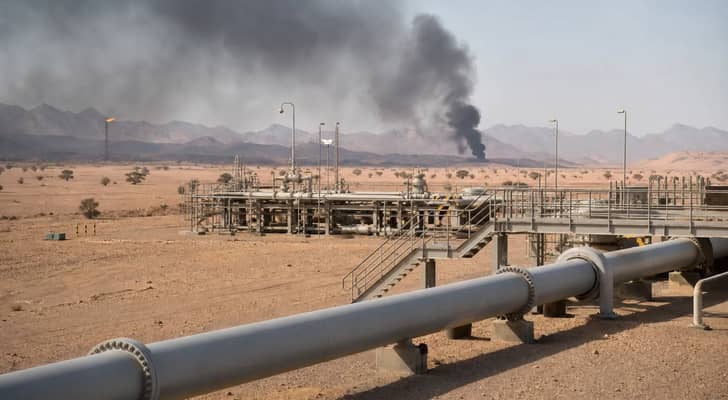
Day 201 | US expects Saudi East-West pipeline to resume flows within days
US Energy Secretary Chris Wright stated that crude oil shipments through Saudi Arabia's East-West pipeline are projected to resume within days after an attack forced a temporary shutdown of the critical energy conduit last week.
The disruption to the pipeline—which allows Saudi Arabia to bypass the Strait of Hormuz by transporting oil to Red Sea ports—has intensified global market volatility and highlighted vulnerabilities in regional energy infrastructure.
Tensions in regional waters escalated further following an attack on an oil tanker in the Strait of Hormuz.
The Royal Navy of Oman rescued 23 crew members from the stricken vessel.
Maritime rescue units are continuing search operations for two missing crew members as risks to international shipping lanes in the Persian Gulf remain elevated.
The combined impact of the strike in Hormuz and the shutdown of Saudi Arabia's East-West pipeline has driven global oil prices steadily upward, as market participants weigh ongoing risks to regional energy exports.
Addressing the geopolitical posture in the Gulf, Iran’s security chief asserted that the strategic reality governing global energy transport and the Strait of Hormuz has fundamentally changed.
Reiterating Tehran's firm diplomatic stance, the official stated that no negotiations will take place with the United States until Washington meets Iran's conditions as outlined in the Islamabad Memorandum of Understanding.
Thread ended
This live thread has ended. Follow our online coverage of day 202 of the war.
Read more: Day 202 | US lawmaker blocks $2.8bn arms sale to 'Israel'
To counter China; US considers buying warships from Japan, South Korea
The US Navy is considering procuring warships built in Japan and South Korea, a highly unusual step aimed at rapidly expanding its fleet to counter China’s naval expansion while American shipyards rebuild capacity, according to the English-speaking Japanese news outlet Nikkei Asia.
Multiple naval officials told Nikkei that Washington is examining options to buy vessels constructed by allied shipbuilders.
One official said the Navy is “actively developing options to fulfill the President’s intent to deliver ships faster while ensuring long-term investment, technology transfer, and workforce expansion within United States shipyards.”
Another acknowledged shortfalls in ship numbers and noted, “We could buy several Japanese frigates… Japanese vessels are excellent.”
The discussions focus on designs such as Japan’s Mogami-class (including its upgraded “New FFM” export variant built by Mitsubishi Heavy Industries) and South Korean frigates such as the Chungnam-class.
These would potentially allow construction of an initial one or two ships overseas before shifting production to US yards, under a framework that requires foreign builders to invest in American facilities, transfer technology, and train US workers.
This approach follows an August White House memorandum that invoked a national-security waiver to ease longstanding restrictions on foreign-built warships entering US Navy service.
The fiscal year 2027 budget process has included substantial funding—around $1.85 billion in related study and procurement efforts—for evaluating allied shipyards and designs, initially centered on Japan and South Korea.
US domestic shipbuilding has faced persistent delays and capacity constraints, while China’s navy has grown rapidly.
Japanese and South Korean yards have demonstrated faster, more cost-effective production of modern surface combatants.
South Korean firms such as Hanwha Ocean already hold stakes in US shipyards, and Japanese designs like the Mogami class have gained international traction, including selection by Australia.
Navy officials and industry sources indicate the effort forms part of a broader push under the Trump administration to expand the fleet quickly.
An assessment of international options is expected by mid-November 2026.
Congressional measures have sought limits on foreign construction, creating potential friction.
Any purchases would mark a major departure from more than a century of primarily domestic US naval construction and would be conditioned on strengthening the American industrial base over the longer term.
US-contracted vessel struck by Iran around Strait of Hormuz: Fox News
A US-contracted ship was hit during an Iranian attack earlier this week, according to Fox News citing two sources.
The vessel was struck “around the Strait of Hormuz” in an attack that involved four Iranian drones and at least one missile, per the report.
One of the projectiles struck the ship and caused minor injuries, with the injured now being treated in an unnamed Gulf country.
Some “US personnel” were onboard the ship, the report added.
Sweden expels Iranian embassy employee, summons ambassador
- Sweden cited threats against 'Israeli' interests in the country as a reason.
Sweden announced Wednesday that it has expelled an employee of the Iranian embassy and summoned Iran's ambassador, accusing Tehran of making threats against Jewish and 'Israeli' interests within the country.
Justice Minister Gunnar Strommer confirmed the move in a statement to AFP, linking it to what he described as a pattern of hostile activity by Iran on Swedish soil.
"We know that Iran, over a long period of time, has conducted activities that threaten security in and against Sweden, targeting both individuals who oppose the Iranian regime and various Jewish and Israeli interests in our country," Strommer said.
According to the minister, Iran has carried out these activities partly by enlisting criminal networks. "This has, among other things, been done by making use of criminal networks," he said.
Lebanon president seeks deal with ‘Israel’
- Lebanese President Joseph Aoun emphasized that the process of disarming Hezbollah will be pursued through peaceful diplomatic means to avoid sparking internal conflict or a civil war.
- Ahead of a high-level summit in Paris with French President Emmanuel Macron and King Abdullah II of Jordan, Aoun urged the US, European nations, and Arab states to provide direct support to strengthen the Lebanese Armed Forces during their southern deployment.
Lebanese President Joseph Aoun has stated Lebanon's intention to reach a security agreement with 'Israel' following its withdrawal from the south, while wanting to disarm Hezbollah peacefully without resorting to confrontation.
Aoun called for international backing to support the deployment of the Lebanese Armed Forces (LAF) and maintain stability along the border, he said in an exclusive interview with AFP ahead of his trip to France.
President Aoun emphasized the necessity of preventing a security vacuum in the south once UNIFIL's mandate ends. He noted that while extending UNIFIL's mandate remains the optimal choice, Lebanon is open to alternative international forces, whether European, Arab, Asian, or American, to serve temporarily until the Lebanese army completes its full deployment.
On relations with 'Israel', Aoun stated that a security arrangement is necessary to end the current state of hostility and secure the border.
"We have no choice but negotiations, because the alternative is war, which would be very costly for us," Aoun explained, noting that a security deal could serve as a prelude to future peace talks rather than an immediate treaty.
Addressing the status of Hezbollah, Aoun stated that disarming the group is "neither negotiable nor open to discussion." However, he said that the process must be conducted diplomatically to prevent domestic turmoil.
"The objective is not a confrontation... We are determined to resolve this issue peacefully," he said, warning against any outcome that could spark a new civil war. Aoun added that he informed Iranian officials that future bilateral relations must be built on mutual respect and strict non-interference in Lebanese domestic affairs.
UN Security Council peacekeepers (UNIFIL) have been stationed in southern Lebanon since 1978, currently comprising around 8,500 personnel.
Following US pressure, the UN Security Council voted to terminate UNIFIL’s mandate on Dec. 31, 2026. To address the upcoming deployment, Aoun traveled to Paris to attend a conference hosted by French President Emmanuel Macron and attended by His Majesty King Abdullah II of Jordan to mobilize international support for the Lebanese army.
Aoun called on the United States, European nations, and Arab allies to support the reinforcement of the Lebanese Armed Forces.
The upcoming summit in Paris and subsequent diplomatic talks are expected to play a key role in shaping the security arrangements along Lebanon's southern border as the planned transition of control proceeds.
Houthis tell US they will not target American ships, Reuters says
- The Houthis assured the US of their commitment to the 2025 ceasefire agreement.
US officials met with representatives of Yemen's Houthi movement in Oman over the weekend, Reuters reported, citing five sources familiar with the matter.
During the talks, the Houthis told US officials that they had no intention of attacking American vessels and that they remained committed to the 2025 ceasefire agreement with the United States, according to two of the sources.
Oman, which has previously played a mediating role between Washington and the Houthis, hosted the meeting. The assurances come amid ongoing scrutiny of the truce's durability and concerns over shipping security in the Red Sea region.
Further details about the discussions, including the officials involved and any additional issues raised, have not been made public.
Trump approves $2.8B weapons sale to ‘Israel’
- Biden had paused a similar weapons shipment to ‘Israel’.
The Trump administration is moving forward with a major arms package for ‘Israel’ that includes tens of thousands of 2,000-pound bombs, the same category of munitions the Biden administration once paused over fears they could cause mass casualties in Gaza.
According to US, the $2.8 billion package would send ‘Israel’ 40,000 heavy bombs: 20,000 Mk84s and 20,000 BLU-117s.
Congress has been informally notified of the pending sale, though it has not yet been finalized.
Most of the cost would be covered through foreign military financing, a system in which US taxpayer dollars are provided to ‘Israel’ so it can purchase the weapons from American manufacturers.
The 2,000-pound bombs come in several variants, some built to penetrate deep underground targets, others designed to detonate above ground with a wider blast radius.
Read more: Trump says US weapons production at unprecedented levels
Part of a Broader Pattern
This latest sale continues a string of moves by the Trump administration to bolster ‘Israel's’ military capabilities.
Last year, the administration bypassed the standard congressional review process to approve a roughly $3 billion sale that included more than 35,500 of the same bombs. In January, it approved additional arms sales to ‘Israel’ totaling $6.67 billion.
The bombs at the center of this new deal were also the subject of a 2024 Biden administration hold on one shipment, a hold Trump lifted upon returning to office.
IRGC claims 52nd US drone shootdown over Qeshm Island
- US Central Command has not confirmed any drone loss over Qeshm Island
Iranian state media reported early Wednesday that the Islamic Revolutionary Guard Corps (IRGC) Aerospace Force intercepted and destroyed a US MQ-9 Reaper drone over Qeshm Island at 2:29 a.m. local time, describing it as the 52nd such aircraft brought down by Iranian forces since fighting with the United States escalated this year.
According to the IRGC's account, the drone was detected and destroyed by an "advanced, modern air defense system" operating under Iran's integrated air defense network.
As of publication, US Central Command has not confirmed the loss of an aircraft over Qeshm Island, and the claim could not be independently verified.
That pattern is consistent with recent months of the conflict: Iranian officials have announced a rising tally of downed MQ-9s, the 50th claimed on Sep. 2, followed by wreckage from a drone shot down over Khomein put on public display on Sep. 3, while US officials have often declined to confirm individual losses.
Read more: IRGC claims downing advanced MQ-1 drone over Hormuz
Explosions reported near Iran's Qeshm Island
Multiple explosions were heard coming from the direction of the sea near Qeshm Island, according to local sources to the Iranian news agency, while Iranian officials have not yet issued an official statement regarding the cause.
Previous day
For coverage of the previous day, visit the link below.
Read more: Day 201 | US expects Saudi East-West pipeline to resume flows within days
Thread ended
This live thread has ended. Follow our online coverage of day 200 of the war.
Read more: Day 200 | Saudi Arabia postpones Hormuz summit with Iran


