
Iranian Foreign Minister Abbas Araghchi, with Saudi counterpart Prince Faisal Bin Farhan.

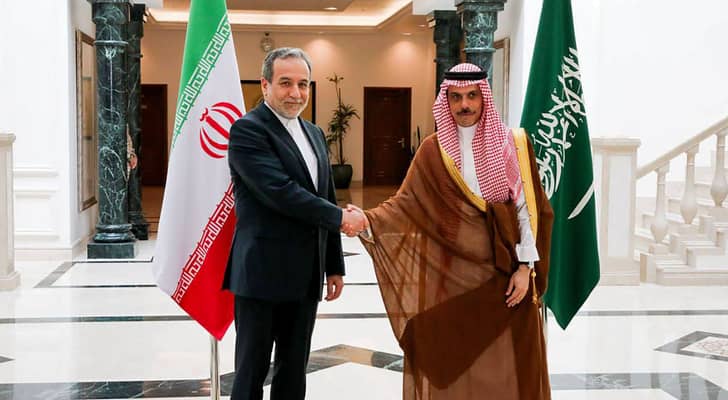
Day 200 | Saudi Arabia postpones Hormuz summit with Iran
Iran said that a planned diplomatic meeting with Gulf Arab nations to negotiate control and navigation protocols in the Strait of Hormuz has been postponed by Saudi Arabia following rapid military developments in Yemen.
The postponement follows a sharp intensification of cross-border hostilities and maritime movements across the southern Red Sea corridor.
Concurrently, Yemen's Houthi movement claimed that its forces had taken control of the strategic islands of Greater Hanish and Lesser Hanish in the southern Red Sea.
Houthi military representatives added that Saudi warplanes executed 54 airstrikes targeting various sectors in Yemen over the preceding 24 hours.
In a major cross-border escalation, Houthi military sources alleged that they launched a large-scale strike combining ballistic missiles and drones against Saudi Arabia's King Khalid Air Base in Khamis Mushait.
Houthi representatives claimed the salvo achieved "direct hits" on military targets within the facility.
Saudi authorities issued no immediate public response or confirmation regarding the reported strike or potential damage.
On the ground in Yemen, fighting intensified across multiple battlefronts.
Saudi-backed Yemeni government forces launched a series of airstrikes against Houthi military positions in an effort to retake the coastal city of Mocha.
The counter-offensive comes days after Houthi forces captured the strategic port city, expanding their territorial footprint along the Red Sea coast.
IRGC says it downed second MQ-1 drone over Hormuz
- IRGC says it is the fourth drone to be downed
Iran’s Islamic Revolutionary Guard Corps claims it has shot down a second MQ-1 drone over the Strait of Hormuz, according to Mehr News Agency.
This is the second drone the IRGC claimed it downed Tuesday, bringing the total number of downed drones to four, according to Mehr.
US-developed MQ-1s are used for surveillance and reconnaissance.
This is a developing story.
Trump claims Iran wants deal, Tehran rejects immediate talks
- Both sides continue trading contradictory/hardline messaging.
US President Donald Trump renewed his claim Monday that Iran is eager to negotiate, while a top Iranian security official flatly rejected the overture, accusing Washington of sending contradictory messages amid the ongoing conflict between the two countries.
In a post on Truth Social, Trump wrote that Iran wants to make a deal "quickly and badly," and said he alone would decide whether the United States chooses to engage, adding that such engagement is "a concept" Washington remains open to.
The remark echoed similar claims Trump has made at earlier points in the conflict, when he pointed to the US military buildup in the region as leverage bringing Tehran to the table.
Oil prices briefly eased on the news before markets absorbed the ambiguity of Trump's phrasing, which left open whether formal talks were imminent or merely possible.
Rezaei rejects "Mixed Signals"
Don’t get distracted by the U.S. president’s mixed signals—from “no negotiations” to “we’re ready to talk.” The stakes around oil and the straits have changed. Damage control won’t stop what’s coming.
— محسن رضایی (@ir_rezaee) September 14, 2026
No talks until Iran’s conditions are met. Period!
The response from Tehran came quickly. Mohsen Rezaei, secretary of Iran's Supreme National Security Council, posted on X that Iran should not be distracted by Trump's shifting position, swinging, as he put it, between ruling out negotiations entirely and claiming readiness to talk.
Rezaei said conditions surrounding oil markets and the Strait of Hormuz had fundamentally shifted, and that no amount of "damage control" from Washington would halt what he described as coming events. He closed with a blunt line: there will be no talks until Iran's conditions are met.
Iranian President Masoud Pezeshkian separately voiced confusion over which of Trump's statements should be treated as the administration's actual position, saying it was unclear which of the president's remarks Tehran was expected to take seriously.
Trump demands Reimbursement over Hormuz
In a separate string of posts, Trump claimed oil continues to move through the Strait of Hormuz and argued that countries benefiting from that flow, which he said had offered the US "no help whatsoever", should and will reimburse Washington once what he called the "SCAM Confligration" comes to an end.
He added that the United States has been shouldering this burden for other nations "for Generations," without specifying which countries he meant or what form reimbursement might take.
The demand revives a theme Trump raised earlier in the year, when he floated and then dropped a proposed 20 percent fee on cargo transiting the strait in favor of pursuing trade and investment arrangements instead.
His latest comments came as global oil prices hovered above $100 a barrel and as reports emerged of ships coming under fire in the strait amid Iran's restrictions on shipping.
Read more: Trump dismisses report of Chinese intel support for Iran
IRGC claims downing advanced MQ-1 drone over Hormuz
The Islamic Revolutionary Guard Corps (IRGC) claimed on Monday that its aerospace forces intercepted and destroyed an advanced MQ-1 unmanned aerial vehicle over the airspace west of the Strait of Hormuz.
In a press release carried by state media, the IRGC Public Relations Department stated that the drone was targeted early in the morning after being detected by Iran's integrated air defense system.
"At dawn today, an advanced MQ-1 drone was intercepted and destroyed by a new advanced air defense system of the IRGC Aerospace Force, under the control of the country's integrated air defense network, in the sky west of the Strait of Hormuz," the statement read.
The statement did not specify the origin or operator of the aircraft, nor did it offer further operational details regarding the specific air defense platform deployed.
The incident follows ongoing high-altitude surveillance and counter-drone engagements in the strategic maritime corridor.
Pentagon inspector general confirms US munitions shortages
- US spending reached $33.4 billion over four months, including $22.3 billion in munitions and $3.7 billion in lost equipment.
- Confirmed losses include 30 MQ-9 drones, multiple combat aircraft (F-15Es, F-35A, A-10), 12 KC-135 refuelers, and damaged logistics hubs.
A congressionally mandated report released Monday by the War Department Inspector General reveals that the ongoing war with Iran has caused significant US munitions shortfalls and supply chain "bottlenecks".
The report marks the first official public accounting by a government oversight agency on the scope, scale, and costs of the conflict initiated on February 28 by the US and 'Israel'.
Covering the period from the start of the war through June 30, the inspector general noted that the War Department is working to "streamline procurement processes and production lead times, and to stockpile critical materials, components, and selected munitions to respond rapidly to a contingency".
The watchdog's findings contrast with statements from senior leadership. Secretary of War Pete Hegseth has previously denied reports that the US is running low on munitions.
On Monday, US President Donald Trump wrote on Truth Social that the US is "producing more Exquisite and Elite Weapons than at any time in our History," adding that they "are being delivered on a daily basis to our Forces in the Middle East and beyond".
Two weeks prior, Trump posted that the US maintained "virtually unlimited" amounts of ammunition, brushing off reports of stockpiling issues.
Military gear, facility damage
The report provides government confirmation that Iranian forces targeted the U.S. Navy's main regional logistics hub in Bahrain using drones and ballistic missiles.
In total, the watchdog estimates the war cost $33.4 billion through June 30—a figure comprising $22.3 billion in expended weapons, $3.7 billion in equipment losses, and $7.4 billion in other operational expenses.
The calculation does not include repair costs for damaged installations.
The figures offer a baseline compared to broader estimates cited by NBC News in July, where officials indicated total costs ranged between $80 billion and $100 billion, or the War Department's public statement in July citing $37.5 billion.
Equipment losses detailed in the report include the destruction or heavy damage of four F-15E jet fighters, an F-35A Joint Strike Fighter, an A-10 Warthog, 12 KC-135 refuelers, nine other aircraft, and at least 30 large MQ-9 drones.
Furthermore, State Department facilities in Iraq, Kuwait, Saudi Arabia, and the United Arab Emirates sustained more than $208 million in physical damage and project delay costs.
The report does not address an alleged US strike on an Iranian elementary school during the initial hours of the campaign, an incident NBC News reported in June was under internal military investigation.
Logistical strains, troop displacements
More than 20,000 US military and diplomatic personnel have been displaced and relocated since the onset of hostilities.
Medical evaluations for injured service members were frequently conducted on the ground via local ambulances to regional facilities due to airlifts being repositioned over threat concerns.
Additionally, US forces flew up to 5,000 flights from European air bases to support Middle East operations.
While US President Trump initially stated the war would last only weeks, he remarked over the weekend that the conflict might not conclude until "right after" November's midterm elections or shortly before.
The watchdog report omitted assessments of troop morale.
However, following escalating concerns over conditions aboard the USS Abraham Lincoln during an extended deployment, the War Department announced the aircraft carrier is being replaced and is currently returning to its home port in San Diego following a stop in Thailand.
The War Department did not immediately respond to requests for comment regarding the report's release.
US confirms orbital deployment of space control weapons
- US Space Force defined space control as using kinetic and non-kinetic means for offensive and defensive operations against adversary assets.
- The announcement follows escalating space rivalry with Russia and China, both viewed as threats to US space assets.
The United States Space Force has claimed that the US has weapons deployed in orbit, providing the first official confirmation of operational space-based combat capabilities.
A spokesperson for the service branch stated in an official release:
"The United States has deployed space control weapons in orbit capable of protecting joint US forces from hostile threats."
The statement did not disclose further specifics regarding the exact nature, specifications, or technical parameters of the deployed systems.
The spokesperson explained that the concept of space control encompasses a full range of missions required to compete with adversaries and establish control using both kinetic and non-kinetic means to affect their capabilities.
The spokesperson added that these assets can be employed for both offensive and defensive purposes.
Competition with Beijing and Moscow
The announcement comes against a backdrop of growing space competition between the United States and its principal rivals, Russia and China, both of which Washington views as potential threats to its strategic interests in space.
According to the US Space Force, China is "developing and operating space and counter-space capabilities as part of its strategy to modernize its armed forces."
Meanwhile, the service noted that Russia "views space as a battleground and believes that superiority in space represents a decisive factor in future conflicts."
The militarization of outer space is not a new phenomenon, tracing back to the origins of the space race itself. Following the launch of Sputnik in 1957, the United States and the Soviet Union began studying the military applications of space, including satellite weaponization and anti-satellite (ASAT) technologies.
While early cold war anxieties focused on the potential deployment of nuclear weapons in orbit, major powers and other nations signed the Outer Space Treaty in 1967, which explicitly banned placing weapons of mass destruction in orbit.
Since then, the US, Russia, China, and India have continued to develop space combat capabilities not covered by the treaty—particularly systems capable of targeting satellites critical to military communications, reconnaissance, and navigation.
Iran rules out US talks without conditions met
Mohsen Rezaee, Secretary of Iran's Supreme National Security Council, dismissed Washington's "mixed signals" regarding potential negotiations, warning that regional dynamics around oil and strategic straits have fundamentally changed and asserting that no talks will take place until Iran's conditions are fully met.
Don’t get distracted by the U.S. president’s mixed signals—from “no negotiations” to “we’re ready to talk.” The stakes around oil and the straits have changed. Damage control won’t stop what’s coming.
— محسن رضایی (@ir_rezaee) September 14, 2026
No talks until Iran’s conditions are met. Period!
Previous day
For coverage of the previous day, visit the link below.
Read more: Day 199 | New explosions rock Iran's Sirik after midnight


