USS George Washington.


US to rotate aircraft carriers in Middle East amid Iran war
Note: AI technology was used to generate this article’s audio.
The US Navy is preparing to send the aircraft carrier USS George Washington to the Middle East to relieve the USS Abraham Lincoln, which has been at sea for more than 250 days amid the ongoing war with Iran, according to multiple reports in US media.
The George Washington, the Navy’s only forward-deployed carrier based in Japan, recently completed a port call in Da Nang, Vietnam, and has been operating in the South China Sea.
Open-source tracking and Navy statements indicate the carrier, accompanied by a cruiser and destroyer, has transited the Singapore Strait and entered the Strait of Malacca, placing it on course for the Indian Ocean and ultimately the Arabian Sea.
Officials described the swap as part of a previously scheduled rotation rather than a direct response to recent concerns about conditions aboard the Lincoln.
The office of the Chief of Naval Operations declined to discuss plans for either carrier, citing operational security.
The Lincoln, which departed San Diego in November 2025 and was redirected to the Middle East in January ahead of US and ‘Israeli’ operations against Iran, has played a central role in the campaign known as Operation Epic Fury and the subsequent naval blockade of Iranian ports in the Strait of Hormuz.
It is one of two US carriers currently in the region, alongside the USS George H.W. Bush.
The Lincoln’s deployment has stretched far beyond its original schedule, with the ship logging roughly 200 consecutive days without a port call—a modern record for a US aircraft carrier.
Crews typically expect port visits every 30 to 45 days.
Families of the roughly 5,000 sailors and Marines aboard have raised alarms about shortages of food and hygiene products, plumbing problems, water issues, exhausted personnel, and reports of multiple attempts by sailors to jump overboard.
Sen. Richard Blumenthal (D-Conn.) wrote to Defense Secretary Pete Hegseth and Acting Secretary of the Navy Hung Cao this week, citing “widespread reports of shortages of basic supplies, water contamination, plumbing issues, deteriorating mental health, deck safety concerns, and disruptions in the mail system, which have caused many care packages en route to the ship to be lost in transit for months.”
Rep. Marlin Stutzman (R-Ind.) said service members “have to have comfort knowing that they’re getting properly taken care of.”
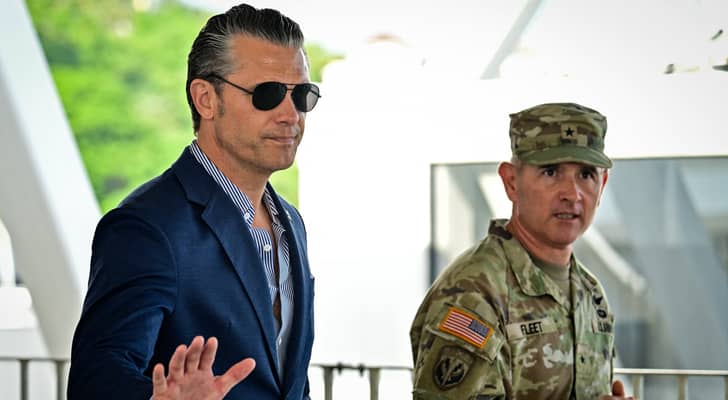
Hegseth pushed back against the accounts while speaking to reporters in Panama, calling reports of poor conditions “completely misrepresented.”
He stated: “We make sure every ship, every crew, every captain has everything we can provide them at every single moment. Some deployments are longer than others, and I have more respect and gratitude for those sailors than anybody. What they do in those high seas in those austere conditions with less port calls—it’s incredible.”
A Navy official said the service had not observed an increase in suicidal ideations or attempts, noting the presence of chaplains, psychologists, and other mental-health personnel, and that leadership prioritized mission-critical supplies amid disrupted logistics in the contested environment.
The George Washington’s arrival is expected to allow the Lincoln to return to its San Diego homeport after months of high-tempo operations supporting the Iran campaign and the Hormuz blockade.
The rotation underscores the strain on the Navy’s carrier force as it sustains presence in the Middle East while managing commitments elsewhere, including the Indo-Pacific, where the departure of the Japan-based carrier will leave a temporary gap.