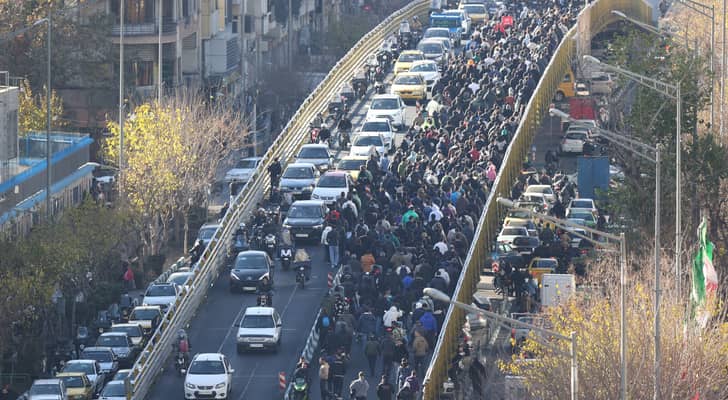
A photo released by Iranian state media shows a protest in Tehran, Credit (Fars News Agency, via Agence France-Presse — Getty Images)

Iran’s GDP contracts during first quarter of war with US
Note: AI technology was used to generate this article’s audio.
- Iran’s GDP plunged 10.1% year-on-year in Q1 of the Persian calendar (late March to late June).
- Official data directly links the drop to ongoing military conflict with the U.S. and Israel that began in late February.
- The contraction exacerbates existing financial crises, including rampant hyperinflation and a collapsing rial under severe sanctions.
Iran’s economy contracted by more than 10 percent during the ongoing Middle East conflict, driven by severe disruptions following the onset of US-'Israeli' military strikes in late February.
According to official statistics released by the Statistical Center of Iran on Sept. 20, the nation’s real gross domestic product (GDP) shrank by 10.1 percent year-on-year from late March to late June.
This period corresponds to the first quarter of the Persian calendar.
The economic downturn reflects the immediate fallout of the conflict, which escalated after initial US-'Israeli' strikes killed the Islamic Republic’s supreme leader alongside senior military officials at the launch of a broader campaign.
Structural economic pressure
In response to the late-February strikes, Tehran retaliated by blocking the Strait of Hormuz, the crucial maritime transit point for global energy exports.
The closure triggered a sharp surge in international oil prices and deepened the economic fallout across the region.
The wartime contraction further compounds long-standing economic turmoil within Iran. Prior to the outbreak of hostilities, the country's economy was already severely burdened by persistent hyperinflation, rapid devaluation of the national currency, and sweeping economic sanctions.