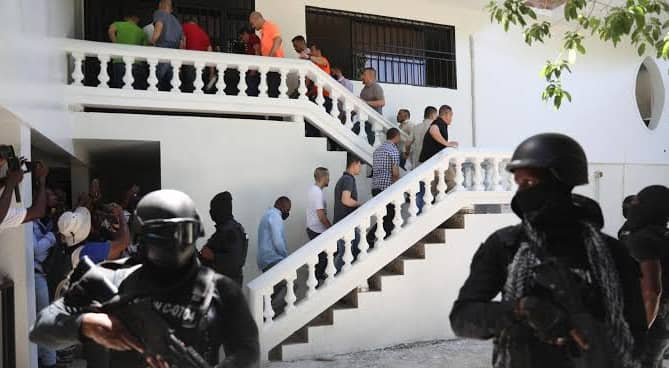
FILE – Colombians and Haitians who are accused of involvement in the 2021 assassination of Haitian President Jovenel Moise are escorted in handcuffs to their court hearing in Port-au-Prince, Haiti, May 26, 2025. (AP Photo/Odelyn Joseph, File).

18 suspects extradited to US over assassination of Haitian President
Note: AI technology was used to generate this article’s audio.
- The Southern District of Florida leads prosecution, citing the plot's staging and financing in South Florida.
- Haitian rights advocates called the transfer a disgrace for Haiti's justice system, which remains paralyzed by gang violence.
Eighteen suspects facing federal charges for their involvement in the July 2021 assassination of former Haitian President Jovenel Moïse have been extradited from Haiti to the United States.
A military aircraft transported the defendants on Sunday from the Haitian capital, Port-au-Prince, to the state of Florida, where they will stand trial in federal court for their roles in the transnational plot.
The major extradition comes following a series of successful prosecutions led by the US Attorney’s Office for the Southern District of Florida, which previously secured convictions against individuals characterized as key "gang leaders" and "co-conspirators" in the conspiracy.
The ongoing high-profile federal investigation is overseen by US Attorney Jason A. Reding Quiñones, an appointee of U.S. President Donald Trump.
"Today marks the next major phase in our pursuit of accountability for the assassination of President Jovenel Moise," Quinones wrote on social media. "We will follow the evidence wherever it leads, to those who financed it, facilitated it, supported it or committed crimes to make it possible. Five years later, we are still bringing defendants before American courts, and we are not finished."
While federal authorities did not immediately release the names of the 18 extradited individuals, those awaiting trial in Haiti prior to the transfer included a former Haitian government official and more than a dozen Colombian soldiers.
FBI Special Agent in Charge Brett Skiles confirmed that multiple arrests were executed both in the US and internationally on Sunday, while US Attorney Quinones reiterated that federal law enforcement remains focused on holding all facilitators accountable.
Profound institutional collapse
Haitian President Jovenel Moïse, 53, was shot dead overnight in July 2021 inside his private residence in the Pelerin 5 neighborhood in the hills above Port-au-Prince, while his wife sustained critical injuries.
His murder generated an unprecedented power vacuum, leaving Haiti without any elected national leadership, as no national elections have been held since the assassination.
Taking advantage of the institutional collapse, heavily armed criminal gangs rapidly expanded their territorial dominance, eventually seizing control of an estimated 90 percent of Port-au-Prince.
According to United Nations documentation, widespread insecurity displaced approximately 1.5 million people and resulted in at least 8,100 gang-related killings in 2025 alone.
US legal jurisdiction
Federal courts in South Florida established legal jurisdiction over the transnational case because the core financial, organizational, and logistical elements of the conspiracy originated within southern Florida.
Furthermore, conducting a fair trial within Haiti became increasingly impossible as the country's judicial system was severely hollowed out by pervasive corruption, political chaos, intense gang violence, and overlapping humanitarian crises.
In Haiti, the extradition generated sharp criticism regarding the state of local governance.
Pierre Esperance, executive director of the National Human Rights Defense Network, described the transfer of the 18 suspects to the US as a "disgrace for the Haitian justice system."
Esperance urged comprehensive reforms to enable Haitian courts to handle complex, high-level prosecutions domestically in the future.
The extradition marks the latest step in a multi-year federal crackdown.
In May, a Florida jury convicted four men for their roles in Moïse's murder, while at least five other co-conspirators have entered guilty pleas and are currently serving life sentences in US federal prisons.