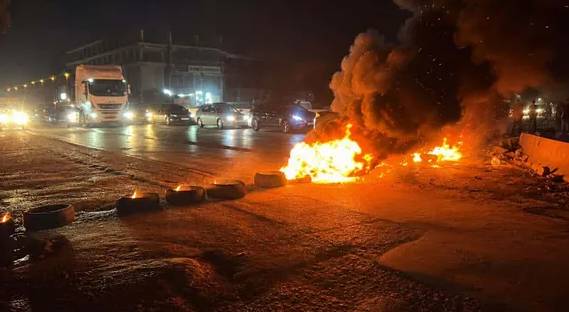
Protesters unload garbage trucks at govt. offices in Libya
Note: AI technology was used to generate this article’s audio.
- Protests erupt across western Libya over power cuts.
- Demonstrators blockade government buildings and roads.
- Protesters demand halt to gas exports to Italy.
- Calls grow for government to step down.
Widespread demonstrations and burning roadblocks erupted across western Libya over the weekend, as rising summer temperatures and chronic power outages lasting more than 12 hours triggered intense civil unrest.
Overwhelmingly led by local youth, protests spread through the capital city of Tripoli as well as neighboring municipalities, including Bani Walid, Zawia, and Janzour.
Demonstrators set fire to tires, debris, and trash, severely disrupting traffic along major arteries, including temporary closures of Tripoli's Corniche and Second Ring Road.
Demand halt to Italian gas exports
Protesters escalated their campaign by dumping truckloads of soil and rubble in front of key government entrances in Tripoli, including the Foreign Ministry, the Ministry of Transport, the Audit Bureau, and the state Telecoms Holding Company, attempting to prevent employees from entering.
State broadcaster Alwataniya went off the air following criticism from demonstrators for omitting coverage of the unrest.
Outside the capital, demonstrators gathered at the entrance of the Mellitah gas processing plant.
Protesters called for an immediate halt to natural gas exports via the submarine pipeline to Italy, demanding the gas be redirected to fuel domestic power generation stations.
In public declarations claiming peaceful civil disobedience, organizing groups warned civil servants against entering government buildings and called for a nationwide civil disobedience campaign.
Political demands escalate
While protests initially focused on electricity shortages managed by the General Electricity Company of Libya (GECOL), public demands have rapidly broadened.
Protesters are now calling for the resignation of GECOL leadership, government accountability against corruption, better living conditions, and the complete removal of Prime Minister Abdul Hamid Dbeibah's government alongside major political power centers.
In response, security forces tightened security perimeters around the Prime Minister's Office in Tripoli to prevent potential political escalations.
The prolonged blackouts have severely affected daily life, causing shortages of bottled drinking water and driving black-market diesel prices from 3 dinars to around 5 dinars per liter for generator fuel.
Municipal cleaning crews worked into Monday morning to clear burnt debris and unblock primary transportation corridors across the capital.