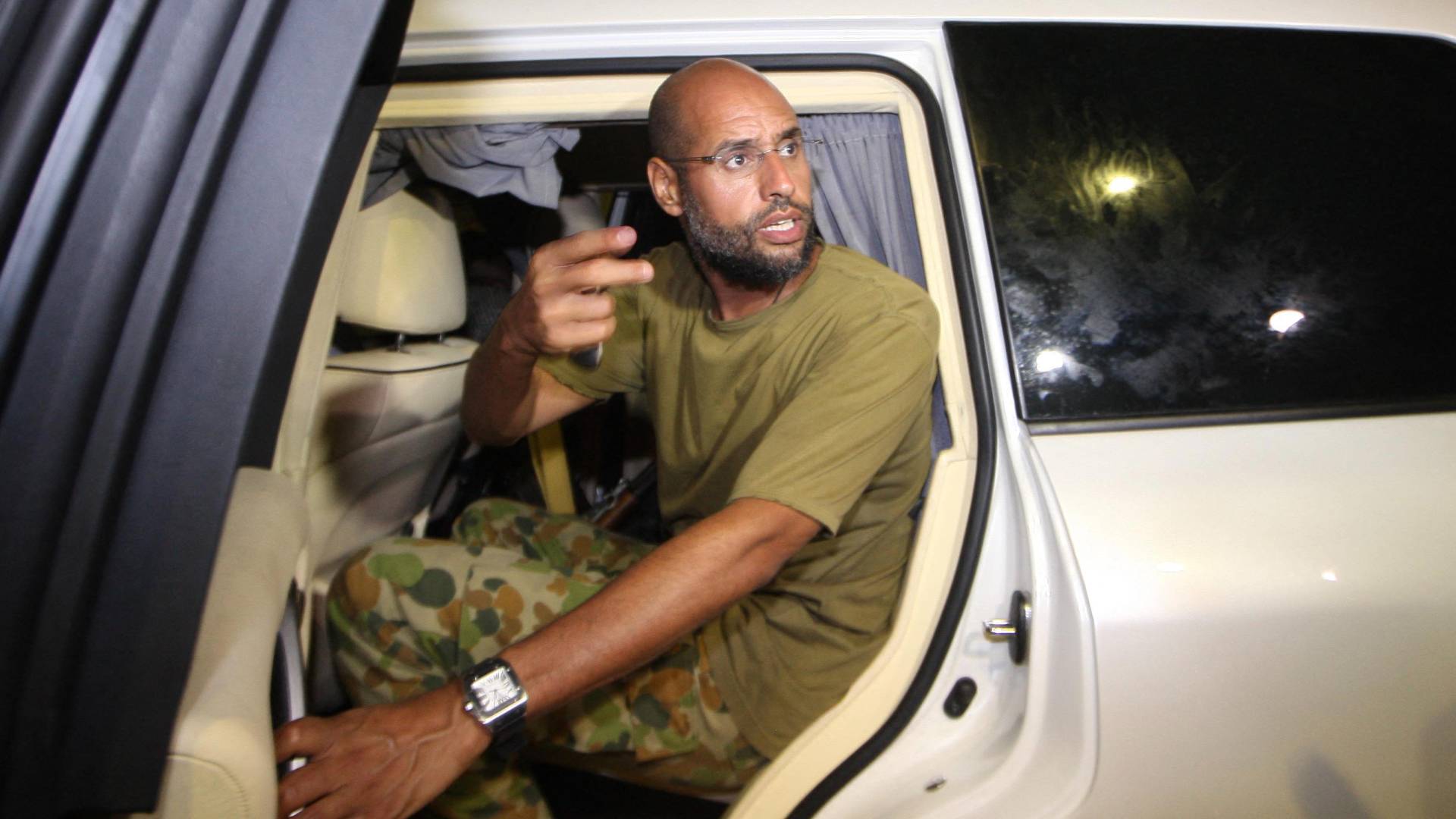
Seif al-Islam Gaddafi at his father's residential complex in the Libyan capital Tripoli. (August 23, 2011)

Lawyer of Gaddafi’s son reveals details of his death
Note: AI technology was used to generate this article’s audio.
- Seif al-Islam Gaddafi, the 53-year-old son and one-time heir apparent of the late Muammar Gaddafi, was reportedly executed in his residence south of Zintan by a four-man commando team who disabled surveillance cameras before the attack.
- While his death has been confirmed by close advisers and relatives, the Tripoli-based 444th Combat Brigade denied involvement; analysts suggest his killing removes a controversial presidential candidate but risks turning him into a martyr for former regime loyalists.
Seif al-Islam Gaddafi, the son of Libya's late longtime ruler, has been killed by gunmen, his adviser told the media on Tuesday, with relatives confirming his death.
Abdullah Othman Abdurrahim told al-Ahrar TV channel that Seif al-Islam was killed in his house by a group of four unidentified men.
"Four armed men stormed the residence of Seif al-Islam Gaddafi after disabling surveillance cameras, then executed him," Abdurrahim was reported as saying.
His lawyer revealed to AFP that he was killed by a “four-man commando”.
"For now, we don't know" who was behind the killing, Marcel Ceccaldi said, adding that he was told by one of Seif al-Islam's close associates about ten days ago "that there were problems with his security".
Saif al-Islam was a suspect wanted by the International Criminal Court on charges of crimes against humanity.
Earlier, his adviser and head of his political team, Abdullah Othman, told Libya al-Ahrar television that the 53-year-old, long viewed as a potential successor to his father before the regime’s fall in 2011, was killed inside his home by a group of four unidentified men.
The channel quoted Othman on X as saying that “four armed men stormed Saif al-Islam’s residence and killed him after disabling the surveillance cameras.” Othman had earlier announced the death in a Facebook post without providing details.
The same channel reported in a phone call with his cousin, Hamid Gaddafi, that “Dr. Saif al-Islam has been martyred,” adding, “We have no other information.”
Several media outlets said he was killed south of Zintan in western Libya.
For years, Saif al-Islam sought to project an image as a moderate reformer, a reputation that collapsed with the outbreak of the 2011 uprising when he threatened “rivers of blood.”
He was arrested in southern Libya and held for a long period by an armed group in Zintan, about 145 kilometers southwest of the capital, Tripoli.
Saif al-Islam, who was subject to an international arrest warrant via Interpol, appeared before Libyan courts between 2012 and 2013. In 2015, he and several figures from his father’s era were sentenced to death on charges including genocide and the violent suppression of protesters during the Libyan revolution.
However, the armed group holding him refused to hand him over to the judiciary and released him in 2017.
Denials and political fallout
The 444th Combat Brigade, affiliated with the Defense ministry of the Tripoli-based Government of National Unity, denied any involvement in Saif al-Islam Gaddafi’s killing.
In a statement, the brigade issued an “absolute” denial of any link to clashes reported in Zintan or to reports surrounding his death. It said no official orders had been issued to pursue Saif al-Islam, stressing that such matters were not among its “security or military” duties.
No government or judicial authority in eastern or southern Libya has issued an official account of the circumstances of his death.
Until the announcement of his death, Saif al-Islam’s whereabouts were unknown.
In 2021, despite being wanted, he submitted his candidacy for the presidential election, banking on support from loyalists of the former regime. The vote was later postponed.
Analyst Imad Badi said his killing could “turn him into a martyr in the eyes of a large segment of the population” and potentially alter electoral dynamics by removing a “major obstacle” to the presidency, given the controversy surrounding his candidacy.
Former Gaddafi regime spokesman Moussa Ibrahim condemned what he described as a “treacherous act,” saying he had spoken with Saif al-Islam two days earlier.
Ibrahim wrote on X that Saif al-Islam “wanted a unified, sovereign, and secure Libya for all its people. They have assassinated hope and the future and sown hatred.”
Since the fall and killing of Muammar Gaddafi in 2011, Libya has remained deeply divided, with a struggle for power between two rival authorities: the internationally recognized Government of National Unity in Tripoli, led by Abdul Hamid Dbeibeh, and a parallel administration in the east based in Benghazi and backed by Field Marshal Khalifa Haftar.
Last audio recording
An audio recording published by the nephew of Saif al-Islam Gaddafi, the son of the late Libyan leader Muammar Gaddafi, surfaced today discussing the political state of Libya and criticizing foreign intervention.
In the clip, he targets the role of Stephanie Williams, the American diplomat who served as the UN's Acting Special Representative for Libya.
He expresses frustration over what he perceives as a cycle of foreign-led governance, mocking the transition of power between international officials (referring to Williams and her successors, including Anita Kiki Gbeho from Ghana, who served as an assistant secretary-general).
He claims that Stephanie Williams was effectively "ruling Libya" and expresses disdain that power was simply handed over to another foreign official rather than being returned to the Libyan people.
He questions the sacrifices made during the 2011 uprising, asking if people "martyred" themselves just to end up with foreign ambassadors making the country's decisions.