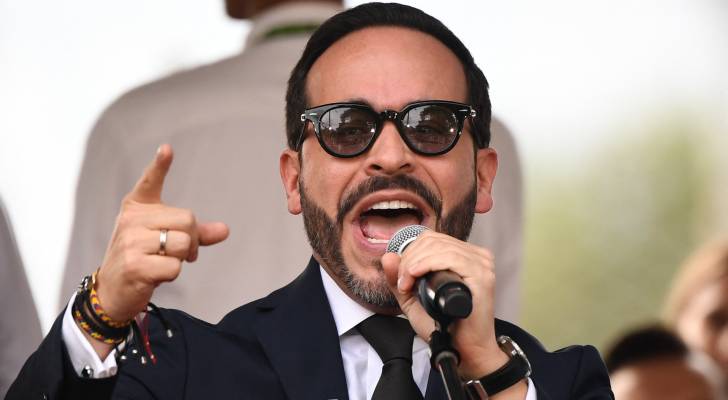
Colombia's president-elect Abelardo de la Espriella delivers a speech during a military parade in Medellin, Colombia.

Colombia’s president-elect suspends plans for Palestinian embassy
Note: AI technology was used to generate this article’s audio.
Colombia’s president-elect Abelardo de la Espriella announced on Sunday that he will suspend plans to open a Colombian embassy in Palestine, a key initiative advanced by outgoing President Gustavo Petro’s government.
De la Espriella said the planned diplomatic mission “nunca llegó a entrar en funcionamiento” (never became operational) and ordered the process halted as part of a broader overhaul of the country’s foreign representations.
The decision forms part of a wider restructuring of Colombia’s diplomatic network. De la Espriella, who takes office on August 7, said he would close embassies in Algeria, Azerbaijan, Barbados, Cuba, Czechia, Ethiopia, Ghana, Haiti, Hungary, Malaysia, Nicaragua, Romania, Senegal, and South Africa, along with about 15 consulates.
He said that these closures, with the exceptions of Cuba and Nicaragua, do not mean breaking diplomatic relations.
“My government will have no ties whatsoever with tyrannies,” he said, adding that consular services will continue through existing representation from other regional embassies.
In parallel, de la Espriella confirmed he will reopen a Colombian embassy in ‘Israel’ in Jerusalem, fulfilling a major campaign promise to restore what he called Colombia’s “historic alliance” with ‘Israel’.
This reverses Petro’s policies, under which relations with ‘Israel’ deteriorated sharply amid strong criticism of ‘Israel’s’ assault on Gaza, participation in South Africa’s case against ‘Israel’ at the International Court of Justice, and moves toward closer ties with Palestine following recognition of a Palestinian state.
De la Espriella framed the changes as a matter of efficiency and national interest.
He also plans to open a new embassy in Nigeria and unify certain missions, such as those in France (including UNESCO) and Italy (including FAO), under single ambassadors.
The announcements mark a sharp break from Petro’s left-leaning foreign policy, which had prioritized ties with progressive governments and criticism of ‘Israel’.
De la Espriella, a right-wing outsider elected by a narrow margin, has prioritized alignment with ‘Israel’ and the United States.
His incoming foreign minister had already signaled full restoration of diplomatic and economic ties with ‘Israel’, including withdrawal from the ICJ case.