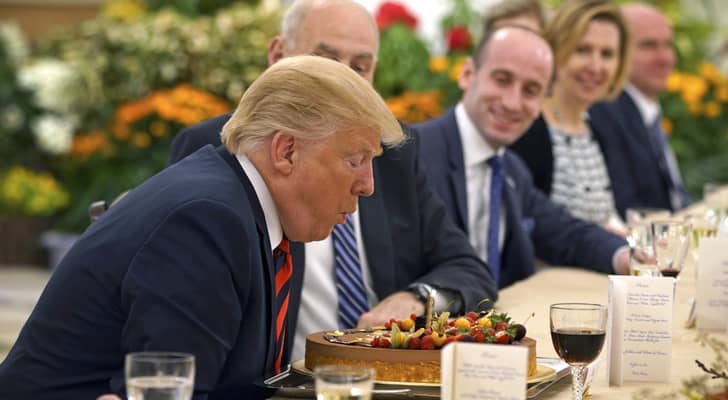
How a sudden flare-up in Lebanon just crashed Trump’s birthday peace plans: CNN analysis
Note: AI technology was used to generate this article’s audio.
- As fighting intensifies in Lebanon, Trump's hopes for a breakthrough regional peace accord face a major new test.
A sudden and violent flare-up of hostilities in Lebanon has thrown the White House’s high-stakes diplomatic timeline into immediate jeopardy, threatening to derail a sweeping regional ceasefire agreement that President Donald Trump hoped to finalize on his 80th birthday.
The diplomatic friction comes at a highly symbolic moment for the administration. As the White House prepares to host an unprecedented UFC fight night on the South Lawn to mark the president’s milestone birthday, Trump had actively messaged that a historic breakthrough abroad was imminent, claiming a deal to end the months-long conflict with Iran would be signed by Sunday.
However, a dramatic escalation on the ground in Beirut has exposed the deep vulnerabilities of the proposed truce, according to a new analysis published Sunday by CNN.
In the report, CNN's Oren Liebermann highlights Lebanon as the crucial, fragile linchpin of the broader regional agreement. Tehran has steadfastly demanded a total ceasefire in Lebanon as a non-negotiable prerequisite to any deal with Washington. Yet, despite intense backchannel mediation, the fighting on the ground has continued unabated.
The fragile diplomatic framework fractured further today after the 'Israeli' military carried out targeted airstrikes on the Dahiyeh neighborhood of Beirut. The strikes followed a heavy barrage of Hezbollah rocket fire that crossed into northern 'Israel' earlier in the day.
The geopolitical stakes of the Beirut bombardment are massive. As CNN noted, the last time 'Israeli' forces struck the Lebanese capital, it triggered direct Iranian ballistic missile fire against 'Israel', raising fears of a wider war. That threat of a direct confrontation between Tehran and Israel now hangs heavily over the White House's birthday diplomacy.
Public statements out of Tehran already suggest a sharp chilling of prospects for an immediate signing. Following the Beirut strikes, Iran’s chief negotiator, Mohammad Bagher Ghalibaf, took to social media to heavily criticize the American diplomatic track, asserting that the United States "either lacks the will to fulfill its commitments or the ability to do so."
The reality on the ground stands in sharp contrast to the optimism projected by the administration earlier this month. When Trump first announced the framework of the Lebanon ceasefire, he assured the public on social media that “Israel will not attack (Hezbollah), and they will not attack Israel.”
That delicate equation has now fallen apart.
CNN's analysis points out that Iran’s public rhetoric draws little distinction between the actions of the US and 'Israel', casting deep doubt on whether Tehran would realistically sign a major accord with Washington immediately following an 'Israeli' strike on Beirut. Furthermore, regional sources indicate that Iranian officials have consistently been far less bullish than their American counterparts regarding how close the two sides actually were to a final agreement.
"Let's not blow it": Trump says Middle East is close to peace deal
US President Donald Trump on Sunday criticized an 'Israeli' strike on Beirut, calling it unnecessary and warning that further military action could jeopardize ongoing efforts to reach a peace agreement with Iran.
In a post on Truth Social, Trump said an attack carried out in Beirut earlier Sunday "should not have happened," particularly as negotiators are reportedly nearing what he described as a potential deal that could help stabilize the region.
"Israel has the right to defend itself against threats, but the attack it was responding to was very small and meaningless," Trump wrote. He added that no one had been "hurt, injured, or killed" in the incident that prompted 'Israel's' response.
Trump urged all sides to avoid further escalation, saying the latest exchange should not disrupt diplomatic progress.
"We are very close to a Deal that will bring peace to the region, including to Lebanon, and all sides should stand down," he said.
The president called for an immediate halt to attacks by all parties, specifically urging Israel to refrain from conducting additional strikes in Lebanon while also demanding that Hezbollah cease attacks against 'Israel'.
"There should be no more attacks by Israel anywhere in Lebanon, but there should also be no more attacks by any other party, including Hezbollah, against Israel," Trump said.
Trump framed the current moment as a potential turning point for regional stability, describing the prospect of a broader agreement as "the beginning of a long and beautiful peace."
With central Beirut under fire once again, crossing a threshold that Tehran previously vowed would provoke a direct Iranian response, what were already labyrinthine negotiations between the US and Iran have become exponentially more complicated. What was envisioned as a weekend of foreign policy triumph for the administration now faces the grim, unravelling reality of Middle East volatile dynamics.