

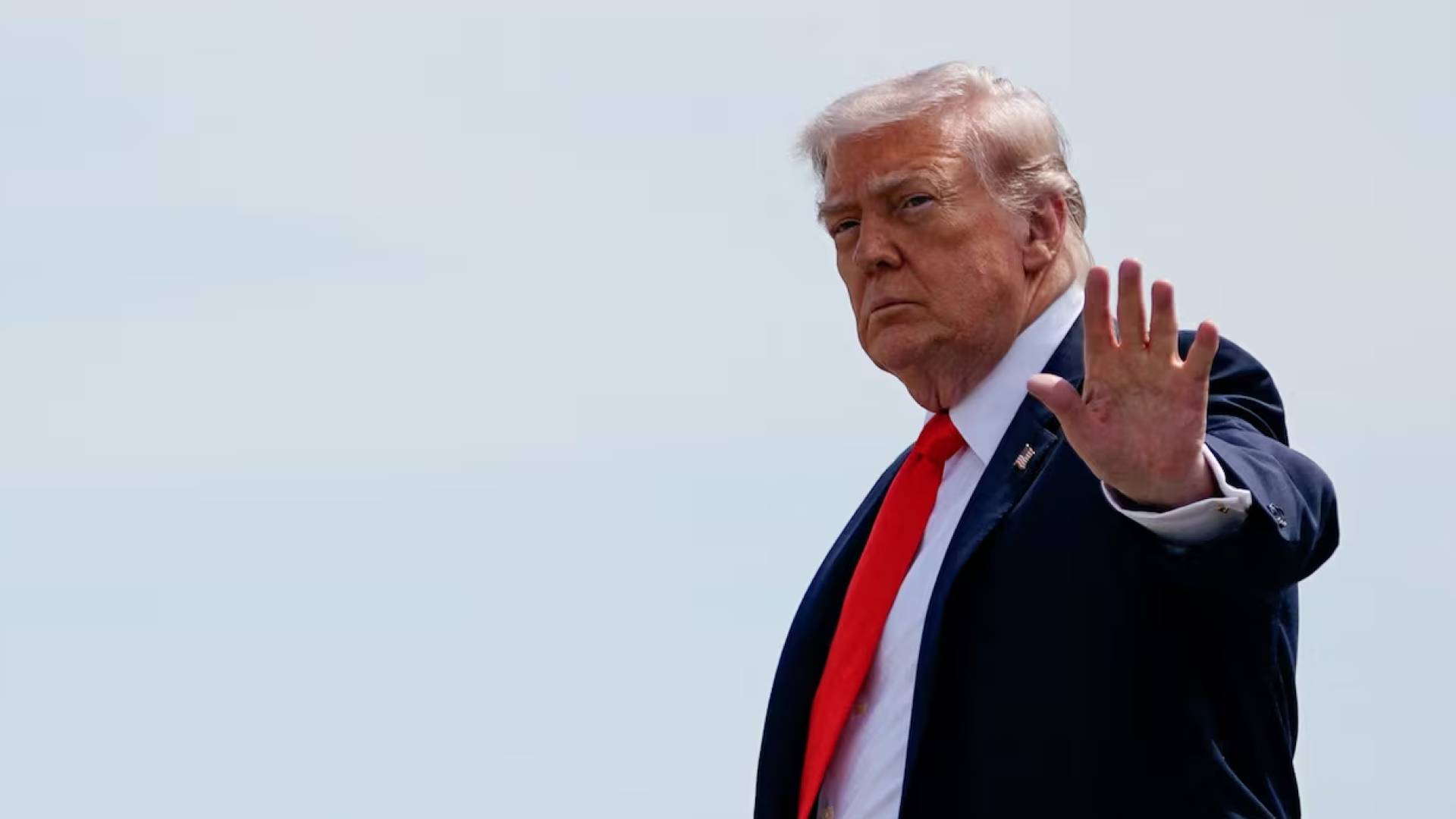
Day 64 | Trump ‘not satisfied’ with Iran’s latest proposal
US President Donald Trump on Thursday criticized congressional efforts to restrict his war powers after the Senate rejected the latest measure aimed at limiting his military authority. The US president was also expected to receive an updated briefing from Pentagon officials on possible military options related to Iran.
Meanwhile, the closure of the Strait of Hormuz continued to rattle global markets, pushing the average price of gasoline in the United States to $4.30 per gallon, the sharpest single-day increase recorded in the past six weeks.
In Tehran, Supreme Leader Mojtaba Khamenei struck a defiant tone, insisting that Iran’s recent strategic gains are irreversible and delivering pointed messages to neighboring countries.
At the same time, tensions flared on the Lebanon border, where the Israel Defense Forces said several soldiers were wounded in Hezbollah attacks in the south. While no specific location was disclosed, the group said it carried out drone strikes in response to what it described as ceasefire violations.
Thread ended
This live thread has ended. Follow our online coverage of day 65 of the war.
Read more: Day 65 | US-Iran diplomacy stalls, fears mount over return to conflict
Tehran demands total "end of war"; inside Iran’s 14-point response
- Tehran rejects Washington’s request for a two-month ceasefire, demanding a permanent end to the war within a 30-day window.
- The 14-point counter-proposal includes demands for war reparations, a US withdrawal from the region, and an end to the naval blockade.
Details have emerged regarding the 14-point formal response sent by Iran to the United States via Pakistani mediators. According to a report by Tasnim News Agency, the central theme of Tehran’s proposal is a definitive and permanent "end to the war," rather than the temporary pauses sought by Washington.
The report reveals a significant gap in the timeline for diplomacy between the two nations. While the United States proposed a 60-day ceasefire to allow for negotiations, Iran has countered by insisting that all primary issues must be settled within 30 days. Tehran’s position is that the focus must remain on a total cessation of hostilities rather than a cycle of ceasefire extensions.
Comprehensive roadmap for peace
Tasnim reports that the 14-point document outlines a series of strict conditions and strategic "red lines" that Iran deems necessary for a lasting settlement. Key pillars of the Iranian proposal include:
Regional withdrawal: A demand for the removal of US military forces from the immediate environment surrounding Iran.
Lifting the blockade: An immediate end to the US naval blockade in the Persian Gulf and the Strait of Hormuz.
Financial redress: The release of all frozen Iranian assets abroad and the payment of war reparations (damages) for the conflict.
Broad peace: An end to the war on all active fronts, including Lebanon.
Hormuz sovereignty: Establishing a "new mechanism" for the Strait of Hormuz that recognizes Iranian maritime rights.
Guarantees: Formal guarantees against any future US military aggression and the total lifting of economic sanctions.
The Ball in Washington's Court
The 14-point plan serves as a direct counter to the 9-point proposal recently offered by the Trump administration. By shortening the timeline and expanding the list of demands, Iran is attempting to force a quick resolution that addresses its long-standing economic and security grievances.
Tasnim notes that the proposal was finalized after extensive internal deliberations among Iran's top leadership. Tehran is now reportedly "waiting for an official response" from the United States to determine if the 14-point framework can serve as the basis for a final agreement.
The move highlights Iran's strategy of "active diplomacy" even under the weight of the US "Roaring Lion" military campaign, signaling that while the regime is open to ending the conflict, it will only do so under conditions that significantly alter the regional security status quo.
Iran replies with a 14-point roadmap to Pakistan for ending war
- Tehran has delivered a 14-point response to a US proposal, outlining its definitive roadmap for ending the war.
- The document was transmitted via Pakistani mediators following approval from Iran’s highest decision-making bodies.
Iran has submitted a detailed 14-point response to Pakistani mediators, outlining its strategic requirements for a permanent end to the current conflict with the United States.
The move marks a significant escalation in the ongoing "back-channel" diplomacy currently being facilitated by Islamabad.
According to reports from the Fars News Agency, the 14-point document was drafted as a direct counter-response to a 9-point proposal previously submitted by Washington.
Sources familiar with the matter state that the Iranian response emphasizes the nation's "red lines" while offering a specific "roadmap" to conclude what Tehran refers to as the "imposed war."
Disciplined diplomatic push
The transmission of this message was not a sudden move; Fars reports that the 14-point plan underwent a rigorous review process within Iran’s relevant state institutions and received all necessary high-level approvals before being handed to the Pakistani side.
This structured approach signals that despite the intense military pressure of the US blockade, the Iranian leadership is maintaining a unified diplomatic front.
Analysts suggest that the detailed nature of the response indicates that Tehran is seeking to broaden the scope of the negotiations to include long-term security guarantees and sanctions relief.
High stakes and mutual distrust
While the diplomatic track remains active, it is reportedly operating in an atmosphere "filled with suspicion" toward the United States. However, Iranian officials view the continuation of talks through Pakistan as a sign of "seriousness and self-confidence."
By engaging in this 14-point exchange, Tehran aims to demonstrate that it is pursuing its national interests from a position of strength, even as the US Treasury ramps up sanctions on its "shadow banking" networks and the Navy maintains its presence in the Strait of Hormuz.
The Pakistani role
Pakistan has emerged as the primary "postman" for both Washington and Tehran in this conflict. The delivery of this roadmap puts the ball back in the US court, as mediators now work to bridge the gap between Washington’s 9-point framework and Tehran’s 14-point counter-proposal.
Whether these points can be reconciled remains the central question as the region hovers between a permanent ceasefire and a return to full-scale hostilities.
US to pull 5,000 troops from Germany as Trump clashes with Chancellor Merz
- Pentagon confirmed the withdrawal of 5,000 US troops from Germany over the next 6 to 12 months.
- The move follows a public spat between US President Trump and German Chancellor Friedrich Merz over the US-Iran war.
The United States will withdraw approximately 5,000 service members from Germany within the next year, the Pentagon announced Friday.
The decision fulfills a recent threat by President Donald Trump and marks a significant shift in the US military footprint within one of its most critical NATO allies.
The withdrawal represents roughly 14% of the 36,000 American personnel currently stationed in Germany. Pentagon spokesman Sean Parnell stated the move followed a "thorough review of force posture" and was based on "theater requirements and conditions on the ground."
Diplomatic rift over Iran
The timing of the announcement appears directly linked to a deteriorating relationship between President Trump and German Chancellor Friedrich Merz.
Earlier this week, Merz criticized the US military strategy in the ongoing war with Iran, suggesting that Washington was being "humiliated" by Tehran.
President Trump fired back on social media, telling Merz to focus on "fixing his broken country" and ending the Russia-Ukraine war rather than criticizing US efforts in the Middle East.
Trump has long expressed frustration with NATO allies for their refusal to assist in the Iran conflict, which began with US-'Israeli' strikes in February.
Germany braces for a new reality
Germany is home to several vital US strategic assets, including Ramstein Air Base and the headquarters of both European and Africa Commands.
While the withdrawal of 5,000 troops is a blow to the local economy and traditional security arrangements, German Defense Minister Boris Pistorius described the move as "foreseeable."
"We Europeans must take on more responsibility for our security," Pistorius told the dpa news agency, emphasizing that Germany has already begun accelerating military procurement to adjust to a potential American pivot away from the continent.
Political backlash in Washington
The decision sparked immediate condemnation from Democrats and security hawks in Washington. Critics argue the move creates a power vacuum that benefits Russian President Vladimir Putin and signals that US security commitments are "mercurial."
"The president should immediately cease this reckless action before he causes irreversible consequences for our alliances," said Sen. Jack Reed (D-RI), the ranking member of the Senate Armed Services Committee.
Strategic implications
Military analysts, including Bradley Bowman of the Foundation for Defense of Democracies, warned that reducing the US presence in Germany complicates the "projection of American military power" into the Middle East and Africa.
While the Trump administration has previously mired similar troop cuts, this current order comes amidst an active war with Iran, signaling a much firmer intent to redistribute American forces toward the Middle Eastern theater.
Iran Army spokesman warns of ‘new tools and means’ to counter aggression
The spokesperson for the Iranian Army, Brigadier General Amir Akrami-Nia, issued a stern warning on Saturday, stating that any new aggression by the "enemy" would be met with "new tools and methods" that Tehran has not yet deployed.
'Israeli' military ramps up coordination with US CENTCOM for potential operations
'Israeli' military Chief of Staff Herzi Halevi is intensifying communications with General Michael Kurilla, Commander of U.S. Central Command (CENTCOM), to synchronize upcoming military actions, ‘Israeli’ Channel 12 reported.
Iran moves to legalize "Hormuz toll", ban ‘Israeli’ ships, tax "hostile" states
- Iran’s Parliament is drafting a law to permanently ban ‘Israeli’ vessels from the Strait of Hormuz.
- The bill would force "hostile nations" to pay war reparations as a toll for passage.
- Neutral ships would require prior Iranian approval.
The Deputy Speaker of the Iranian Parliament, Ali Nikzad, announced on Saturday that a new bill is being finalized to overhaul the management of the Strait of Hormuz.
The proposed legislation seeks to codify Iran’s wartime control over the world’s most critical maritime chokepoint into a permanent legal framework.
According to Nikzad, the draft law includes a total and indefinite ban on all ‘Israeli’ vessels, stating they will be barred from crossing the strait "at any time."
"War reparations" for passage
In a move that significantly escalates the economic stakes of the 2026 conflict, the bill targets countries deemed "hostile" by the Iranian government.
These nations would be prohibited from using the waterway unless they pay "compensation for the war", effectively a reparations tax for the US-led "Roaring Lion" campaign.
"The movement of ships in the Strait of Hormuz will not return to how it was before the war," Nikzad warned, reinforcing earlier statements by Supreme Leader Mojtaba Khamenei that the strait must remain a strategic lever for Tehran.
Key provisions of the proposed law:
Permanent ‘Israeli’ ban: No ‘Israeli’ flagged or owned vessels allowed under any circumstances.
Hostile state tolls: Ships from nations involved in the conflict must pay war reparations to receive passage.
Permit system: All other international vessels must obtain prior authorization and approval from Iranian authorities before entering the strait.
Sovereignty claims: Iran asserts that these measures will be implemented in accordance with "international laws and the rights of neighboring countries," though maritime experts argue this directly contradicts the UN Convention on the Law of the Sea (UNCLOS).
By moving to pass this into law, the Iranian Parliament is attempting to normalize the "tollbooth" scheme that has seen some vessels reportedly pay up to $2 million for safe passage in recent weeks.
Qatari PM alerts Iranian counterpart that closing Hormuz will "deepen the crisis"
The Qatari Ministry of Foreign Affairs stated on Saturday that Prime Minister Sheikh Mohammed bin Abdulrahman Al Thani told Iranian Foreign Minister Abbas Araghchi that closing the Strait of Hormuz, or using it as a "bargaining chip," would only lead to a deeper regional crisis.
Qatar warns Iran that freedom of navigation is ‘non-negotiable’
The Qatari Ministry of Foreign Affairs reported on Saturday that Prime Minister Sheikh Mohammed bin Abdulrahman Al Thani delivered a firm message to Iranian Foreign Minister Abbas Araghchi, emphasizing that freedom of navigation is a "well-established and non-negotiable principle."
Qatari PM receives call from Iranian FM to discuss negotiation trajectory
The Qatari Ministry of Foreign Affairs confirmed on Saturday that Prime Minister and Minister of Foreign Affairs, Sheikh Mohammed bin Abdulrahman Al Thani, received a phone call from Iranian Foreign Minister Abbas Araghchi.
No “magic way” to stop Hezbollah FPV drone strikes, ‘Israel’ admits
- 'Israeli' Air Force (IAF) admitted that there is "no magic" solution to stop Hezbollah’s FPV drones.
- Officials believe removing US-imposed restrictions on strikes north of the Litani River could reduce the threat by 80%.
'Israel' Occupation Forces (IOF) issued an assessment on Friday, to local media, acknowledging that the IOF currently lacks a comprehensive technological "answer" to the lethal threat posed by Hezbollah’s First Person View (FPV) drones.
Despite improvements in overall drone defenses since 2023, the Air Force stated that the manual nature of FPV technology -where operators "ride" the drone via virtual reality headsets- makes these devices exceptionally difficult to jam or intercept before impact.
Several recent incidents in Southern Lebanon have resulted in 'Israeli' casualties directly attributed to these precise, low-altitude strikes.
The "Litani factor"
While IOF is testing new tactics and defensive measures, the Air Force emphasized that the most effective solution is not technological, but political.
According to 'IAF' sources, the single largest "positive change" in the drone war would occur if the United States removed current restrictions preventing 'Israel' from attacking Hezbollah targets north of the Litani River.
"Removing such restraints could help Israel reduce the FPV drone threat by around 80%," an Air Force source stated to 'Israeli' media.
This strategy would allow the IDF to shift from a "defensive" posture -trying to catch drones mid-flight- to an "offensive" one, targeting the entire ecosystem: production sites, storage facilities, and command centers located deeper in Lebanese territory.
Targeting the ecosystem
IOF sources revealed that prior to the recent ceasefire, intelligence units had already begun a wider campaign to dismantle Hezbollah’s FPV infrastructure. This includes:
Material disruption: Targeting the supply chains for the components and electronics used to build the drones.
Command centers: Striking the facilities where pilots are trained and missions are planned.
Pilot elimination: Tracking and neutralizing operators even when they are not actively flying a mission.
New tactics in the pipeline
Despite the admission of current gaps, the Air Force noted that it is "hard at work" on specific new tactics to counter FPVs. Results from tests conducted two weeks ago are currently being analyzed and could have "major ramifications" for how the IOF handles the issue on the front lines.
Until then, however, IOF warned that the FPV threat remains a "deadly and difficult" challenge that cannot be eliminated all at once, especially while diplomatic constraints limit the scope of the Air Force's reach in Northern Lebanon.
Iran lowers oil production to fight off US blockade: Bloomberg
- Iran is curbing oil production by up to 30% to prevent storage tanks from overflowing.
- Experts estimate Iran has only one month of storage left before all available storage capacity is exhausted.
As the United States tightens its naval blockade around the Strait of Hormuz, Iran is facing challenges to handle a massive buildup of unsold oil.
According to reports from Bloomberg, Iran has officially started cutting its oil production because its storage tanks are almost full.
A senior Iranian official, confirmed to Bloomberg that the country is proactively reducing output. Explaining that Tehran is doing this to stay ahead of its storage limits rather than waiting for the tanks to overflow.
Resilience through experience
Despite the pressure from US President Donald Trump’s administration, Iranian leaders insist they can survive the standoff. They are relying on a "resistance economy" designed to withstand US pressure.
Hamid Hosseini, a spokesman for an Iranian oil exporters’ association, told Bloomberg, “We have enough expertise and experience. We’re not worried.”
Iranian engineers say they have learned how to pause oil wells without causing permanent damage, a skill they developed during the first Trump administration's "Maximum Pressure" campaign in 2018.
New kind of blockade
While Iran has used a "shadow fleet" of secret tankers to sell oil to China in the past, Bloomberg reports that this has become nearly impossible. The US Navy is now physically blocking the waters, leaving tens of millions of barrels of oil stranded at sea.
Currently, around 18 tankers carrying up to 35 million barrels of crude oil are sitting in the Persian Gulf with nowhere to go.
US Treasury Secretary Scott Bessent stated on X that Iran’s main export hub, Kharg Island, is "soon nearing capacity," a situation he says costs Iran $170 million every day.
The Treasury Department, through Economic Fury, has targeted Iran’s international shadow banking infrastructure, access to crypto, shadow fleet, weapons procurement networks, funding for terrorist proxies in the region, and independent Chinese “teapot” refineries that support…
— Treasury Secretary Scott Bessent (@SecScottBessent) April 29, 2026
Risks of stalemate
The strategy of cutting production is not without danger. If oil wells are not managed perfectly during a shutdown, the pressure inside the reservoir can drop, causing long-term damage to Iran's ability to pump oil in the future.
Expert Brett Erickson told Bloomberg that Washington may be underestimating Tehran’s ability to adapt. “Regimes do not fold, they adapt,” he said.
However, the economic pain is visible; Iran’s currency hit a record low this week, and the prices of basic goods are soaring.
Running out of time
There is no clear agreement on how long Iran can last. While President Trump predicted last week that Iran's oil system would "explode" within days, that hasn't happened.
However, analysts from JPMorgan Chase and Kpler told Bloomberg that Iran likely has about one month only of storage space left if they keep producing at current levels.
To find a way out, Iran is considering desperate options, such as:
Land Exports: Sending small amounts of oil by truck to countries like Pakistan, Uzbekistan, Afghanistan, and Turkey.
Railways: Moving oil products by train to China, though this is very expensive.
For now, the conflict has reached a stalemate. Iran is betting that high global oil prices -which hit a four-year high this week- will eventually force the US to back down before Iran's storage tanks completely overflow.
No payments to Iran or face sanctions: US warns shippers
- US Treasury warned shipping industry: paying tolls to Iran for passage through Hormuz will trigger punitive sanctions.
- The move follows the designation of 35 entities and individuals involved in "shadow banking" network that launders billions for IRGC.
In a major expansion of its "Economic Fury" campaign, the US Department of the Treasury on Friday warned global shipping companies that making "toll" payments to the Iranian government for passage through the Strait of Hormuz is a violation of US sanctions.
The advisory, issued by the Office of Foreign Assets Control (OFAC), targets Tehran’s recent efforts to monetize the strategic waterway.
The Treasury clarified that any form of payment -cash, crypto, or even donations- is strictly prohibited.
Targeting the "Shadow Banking" Lifeline
The warning comes just days after the Treasury designated 35 individuals and entities across multiple jurisdictions, including China, UAE, and Hong Kong.
These targets are accused of managing Iran’s "shadow banking" architecture, a sprawling network of shell companies and exchange houses that allow the Iranian military to launder tens of billions of dollars from illicit oil sales.
"Iran’s shadow banking system serves as a critical financial lifeline for its armed forces," said Treasury Secretary Scott Bessent. "We will relentlessly target the regime’s ability to generate and move funds, and pursue anyone enabling Tehran’s attempts to evade sanctions."
Key Details of the New Restrictions:
Strait of Hormuz Tolls: US and non-US persons are prohibited from paying the Iranian regime or the Islamic Revolutionary Guard Corps (IRGC) for "safe passage."
Charitable Fronts: The Treasury specifically warned that payments routed through the Iranian Red Crescent are being used as a cover for illicit fees and are subject to sanctions.
Liability: Foreign entities that facilitate these payments risk "civil and criminal enforcement liability," including being cut off from the US financial system.
A Dilemma for Global Shipping
With the US currently maintaining a naval counter-blockade against Iran-linked vessels, Tehran has reportedly demanded "protection fees" from merchant ships to avoid seizure.
The US Treasury’s latest move places shippers in a difficult position: pay the "toll" and face a total US financial blacklist, or refuse and risk Iranian interference.
"Economic Fury" Continues
Since February 2025, the US has sanctioned over 1,000 Iran-related targets as part of the Trump administration's "Maximum Pressure".
By targeting the shadow banks and the shipping tolls simultaneously, Washington aims to completely disconnect the IRGC from the international financial system and force the regime back to the negotiating table.
UAE lifts all airspace restrictions
The UAE’s General Civil Aviation Authority (GCAA) announced today the full resumption of normal air navigation operations across the country’s airspace.
In an official statement posted on X, the GCAA said it has lifted all temporary precautionary measures that had been in place, since the start of the US-‘Israeli’ war on Iran that expanded to the Gulf countries and specifically the UAE, which beared the brunt of Iran’s missile and drone strikes.
“We are pleased to announce the full resumption of normal air navigation operations across UAE airspace,” the authority stated on X.
VIDEO - ‘Israeli’ military claims destroying 50 Hezbollah sites
Footage released by the ‘Israeli’ military showing what it says are strikes on Hezbollah infrastructure in southern Lebanon.
The military said it had carried out 50 strikes on Friday.
Iran considering mine-carrying dolphins to target US Navy: WSJ
Iran is reportedly exploring the deployment of dolphins equipped with mines to target US warships in the Strait of Hormuz amid an ongoing US naval blockade that has severely restricted its oil exports.
According to Iranian officials cited by The Wall Street Journal, this unconventional measure forms part of broader considerations for countering the blockade, which has imposed significant economic pressure on Tehran.
The proposal emerges as hardliners within Iran advocate for renewed military action, viewing the blockade as an act of war rather than a diplomatic tool.
A fragile cease-fire holds between the parties, yet the financial strain from disrupted oil shipments has intensified internal debates.
Moderates reportedly favor negotiations, while others argue that escalated conflict may prove less costly than prolonged economic isolation.
The Strait of Hormuz remains a critical chokepoint for global energy supplies, handling approximately one-fifth of the world’s oil and liquefied natural gas trade.
US forces have enforced the blockade following Iranian attacks on commercial vessels earlier in the conflict, which disrupted maritime traffic. Iranian capabilities have been degraded, with reports indicating substantial losses to its conventional navy.
This would not represent Iran’s first engagement with military marine mammals. In 2000, Iran acquired dolphins from a former Soviet program, along with their trainer.
Those animals were reportedly trained for tasks including attaching harpoons to targets and conducting kamikaze-style strikes by carrying mines to enemy vessels.
US officials and analysts have expressed skepticism regarding the immediate feasibility and effectiveness of such tactics, noting the advanced mine countermeasures employed by the US Navy, which include its own trained dolphins for detection and clearance.
Germany says withdrawal of US troops was “expected”
Germany's defence minister on Saturday said the withdrawal of American troops from Germany had been expected and that Europe needed to do more to ensure its own security.
"That US troops are withdrawing from Europe and also from Germany was to be expected," Boris Pistorius said in a statement sent to AFP by his ministry. "We Europeans must take greater responsibility for our security," he added.
The Pentagon on Friday announced the withdrawal of about 5,000 troops from Germany within the next year, the latest rift in transatlantic ties over the Mideast war.
The move came as US President Donald Trump announced that tariffs on cars and trucks from the European Union would increase to 25 percent next week, accusing the bloc of not complying with a trade deal signed last summer.
Trump has renewed criticism of German Chancellor Friedrich Merz, who said Monday that Iran was "humiliating" Washington at the negotiating table. Trump said Merz "thinks it's OK for Iran to have a Nuclear Weapon. He doesn't know what he's talking about!"
On Wednesday, the American leader said Washington was "studying and reviewing the possible reduction" of US troops in Germany, and that he would decide in a "short period of time".
Iran executes two men convicted of spying for ‘Israel’
Iran’s judiciary announced Saturday that two men were executed by hanging on charges of spying for ‘Israel’, in the latest in a series of executions carried out in recent weeks.
The judiciary’s Mizan Online website said that “Yaghoub Karimpour and Nasser Bekrzadeh were executed for intelligence cooperation and espionage for the Zionist entity.”
It was not immediately clear when the two men had been arrested.
Mizan said Karimpour was convicted of “waging war against God,” a crime punishable by death, for “photographing security and military sites and sending them to a Mossad officer during the imposed war,” referring to the 12-day war between Iran and ‘Israel’ in June 2025.
The outlet added that Bekrzadeh had cooperated with ‘Israel’s’ Mossad by sending information about “religious and regional figures, in addition to important centers such as the Natanz area,” which hosts a major nuclear facility.
Mizan did not specify whether Bekrzadeh’s activities took place during the war period.
On Feb. 28, ‘Israel’ and the United States launched airstrikes on Iran, triggering a new war that spread across various parts of the Middle East.
The conflict has been paused since April 8 under a fragile truce.
In recent weeks, Iran has carried out several executions against individuals linked to protests that took place in January, which authorities claim were incited by ‘Israel’, the United States, and opposition groups, including the banned Mojahedin-e-Khalq (MEK) organization.
On Thursday, Iran announced the execution of a young man identified as Sassan Azadvar on charges of working for these groups by “attacking police officers” in Isfahan province during protests that preceded the war.
The demonstrations began in late December over rising living costs, then spread across the country and evolved into anti-government protests that peaked on Jan. 8 and 9.
Iranian authorities say the protests began peacefully before turning into “riots fueled by foreign incitement,” involving killings and acts of sabotage.
Iran senior military official says renewed conflict with US “likely”
An Iranian military official said Saturday that a renewed conflict with the United States was "likely", as peace talks remain stalled and President Donald Trump criticised Iran's latest proposal in negotiations.
"A renewed conflict between Iran and the United States is likely, and evidence has shown that the United States is not committed to any promises or agreements," Mohammad Jafar Asadi of the military's central command centre, Khatam al-Anbiya, was quoted as saying by Iran's Fars news agency.
'Israeli' military issues forced displacement order in southern Lebanon
'Israel’s' military has ordered residents of several towns and villages in southern Lebanon to evacuate, continuing displacement warnings despite a ceasefire.
The order covers Qaaqaait al-Jisr, Adchit al-Shaqif, Jebchit, Ebba, Kfar Jouz, Harouf, al-Duwayr, Deir ez-Zahrani, and Habboush, according to a post by the 'Israeli' army on X.
The announcement comes a day after at least eight people were killed in an 'Israeli' strike on Habboush, according to earlier reports.


