
Iranian Parliament Speaker Mohammad-Bagher Ghalibaf.

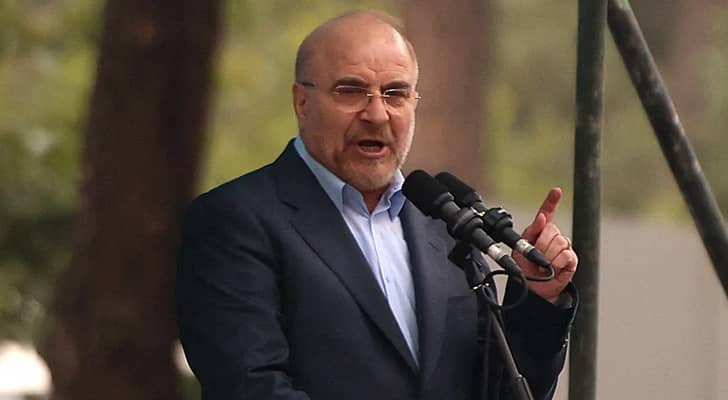
Iran to keep Hormuz closed until US blockade lifted: parliament speaker
Note: AI technology was used to generate this article’s audio.
Iranian Parliament Speaker Mohammad-Bagher Ghalibaf issued a series of defiant warnings on Sunday, asserting that the Strait of Hormuz will remain closed to international traffic as long as the United States maintains its naval blockade of Iranian ports.
Speaking following high-stakes negotiations in Islamabad, Ghalibaf, who has emerged as Iran’s lead negotiator, detailed the "diplomacy of authority" guiding Tehran’s response to the most significant military conflict in the region in decades.
“The Americans have been declaring a blockade for several days, this is a clumsy and ignorant decision. It is not possible that others can pass through the Strait of Hormuz but we cannot,” he said.
“If the US does not lift the blockade, traffic in the Strait of Hormuz will definitely be limited”.
Escalation in the Strait of Hormuz
The conflict, which escalated sharply following US and ‘Israeli’ strikes on February 28, 2026, has seen the heart of Iran’s leadership targeted.
Ghalibaf highlighted that despite the killing of the Commander-in-Chief of the Armed Forces, the Commander of the IRGC, and the Chief of General Staff, Iran's military response was "immediate."
He contrasted this with the "12-day war" in June 2025, where he admitted to a 14-hour delay in Iran’s reaction.
"In the third imposed war... you saw that our response began immediately," Ghalibaf stated, framing the swift retaliation as a sign of their resilience.
The Speaker confirmed that Iran has engaged in direct "points of conflict" with US naval assets attempting to clear mines in the Strait.
"In Islamabad, I told the American delegation that if their minesweeper moves even a little further from its location, we will definitely shoot at it," Ghalibaf said.
"They asked for 15 minutes to give the order to turn back, and they did."
Demands for a "Public" Ceasefire
Addressing the ongoing diplomatic efforts, Ghalibaf rejected private assurances from the Trump administration.
He demanded that any ceasefire request be made publicly by the US President to signify American concessions.
Ghalibaf insisted that Trump must announce a ceasefire request via social media (X/Twitter) so that "everyone knows the request came from them."
The 36-Day Silence
He revealed that Tehran ignored all US ultimatums and messages for the first 35 days of the war, only beginning to examine them on the 36th day once Iran had established its "diplomatic authority."
Iran’s ten conditions for a lasting peace include a regional ceasefire that specifically encompasses Hezbollah. Ghalibaf said that Hezbollah "fought the recent war for the Islamic Republic," making their security a non-negotiable term for Tehran.
"Ready to Drink Blood"
Ghalibaf addressed US Vice President J.D. Vance directly regarding the lack of trust between the two nations. He accused the US government of prioritizing ‘Israeli’ interests based on "false information" and attempting to "Venezuelanize" Iran to seize its oil wealth.
"In Islamabad, I told Vance; We have no trust in you".
"I am ready to sacrifice both my life and my honor," Ghalibaf declared.
"We are ready to give blood and we are ready to drink blood. The important thing is that the rights of the nation and the pride of Iran are protected."
As the April 22 ceasefire deadline approaches, Ghalibaf’s latest statements suggest that unless the naval blockade is lifted and the Strait of Hormuz is recognized under Iranian "authorization," the region remains on the brink of further escalation.







