
Iranian woman flashes the V-sign in a rally dubbed "Sacrificed Girls” to pay tribute to women killed during the war, in Tehran. (April 17, 2026)


Day 51 | Iran closes Hormuz Strait again as Trump warns against “blackmail”
The 2026 Iran War began on February 28, when the United States and ‘Israel’ launched a large-scale attack on Iran, unleashing nearly 900 airstrikes within 12 hours on the Islamic Republic’s missile systems, air defenses, nuclear facilities, military bases, and leadership targets.
The assault followed years of shadow conflict, including direct missile exchanges in 2024 and a limited 12-day war in 2025 that damaged Iran’s nuclear and ballistic capabilities.
Supreme Leader Ayatollah Ali Khamenei and senior officials were killed in the opening strikes. Iran responded within hours, launching waves of ballistic missiles and drones at ‘Israel’, US bases, and targets across the Gulf.
On April 8, the United States, Iran, and ‘Israel’ agreed to a temporary two-week ceasefire, brokered by Pakistan, with Iran committing to reopen the Strait of Hormuz while negotiations continue toward a broader agreement.
The fragile truce has since come under strain, particularly as ‘Israel’ launched major bombardments in Lebanon and clashes with the Iran-backed group Hezbollah intensified.
Here’s the latest updates:
- Trump Signals Imminent Deal: President Trump stated on April 16 that the US is "very close" to a deal, claiming Iran has agreed to "almost everything." He has even floated the possibility of traveling to Pakistan—the primary mediator—to sign a final agreement.
- The "$20 Billion for Uranium" Swap: Discussions have centered on a high-stakes proposal where Iran would hand over its entire enriched uranium stockpile (reportedly around 440 kg) in exchange for the release of $20 billion in frozen funds.
- Key Sticking Points: While Trump is optimistic, Iranian officials have called the total handover of uranium a "non-starter." Disagreements remain over the length of an enrichment pause, with the US demanding 20 years and Iran offering 3–5 years.
- Hormuz Closed Again: After a brief 24-hour reopening on April 17, Iran re-closed the Strait of Hormuz on Saturday, April 18. Tehran cited the continued US naval blockade as a violation of the spirit of the truce.
- Contradictory Sea Rules: The situation is volatile; while Iran briefly declared the Strait "open" to commercial traffic, the US naval blockade remains in "full force." Since the blockade began on April 13, CENTCOM has intercepted at least 23 vessels.
- Economic Pressure: The blockade is costing Iran an estimated $400 million per day in revenue. Experts warn that if the blockade isn't lifted by April 26, Iranian oil wells may suffer permanent damage due to overflow.
- 10-Day Ceasefire Holding: The US-brokered ceasefire between ‘Israel’ and Lebanon, which began on April 16, is largely holding despite high tension.
- Oil Price Volatility: Oil prices initially plummeted by 11% (US Crude to ~$83) on Friday following the brief reopening of the Strait. However, prices are expected to face renewed upward pressure following Iran's Saturday decision to re-close the waterway.
Thread ended
This live thread has ended. Follow our online coverage of day 52 of the war, as the US Navy fired on and seized Iranian-flagged vessel in the Gulf of Oman.
Read more: Day 52 | US Navy fired on and seized Iranian-flagged vessel in the Gulf of Oman
Iranian President calls US blockade "ceasefire violation"
Iranian President Masoud Pezeshkian told Pakistan’s Prime Minister that the continued US naval “blockade” constitutes a clear violation of the ceasefire agreement, according to the Iranian presidency.
Pezeshkian also said that the continuation of maritime pressure and US threats reflects what he described as an attempt to undermine diplomacy.
He added that Iran is determined to defend itself against any new “adventure” by the United States or 'Israel', the presidency said in a statement reported by Iranian state media.
Trump says US Navy intercepted Iranian-flagged cargo ship in Gulf of Oman
US President Donald Trump said Sunday that US forces intercepted an Iranian-flagged cargo ship in the Gulf of Oman after it allegedly attempted to breach a US naval blockade.
In a statement, Trump identified the vessel as the TOUSKA, describing it as a nearly 900-foot-long cargo ship. He said the ship was stopped by the USS Spruance, a US Navy guided-missile destroyer, after warnings were issued and ignored.
Trump claimed the vessel sustained damage to its engine room after the interception and said US Marines later took custody of the ship. He added that the ship is under US Treasury sanctions for prior alleged illegal activity.
The situation has not been independently verified, and there has been no immediate response from Iranian authorities.
Iran denies plans to join next round of US talks
Iranian officials said there is no clear prospect for “decisive” negotiations with the United States, according to statements reported by state media.
A member of Iran’s negotiating team told the Islamic Republic of Iran Broadcasting (IRIB) that Tehran does not expect any meaningful progress in talks, while Iranian sources denied any current plans to participate in a new round of negotiations.
Additionally, the Islamic Republic News Agency (IRNA) rejected reports about a second round of talks in Islamabad, describing such claims as inaccurate.
According to both reports, Iranian officials cited what they described as excessive and unrealistic US demands, repeated shifts in positions, and ongoing contradictions as key obstacles. They also pointed to the continuation of what they called a “naval blockade,” which they say violates ceasefire understandings, alongside what they described as threatening rhetoric.
IRNA further reported that US narratives around the negotiations are part of a media strategy aligned with a “blame game” aimed at increasing pressure on Iran, adding that no clear signs of productive talks are currently emerging.
Pakistan PM holds call with Iranian president on regional situation
Pakistan’s Prime Minister Shehbaz Sharif held a phone call with Iranian President Masoud Pezeshkian, discussing the current regional situation, according to the Prime Minister’s Office.
Sharif reaffirmed Pakistan’s commitment to playing a mediating role to achieve lasting peace and regional stability during the conversation.
‘Israel’ reports 690 soldiers injured in Lebanon operations
- 37 'Israeli' soldiers injured in past 24 hours in southern Lebanon
- Total injuries since start of operations reach 690
- Violations reported despite ceasefire understanding
The 'Israeli' army announced that 37 of its soldiers were injured in southern Lebanon over the past 24 hours, despite the declaration of a ceasefire agreement.
In a statement, the army said the total number of wounded troops since the start of its military operations in Lebanon has risen to 690. According to official figures, the injuries include 42 serious cases and 96 moderate cases.
The military also indicated that operations to remove threats are not subject to the ceasefire decision in Lebanon, suggesting continued activity on the ground.
These developments come amid ongoing tensions, with monitoring sources reporting continued field violations of the ceasefire understandings.
Hormuz traffic halts as tensions rise: Bloomberg
- Commercial transits through the Strait of Hormuz completely halted on Sunday following a brief, chaotic surge in traffic.
- Tehran re-shut the vital waterway after the US refused to lift its naval blockade on Iranian ports.
- The ongoing standoff traps millions of barrels of oil and LNG, threatening to exacerbate the global energy crunch.
Observed commercial shipping traffic through the Strait of Hormuz has ground to a complete halt following a brief surge on Saturday. The renewed standstill comes as regional tensions escalate further, with vessels coming under gunfire and Iran issuing fresh warnings against waterway crossings.
According to tracking data compiled by Bloomberg, no crossings were observed by early Sunday afternoon in London. The paralysis follows a dramatic Saturday where at least 13 oil tankers abandoned their attempts to leave the Persian Gulf, executing U-turns to head back to safety.
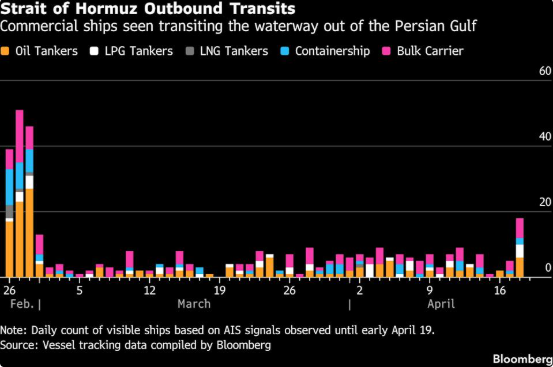
Screengrab from the Bloomberg report
A brief opening and a swift closure
The initial rush of vessels attempting to exit the Gulf began after Iranian Foreign Minister Abbas Araghchi announced on Friday that the strait was open.
However, Tehran swiftly reversed course and shut the waterway again following Washington's refusal to lift its own naval blockade on Iranian vessels.
This geopolitical deadlock is currently trapping millions of barrels of oil and vast quantities of liquefied natural gas (LNG) inside the Persian Gulf, threatening to severely prolong an energy crisis that has already roiled the global economy.
During the short window before the renewed closure, 18 commercial ships managed to complete outbound transits early Saturday.
This included four tankers, one of which was carrying two million barrels of Saudi and Qatari crude. Additionally, 10 ships made the inbound crossing into the Gulf.
Read more: Strait of Hormuz traffic grinds to a halt as waterway closes again
Navigating the US blockade
Data reveals that nearly half of the ships that managed to exit had links to Iran, with eight explicitly sanctioned by the United States.
Despite making it out of the strait, none of these sanctioned vessels appear to have successfully broken through the US naval blockade stationed further out in the open waters of the Gulf of Oman.
Three vessels anchored off Khor Fakkan in the UAE, while two reached the Omani coast before one turned back. Another LPG tanker, the Raine, briefly appeared poised to run the blockade before retreating toward Hormuz.
In a separate maneuver, four empty European-linked cruise ships made a high-speed dash to exit the Persian Gulf on Saturday, steaming quickly to arrive the Omani coastline to avoid the riskiest waters.
Read more: Iran reinstates restrictions on Strait of Hormuz amid escalating US tensions
Tracking challenges and 'dark' fleets
The dual blockades are heavily complicating maritime tracking efforts. Analysts note that the current threat level may encourage ships to switch off their automated tracking signals to avoid detection, a tactic that makes it difficult to ascertain exactly what is moving through the region.
Signal spoofing -where electronic interference deliberately falsifies a ship's apparent position- is also a growing concern. Furthermore, Iran-linked oil tankers frequently operate as "dark fleets," sailing from the Persian Gulf without broadcasting their locations until they reach the Strait of Malacca, roughly 10 days after passing the UAE.
Consequently, transit figures may be revised higher in the coming days as vessels eventually reappear on tracking screens in safer waters.
'Israeli' PM declares 'we are at war against Iran'
'Israeli' Prime Minister Benjamin Netanyahu has explicitly stated that his country is currently "at war against Iran," accusing Tehran of actively spreading instability across the globe.
Amid the soaring regional tensions, Netanyahu also used the address to underscore the strength of his country's foremost alliance, firmly declaring that Tel Aviv has "no better friend" than the United States.
Iran says opposing side shifts stance under pressure
Iran’s First Vice President, Mohammad Reza Aref, stated that the country’s negotiating team is “defending national interests with courage,” calling on all parties to support its efforts.
He added that the opposing side in the talks has shown inconsistent positions, “resorting to appeals under pressure before shifting to a stubborn approach.”
The official also stressed that Iran will preserve its achievements, emphasizing that control and oversight of the Strait of Hormuz should remain under Iranian authority.
White House walkback: VP Vance will lead US delegation for Iran talks in Pakistan
A White House official confirmed to AFP on Sunday that Vice President JD Vance will indeed travel to Islamabad to lead the US delegation in the upcoming peace negotiations with Iran.
Joined by Special Envoy Steve Witkoff and advisor Jared Kushner, Vance's participation directly contradicts earlier statements made by President Donald Trump, who had indicated that the Vice President would not be making the trip.
US helicopters patrol Gulf to enforce Iran port blockade
The United States Central Command announced that helicopters have begun patrol missions over waters to support a US-imposed blockade on vessels entering or exiting Iranian ports.
In a statement, CENTCOM said a helicopter launched from the USS Pinckney (DDG-91) as part of ongoing maritime operations aimed at enforcing the restrictions.
A helicopter takes off from guided-missile destroyer USS Pinckney (DDG 91) to patrol regional waters in support of the U.S. blockade on ships entering or exiting Iranian ports. pic.twitter.com/WFUPKDG0zE
— U.S. Central Command (@CENTCOM) April 19, 2026
‘Last chance’ for Iran to make a peace deal, warns Trump
The US president has warned Iran that it faces a “last chance” to agree to a peace deal, according to an interview with Fox News.
The president said he would not repeat what he described as a mistake made by former President Barack Obama, referring to the 2015 nuclear agreement signed with Tehran.
“If Iran does not sign this deal, the whole country is getting blown up,” he said in the interview.
Pakistan, Iran foreign ministers confer ahead of planned call between leaders
Pakistan’s Deputy Prime Minister and Foreign Minister, Ishaq Dar, held a phone conversation with his Iranian counterpart, Abbas Araghchi, emphasizing the critical need for sustained engagement to resolve ongoing regional conflicts.
According to a statement from the Pakistani Ministry of Foreign Affairs, the two top diplomats agreed to maintain close contact in the interest of promoting broader peace and stability, while also confirming that a direct phone call between the President of Iran and the Prime Minister of Pakistan is scheduled to take place later today.
Netanyahu requests to cancel criminal trial testimony
The prime minister of 'Israel' has requested to cancel his scheduled testimony in a criminal trial set for Monday, citing security and political considerations, according to reports by the Israeli media outlet Haaretz.
The request was submitted ahead of his planned appearance in court, but the State Prosecutor’s Office rejected the motion.
Trump says US negotiators will be in Pakistan tomorrow for talks with Iran
The US president has said American negotiators will travel to Pakistan on Monday for a second round of talks with Iran, as tensions continue to rise over alleged ceasefire violations and maritime incidents in the Gulf.
The president did not specify which US officials will attend the negotiations in Pakistan, and neither the White House nor the office of Vice President JD Vance immediately responded to requests for comment.
The upcoming meeting follows an initial round of talks led by Vice President JD Vance, according to the president’s social media post.
Trump threatens US will ‘knock out’ every power plant, bridge in Iran
“Iran decided to fire bullets yesterday in the Strait of Hormuz – A Total Violation of our Ceasefire Agreement!” the US president posted on his social media platform Truth Social.
He claimed Iran fired at a French ship and a UK freighter.
“Iran recently announced that they were closing the Strait, which is strange, because our BLOCKADE has already closed it. They’re helping us without knowing,” said Trump.
“We’re offering a very fair and reasonable DEAL, and I hope they take it because, if they don’t, the United States is going to knock out every single Power Plant, and every single Bridge, in Iran”, he stated.
“They’ll come down fast, they’ll come down easy and, if they don’t take the DEAL.”
‘Height of desperation’: Iran's Pezeshkian chides US and 'Israel' over attacks
Iran’s President Masoud Pezeshkian has accused the United States and 'Israel' of carrying out attacks on civilian infrastructure, describing their actions as “the height of desperation and defeat.”
In a video statement, Pezeshkian praised Iran’s armed forces, saying they have withstood pressure and threats from what he called “great powers.”
“The performance of the country’s armed forces in the face of pressures and threats has surprised many analysts,” he said, adding that Iran had been able to “stand up to great powers and their widespread support” despite internal challenges.
Pezeshkian claimed that the opposing side had targeted civilian infrastructure, including schools, hospitals, universities, and public spaces, which he said constituted violations of international law.
He described these actions as evidence of “desperation” after what he said was their failure to achieve military objectives.
“The enemies – who have failed to achieve their goals – are attacking civilian infrastructure,” he said.
He also criticised contradictory statements attributed to the opposing side, alleging they spoke of progress for Iranians while simultaneously threatening to destroy the country’s civilisation.
Pope Leo calls for peace in the Middle East
Pope Leo has renewed his appeal for peace in the Middle East, calling on political and military leaders to pursue a diplomatic solution to ongoing conflicts in the region.
The remarks were delivered at the end of a mass during his visit to Angola, part of his broader tour of Africa.
The pope described the recent ceasefire in Lebanon as “cause for hope,” saying it offers relief for people across Lebanon and the wider Levant region.
“It represents a glimmer of relief for the Lebanese people and for the Levant,” he said.
Pope Leo urged continued negotiations aimed at ending hostilities across the region and achieving a permanent cessation of violence.
“I encourage those who are working toward a diplomatic solution to continue peace talks, so that the cessation of hostilities throughout the Middle East may become permanent,” he said.
Spain to propose EU suspension of 'Israel' association agreement
Spain will propose next Tuesday that the European Union suspend its association agreement with 'Israel', according to official statements.
The planned proposal targets the EU–'Israel' Association Agreement, a key framework governing political dialogue and economic cooperation between the bloc and 'Israel'.
Spanish officials said the initiative will be formally presented during upcoming EU discussions, amid increasing calls from some member states to reassess ties.
East Azerbaijan arrests two over alleged Starlink equipment smuggling into Iran
Authorities in Iran’s East Azerbaijan province have arrested two foreign nationals in the border city of Jolfa on allegations of attempting to smuggle equipment linked to Starlink satellite internet systems into Iran.
The announcement was made by the provincial prosecutor, who said the suspects were detained during an operation targeting the alleged transport of restricted satellite communication devices.
Officials stated that the equipment is associated with Starlink systems, which are not authorized in Iran. No further details were released regarding the identities or nationalities of those arrested.


