
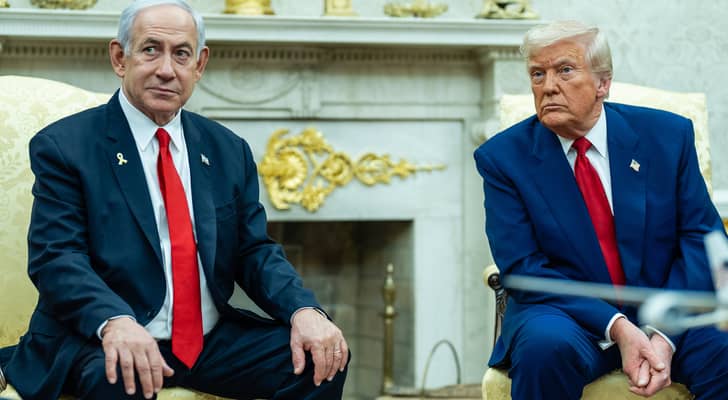
File photo of Trump-Netanyahu meeting in the White House.

Possible Iran strike: Netanyahu to brief Trump on options next meeting
Note: AI technology was used to generate this article’s audio.
- Netanyahu will brief Trump on four military options targeting Iran's ballistic missile program, warning that production could escalate to 3,000 units per month and threaten regional security.
- The meeting follows the June 2025 "Operation Midnight Hammer," with ‘Israel’ seeking US support to prevent Iran from reconstituting its nuclear and missile capabilities.
‘Israeli’ Prime Minister Benjamin Netanyahu is preparing to brief US President Donald Trump on potential military options targeting Iran's ballistic missile program during a scheduled meeting at Trump's Mar-a-Lago estate in Florida on December 29, 2025, according to NBC News.
This discussion arises amid growing concerns over Iran's efforts to rebuild its military capabilities following previous US and ‘Israeli’ operations.
‘Israeli’ officials aim to emphasize the regional threats posed by Tehran's expansions, potentially seeking US support or involvement in future actions, said the report by NBC.
The officials are mainly concerned that Iran is rebuilding its nuclear enrichments sites, but also view the Islamic Republic’s efforts to rebuild their ballistic missile facilities as more immediate concerns
“The nuclear weapons program is very concerning. There’s an attempt to reconstitute. It’s not that immediate,” said a person with knowledge of ‘Israel’s’ plans cited by NBC.
The funding of Iranian proxies in the region is also an issue for ‘Israel’.
The briefing will reportedly include four strategic options similar to those presented before the US-led Operation Midnight Hammer in June 2025: ‘Israel’ conducting strikes independently, receiving limited US assistance, engaging in joint operations, or deferring to US-led efforts.
Netanyahu's team intends to argue that Iran's ballistic missile production, if unchecked, could escalate to 3,000 units per month, enhancing defenses around nuclear sites and overwhelming their security systems.
“There is no real question after the last conflict that we can gain aerial superiority and can do far more damage to Iran than Iran can do to Israel. But the threat of the missiles is very real, and we weren’t able to prevent them all last time,” said a former ‘Israeli’ official, who discussed the topic with current officials.
Previous strikes
This initiative follows a series of military engagements in recent years. ‘Israeli’ forces executed strikes in April and October 2024 that severely damaged Iran's S-300 air defense systems, while the US operation in June 2025 targeted nuclear enrichment facilities using over 100 aircraft, a submarine, and seven B-2 bombers.
These actions enabled potential manned aerial operations over Iranian airspace, though Tehran continues repairs and expansions.
The White House previously stated that assessments from the International Atomic Energy Agency and the Iranian government confirm the US view that "Operation Midnight Hammer totally obliterated Iran’s nuclear capabilities."
"As President Trump has said, if Iran pursued a nuclear weapon, that site would be attacked and would be wiped out before they even got close,” it added at the time.
President Trump, addressing the upcoming meeting, commented, "We haven’t set it up formally, but he’d like to see me."
In a national address, he claimed to have "destroyed the Iran nuclear threat and ended the war in Gaza, bringing for the first time in 3,000 years, peace to the Middle East."
Regarding Iran's ballistic missile rebuilding, Trump warned, "It’s going to take them a long time to come back," adding, "But if they do want to come back without a deal, then we’re going to obliterate that one, too," and "You know, we can knock out their missiles very quickly, we have great power."
The agenda may also touch on a fragile ceasefire between ‘Israel’ and Hamas, with US concerns over implementation, including ‘Israel's’ withdrawal from Gaza and the deployment of an international stabilization force.
Potential friction on this issue could influence Trump's receptiveness to new commitments against Iran, especially as the administration considers actions in other regions, such as Venezuela.
Internationally, Iran's expressed interest in resuming diplomatic talks with the US on its nuclear program complicates the scenario, potentially countering ‘Israel's’ push for preemptive strikes.







