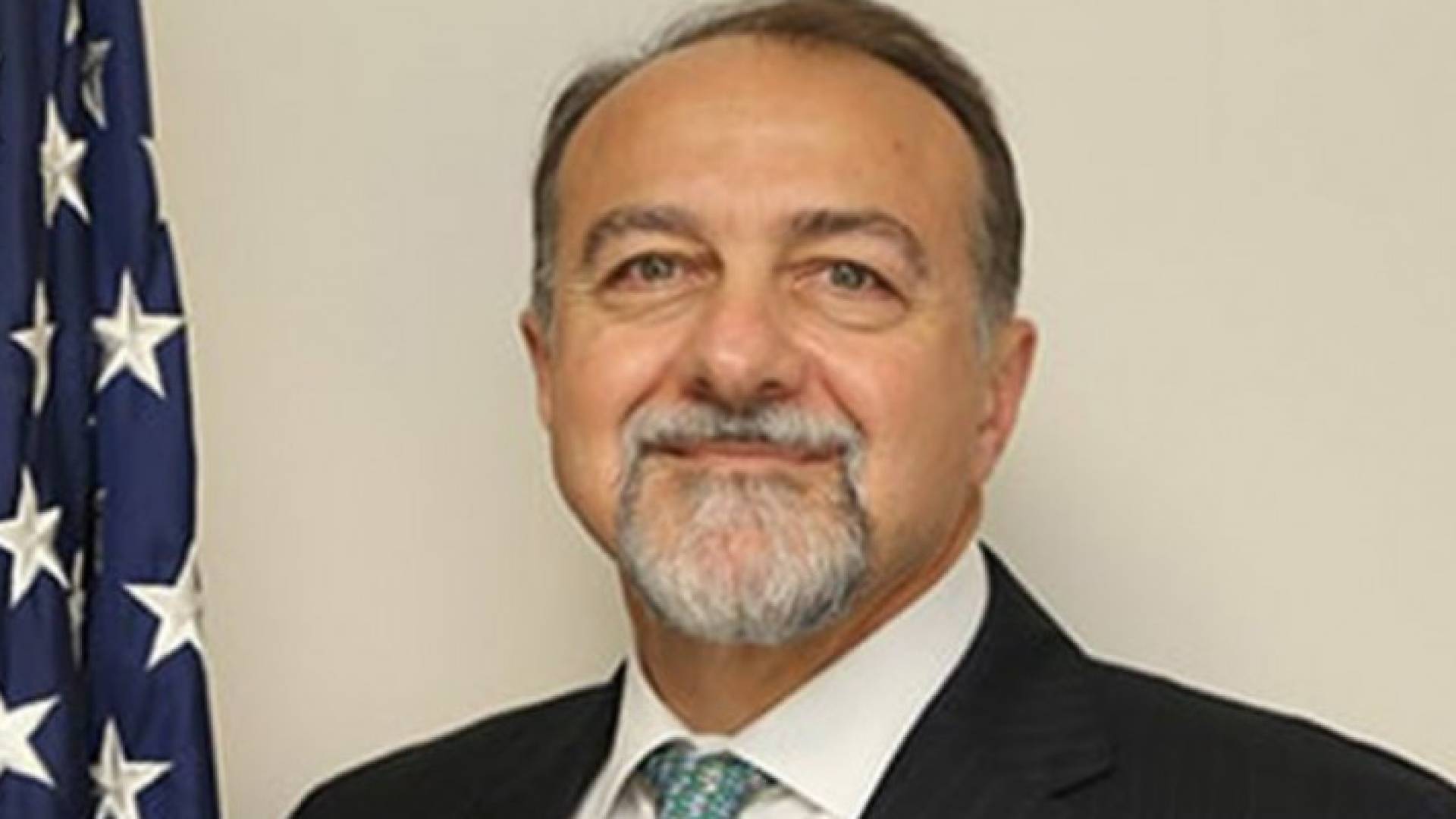
Ambassador Wooster launches US-Jordan Antiquity Preservation Project in Umm Qais
U.S. Ambassador Henry T. Wooster celebrated the beginning of a new, U.S.-funded antiquity restoration project at the historic site of Umm Qais Tuesday in partnership with the Jordanian Department of Antiquities and the nonprofit organization Turquoise Mountain. This project will create more than 150 jobs for Umm Qais community members, who will play a hands-on role in preserving and protecting their heritage.
“Even among Jordan’s many wonders, Umm Qais is special. This ancient city represents the history, culture, religion, and tradition of multiple civilizations dating back thousands of years. For this reason, preserving and protecting Umm Qais is important to me,” Ambassador Wooster said. “I’m glad to use the Ambassador’s Fund for Cultural Preservation to support our efforts here.”
The project will restore the Hawsh Al-Rousan courtyards area of the old village of Umm Qais using traditional building and restoration techniques. After completion, community members will set up a maintenance system and plans for future use of the shared, public space. The project will create more than 150 jobs for local artisans, laborers, and people interested in helping to protect and celebrate the centuries of heritage at Umm Qais.
Through the U.S. Department of State’s Ambassador’s Fund for Cultural Preservation, U.S. ambassadors work with host countries to fund culturally significant projects in countries where they serve. The Department has funded 20 different projects in Jordan since the program’s inception in 2001 – totaling about $3 million for restoring and protecting historical sites and antiquities in the Hashemite Kingdom.
Previous U.S. Ambassadors to Jordan have supported preservation projects in Petra, Qasr Al-Mashtta, and the Roman Nymphaeum fountains in Amman’s balad, among others.
U.S. Embassy Jordan AFCP Fact Sheet
Since 2001, the Ambassador’s Fund for Cultural Preservation has awarded 20 grants to preserve important archeological sites in Jordan, totaling $2,920,921.
Preservation of the Siq al-Mudhlim near the Dead Sea, a Nabataean-era water tunnel and dam carved out of mountain rock and located in a popular hiking and nature area. (2003- $46,500) – Petra National Trust
Preservation and interpretation of the Neolithic Village of Ghwair in Wadi Feinan, one of the best-preserved settlements representing all phases of the Neolithic period. (2005- $39,748) – University of Nevada, Las Vegas/Dept. of Anthropology and Ethnic Studies
Preservation of Tall Hesbon Archaeological Site which consolidates important structures from the Roman, Mamluk, Umayyad, and Byzantine periods. (2005-$50,228) – Andrews University (USA)
Consolidation of the wall paintings in Siq al Barid, Beidha; the finest and most extensive fragments of original plaster and Nabataean mural paintings dating from the first half of 1st century BC. (2006-$33,817) – Petra National Trust
Preservation and access improvements to sites in the Decapolis City of Abila, a large area of ancient sites that enhance the understanding of life in the ancient Near East. (2007-$32,200) – Hartha Charitable Society (Irbid)
Restoration of Petra’s ancient Nabataean flood protection system that protects the Khazne courtyard from flash floods. (2010-$83,700) - Petra National Trust
Conservation of the ruins of the 1st-century Temple of the Winged Lions at Petra. (2011- $600,000) (One of only three AFCP large grants for 2011) – American Center for Oriental Research (ACOR) and the Jordanian Department of Antiquities.
Preservation of the ruins of House XVIII at Umm el-Jimaal in Mafraq. (2011- $96,082) – Dr. Bert De Vries, Umm el-Jimal Project/Calvin College and Open Hand Studios.
The second phase of the preservation of the ruins of Houses XVII and XVIII at Umm el-Jimal Archaeological Site. (2013- $45,000) – Dr. Bert De Vries, Umm el-Jimal Project/Calvin College and Open Hand Studios.
The second phase of the ancient Nabataean flood protection system at Petra. (2013-$58,840) – Petra National Trust.
Conservation of the early 8th century Apodyterium at Qusayr 'Amra. (2013-$99,700) – World Monuments Fund
The Restoration and Rehabilitation of the Roman Nymphaeum in Amman (2014-$194,275) - University of Jordan/Hamdi Mango Center for Scientific Research.
Conservation and Rehabilitation of the Roman Aqueduct of Gadara-Jordan (2015-$160,000) - Yarmouk University/Department of Conservation and Management of Cultural Heritage
Phase Two - Conservation of the 1st Century Temple of the Winged Lions at Petra (2015-$200,000) - American Center for Oriental Research (ACOR) and the Jordanian Department of Antiquities.
Phase Two - The Restoration and Rehabilitation of the Roman Nymphaeum in Amman. (2016-$140,351) – University of Jordan/Hamdi Mango Center for Scientific Research.
Restoration of the Ancient Nabataean Flood Control System in Wadi Madras at Petra. (2017- $150,000)- German Jordanian University.
Conservation of the 2nd-Century Temple of Artemis at Jerash. (2018 - $200,000)- Monumenta Orientalia.
Conservation of the 8th-Century Umayyad Qasr Al-Mshatta (Mshatta Palace) near Amman. (2019- $150,000) - Tarmeem Center for the Preservation and Conservation of Cultural and Natural Heritage.
The Madaba Regional Archaeological Museum Project (MRAMP) Phase Four: Repurposing Current Museum and Preserving the Collection. (2019- $ 188,950). Gannon University. This project is jointly funded by AFCP and the Cultural Antiquities Task Force, in support of the upcoming cultural property bi-lateral agreement between USG and Jordan.
Conservation of 19th-Century Buildings in the Old Village of Umm Qais (2021 - $351,530) – Turquoise Mountain.