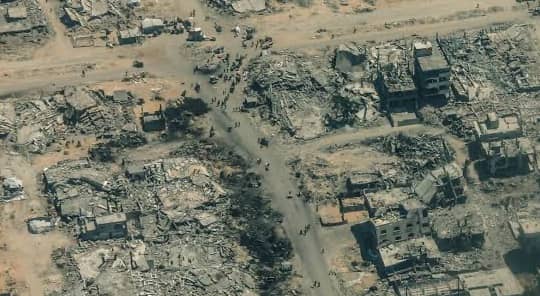
Gaza rubble (The Guardian)

99% of Gaza shows signs of toxic contamination, Oxfam warns
Note: AI technology was used to generate this article’s audio.
- Around 78% of the territory's land area has been affected by the military assault.
- Gaza has accumulated more than 61 million tonnes of rubble.
- Only 19% of sewage pumping stations remain functional.
More than 99 per cent of the Gaza Strip shows indicators of potential environmental contamination following ‘Israel’s’ military assault, with toxic substances threatening Palestinian health and the territory’s ability to sustain human life for generations, according to a new report by Oxfam and the Conflict and Environment Observatory (CEOBS).
The report, published on Sunday under the title Environmental War Crimes: How Israel’s military assault has turned Gaza into a toxic wasteland, threatening human survival, warns that widespread bombardment, fires and the destruction of buildings and essential infrastructure have contaminated air, soil and water across the besieged territory.
Its spatial analysis found that approximately 78 per cent of Gaza’s land area has been directly affected by the military assault, while indicators of potential contamination extend across more than 99 per cent of the Strip. The identified hazards include heavy metals, explosive residues, asbestos from destroyed buildings, dioxins and biological contaminants.
Using satellite imagery, remote sensing, scientific analysis and open-source information, researchers identified Gaza City, Khan Younis, Rafah, Jabalia and areas along Salah al-Din Road as among the locations facing the highest levels of potential contamination.
Oxfam International Executive Director Amitabh Behar said the environmental destruction had undermined the conditions necessary for civilian survival, warning that Palestinians were being exposed to toxic substances through the air they breathe, the water they drink, their food and direct contact with contaminated soil and rubble.
He added that the consequences would persist for generations unless large-scale environmental clean-up and remediation efforts were prioritised.
Water and Sanitation Infrastructure
The report also highlights the collapse of Gaza’s water and sanitation infrastructure, with only 19 per cent of sewage pumping stations remaining functional and approximately 30 per cent of the wastewater network retaining some operational capacity.
As a result, around 40,000 cubic metres of untreated sewage flow into the Mediterranean Sea every day, while another 15,000 cubic metres leak from the wastewater collection system through cesspits and other pathways.
Water contamination is also worsening. Testing data from July 2026 found faecal coliform bacteria in 19 per cent of 79 groundwater wells sampled across Gaza, compared with just two per cent of groundwater wells reported as contaminated in 2021.
The findings point to heightened risks to drinking water in North Gaza, Gaza City and Deir al-Balah, where remaining operational wells and desalination facilities overlap with vulnerable groundwater systems, heavily bombarded areas and large accumulations of debris.
The report further identifies serious risks to agricultural land, particularly around Beit Hanoun, Wadi Gaza and northeast of Khan Younis, where clay-rich soils are more likely to retain pollutants, potentially compromising the safety of crops when agricultural production resumes.
Air pollution poses another long-term threat, particularly in Gaza City, Jabalia and the North Gaza Governorate. Dust from destroyed buildings, debris clearance and waste burning can release hazardous particles into the air, increasing respiratory risks, aggravating asthma and potentially causing lasting lung damage.
Children and pregnant women are identified among those facing the greatest health risks from prolonged exposure.
Rubble
The United Nations Environment Programme estimates that ‘Israel’s’ military operations have generated more than 61 million tonnes of rubble across Gaza, creating a vast accumulation of potentially hazardous materials from destroyed homes, buildings and infrastructure.
Oxfam's global water and sanitation specialist and report author, Lama Abdul Samad, said restoring Gaza’s environment would be particularly challenging because contamination is spread across residential areas, agricultural land, water systems and soil. Unexploded ordnance also continues to prevent safe access to large areas.
She called for ‘Israel’ to allow independent environmental experts and technical specialists into Gaza to conduct detailed assessments, identify contamination sources and establish the measures needed to reduce immediate and long-term risks.
The report warns that reconstruction efforts are already advancing without a comprehensive, field-based post-conflict environmental assessment, which it attributes to ‘Israel’s’ continued refusal to grant independent access to the territory.
Researchers said restrictions on testing equipment and technical expertise have prevented a full assessment of the scale of contamination. Their findings therefore rely on remote sensing, available testing data, incident records and research into conflict-related pollution in other countries, including Iraq, Serbia, Lebanon and Ukraine.
Oxfam warned that rebuilding Gaza without addressing environmental contamination could expose Palestinians to further health hazards long after the destruction of the war has ended.
The organisation called for unrestricted access for humanitarian assistance and environmental assessment, an end to arms transfers that sustain the unlawful occupation or facilitate serious violations of international law, and funding for a Palestinian-led programme of environmental assessment, clean-up and reconstruction.
It also stressed that Gaza’s recovery must be Palestinian-led and include accountability and reparations for the damage caused.
Read more: UN warns: record 'Israeli' settler attacks on olive harvest