Destroyed mosque in Gaza.

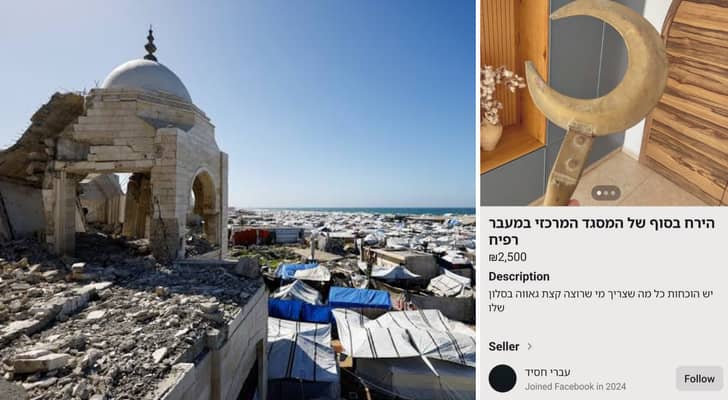
‘Israeli’ lists looted crescent from Rafah Mosque for sale on Facebook
Note: AI technology was used to generate this article’s audio.
An ‘Israeli’ has listed a brass crescent finial, said to have been taken from a mosque near the Rafah border crossing in southern Gaza, for sale on Facebook Marketplace for 2,500 shekels (about $750).
The listing, posted under the name “Ivri Hasid” (a Hebrew phrase roughly meaning “Hebrew pious” or religious Jew), describes the item as “the moon at the end of the central mosque at the Rafah crossing.”
The seller states there is “proof of everything needed” and markets it as suitable “for someone who wants a bit of pride in his living room.”
"עברי חסיד" סוחר בביזה, בשלל מלחמה. מציע למכירה ב- 2,500 ש"ח את "הירח בסוף של המסגד המרכזי במעבר רפיח", ומתגאה שיש לו הוכחות. ואולי הבעיה בחברה הישראלית הרקובה בה חורבן של מקום תפילה הוא אפשרות ל"גאווה בסלון". https://t.co/W8lyTA9FWq
— מסתכלים לכיבוש בעיניים (@Mistaclim) November 21, 2026
Screenshots of the Marketplace post, including a photo of a large brass crescent held indoors, were circulated by the ‘Israeli’ group Mistaclim.Mistaclim, an Israeli organization that documents the occupation and human rights issues, publicized the listing on Saturday.
In its post the group wrote that the seller was “trading in plunder, in war loot” and asked whether the deeper issue lay in “the rotten Israeli society in which the destruction of a place of worship is an opportunity for ‘pride in the living room.’”
The post quickly spread on social media.
Accounts described the seller variously as a settler or a soldier; Mistaclim itself did not specify a military affiliation.
Some commenters called for the listing to be reported and for an investigation into possible looting.
The Rafah area was the site of an intense ‘Israeli’ military attack beginning in May 2024.
Palestinian authorities have reported widespread damage to religious sites across Gaza.
Gaza’s Ministry of Awqaf has stated that hundreds of mosques were completely destroyed or severely damaged during the conflict.
Selling or possessing items taken from protected cultural or religious sites during armed conflict can raise questions under international humanitarian law regarding pillage.