China fears US could target nuclear arsenal more easily with AI: report
Note: AI technology was used to generate this article’s audio.
Chinese military researchers fear that advances in US artificial intelligence could make it easier to locate and destroy China’s nuclear missiles, potentially undermining Beijing’s second-strike deterrent, per the New York Times.
The NYT’s chief China correspondent, Chris Buckley, reviewed more than 100 recent studies by Chinese military and civilian researchers and spoke with experts and former US officials.
The core concern is that AI applied to reconnaissance, data analysis, and precision strike could help US forces detect, track, and target Chinese launchers more quickly than human operators alone, eroding the survivability that underpins China’s strategy of assured retaliation.
Two researchers at Beijing’s Academy of Military Science wrote that integrating AI and related technologies into nuclear decision-making systems could allow the United States to “compress the decision-making process from the traditional 15 to 30 minutes to 90 seconds or less.”
Gerald C. Brown, a former State Department analyst who studies Chinese nuclear strategy, told the Times that in the view of Chinese researchers, AI “could make survivability a lot more difficult.”China currently holds about 620 nuclear warheads, according to estimates from the Federation of American Scientists cited in the report, with projections that the arsenal could reach roughly 1,000 by 2030.
The United States and Russia each deploy around 1,800 warheads.
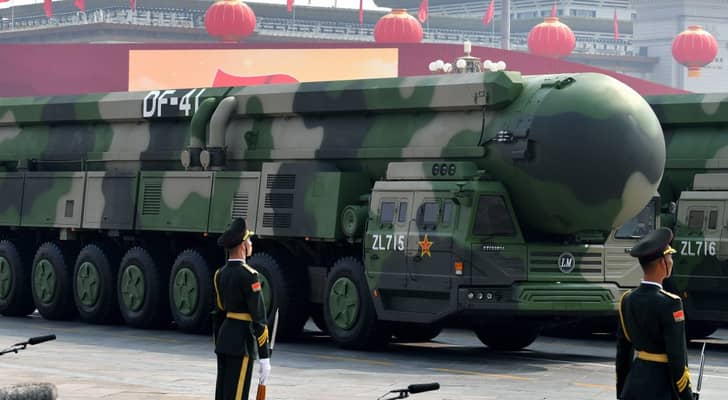
Beijing has sought to improve survivability by dispersing forces, constructing about 320 launch silos in northern deserts, and conducting a long-range submarine-launched missile test in July.
Chinese researchers and the People’s Liberation Army Rocket Force are simultaneously exploring AI applications for their own systems, including ways to help hypersonic and ballistic missiles evade defenses through adaptive flight paths and other techniques.
At the same time, some Chinese military studies caution that flawed or magnified data processed by AI could create “enormous decision-making risks” in command-and-control systems.
Philip Reiner of the Institute for Security and Technology noted that while no one is turning launch authority over to AI, “everything that tells you whether you should launch is now going to be shaped by A.I.”
Experts have also pointed to the risk of miscalculation, with one recent incident involving a false AI-generated intelligence report nearly prompting US action against a Chinese vessel.
Despite a 2024 understanding between then-President Joe Biden and Xi Jinping affirming human control over nuclear-weapon decisions, NYT said there was little progress on formal discussions of AI safeguards in nuclear systems.
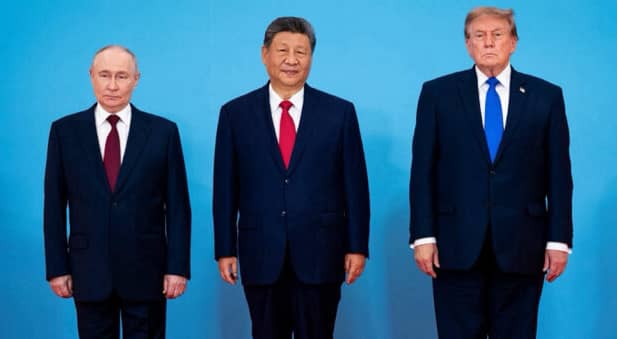
AI’s role in nuclear forces was not addressed at the recent summit involving Xi, President Donald Trump, and Russian President Vladimir Putin.