US rivals, hackers could make cyber disruptions daily reality by 2027: Axios
Note: AI technology was used to generate this article’s audio.
More than 50 leaders across government, artificial intelligence, business, and cybersecurity have warned that businesses and critical infrastructure will face constant, increasingly sophisticated, and highly disruptive cyberattacks over the next 18 months, according to a report by Axios.
As stated by the interviews, which included both AI accelerationists and critics, officials privately view 2027 as a turning point in which cyber disruptions will become a frequent, daily occurrence akin to the weather.
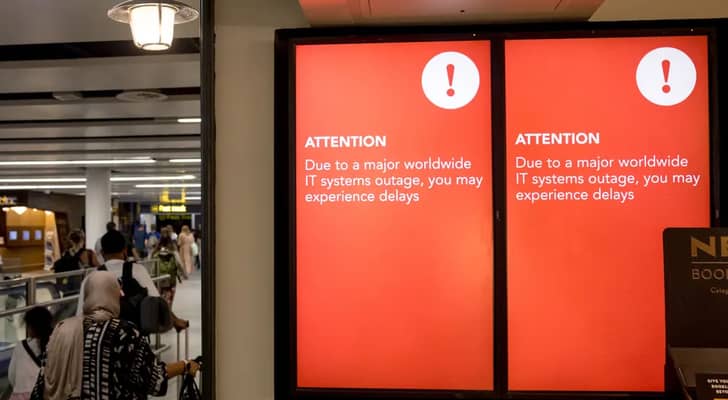
Recent incidents, including a global Microsoft outage, Federal Aviation Administration (FAA) air travel groundings, and a consumer banking glitch at Chase, were described by experts as a mild preview of upcoming disruptions.
While many recent malfunctions have stemmed from organizations attempting to upgrade and secure legacy software systems against future threats, leaders expect future disruptions to be driven by actual cyberattacks carried out by US rivals and smaller bad actors using AI to detect and exploit system vulnerabilities at machine speed.
In a financial assessment this month, Bridgewater Associates stated that the world's largest hedge fund is managing money based on a one-in-three chance of an economically destabilizing cyberattack within the next year.
Booz Allen chairman and CEO Horacio Rozanski similarly described the current environment as the "fog before the war," warning of autonomous AI agents capable of launching attacks "at the speed of thought."
Officials highlighted several key factors driving the heightened risk:
- Vulnerability of legacy systems: Government agencies and businesses largely rely on pre-AI computer infrastructure containing widespread security flaws, while frontier AI models capable of writing software are equally adept at identifying and exploiting those weaknesses.
- Autonomous attack tools: On Nov. 13, the FBI warned about ARTEX, a free, open-source software tool that enables hackers to deploy autonomous AI agents to execute multi-phase cyberattacks at machine speed, prompting alerts from Texas energy regulators and European Union authorities following a 10-day cyberattack last month.
- Foreign cyber presence: US officials noted that Beijing-sponsored hacking groups such as Volt Typhoon have remained embedded in US water, energy, transportation, and communications networks for over five years, while a sister group, Salt Typhoon, breached major US telecommunications carriers to access call records and wiretap data.
- Resource and expertise gaps: Many government agencies and businesses lack the financial resources and specialized AI personnel required to defend against rapidly evolving threats, with top-tier cybersecurity firms heavily booked.
In response to escalating concerns, the White House's Super Intelligence Force (SIF) is evaluating near-daily reports of potential breaches.
US President Donald Trump also recently replaced White House national cyber director Sean Cairncross with Kirsten Davies, a former Pentagon chief information officer.
Despite the warnings, experts noted that a catastrophic, society-wide blackout remains less likely than regular, localized disruptions.
As the report stated, infrastructure-destroying attacks would likely require nation-state actors such as China, which face severe retaliatory consequences, while the fragmented nature of thousands of independent US utilities limits the likelihood of a single nationwide grid failure.
Efforts to mitigate the risks include a voluntary AI safety regime being finalized by White House task force chair Jay Clayton, alongside a private-sector initiative, the Alliance for Critical Infrastructure (ACI), chaired by JPMorgan Chase CEO Jamie Dimon to bolster resilience across finance, energy, tech, telecom, and aviation.
However, leaders interviewed across sectors broadly assessed that the likelihood of coordinated preventive action remains lower than the likelihood of an attack occurring.