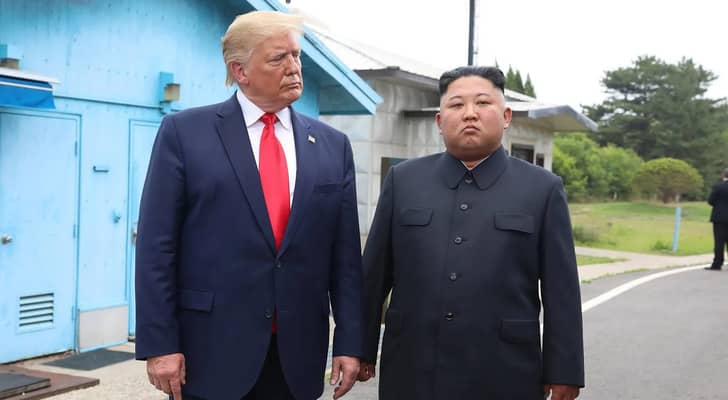
North Korean leader Kim Jong Un and US President Donald Trump inside the demilitarized zone separating South Korea and North Korea in Panmunjom, South Korea, on June 30, 2019. (Dong-A Ilbo/Getty Images)

Trump-Kim meeting hit wall as US rejects N. Korea's terms
Note: AI technology was used to generate this article’s audio.
- US officials discussed ending the Korean War, opening liaison offices, and freezing nuclear tests without demanding arsenal dismantlement
- Pyongyang has grown its arsenal to roughly 60 warheads and solid-fuel ICBMs, backed by a Russian defense pact, softer Chinese opposition
Repeated efforts by US President Donald Trump to revive personal diplomacy with North Korean leader Kim Jong Un have hit a dead end, with Pyongyang rebuffing backchannel outreach and setting unacceptable conditions for a face-to-face meeting during Trump's trip to Asia this week, according to a report by The Wall Street Journal.
People familiar with the matter told the newspaper that Trump first attempted to reach Kim last year via established phone lines and communications channels, only to receive no reply.
White House officials subsequently devised a plan to intercept a North Korean diplomat outside Pyongyang’s permanent mission to the United Nations in Manhattan and hand-deliver a letter from Trump.
However, during a later UN meeting, the diplomat tossed the unopened letter in front of a US representative.
Ahead of his trip to Asia this past week -seeking a major foreign policy breakthrough following Republican losses in the midterm elections- Trump pressed aides to arrange a summit with Kim, The Wall Street Journal reported.
Although the two sides explored the possibility of a last-minute meeting, talks stalled after Kim insisted on conditions Washington could not accept, chief among them US recognition of North Korea as a nuclear power.
A Trump administration official stated on Saturday that there had been no efforts to broker a meeting with Kim, while the White House maintained that it remains committed to North Korea's denuclearization.
Weighing concessions on denuclearization
Despite the public stance, The Wall Street Journal reported that US officials have privately weighed substantial departures from decades of American policy to bring Kim back to the negotiating table.
Among the proposals discussed were a formal declaration ending the Korean War, the establishment of liaison offices as a step toward diplomatic ties, and a joint statement that would stop short of formally recognizing North Korea as a nuclear-weapons state while omitting any demand for the dismantlement of its nuclear program.
In exchange, Washington would seek caps on nuclear and missile testing.
Experts warned that engaging in talks without demanding denuclearization would alarm key US allies in South Korea, Japan, and Europe.
Notably, both the White House’s national-security strategy last year and the Pentagon’s January National Defense Strategy omitted references to North Korean denuclearization -breaks from longstanding precedent- while Trump has left the special envoy position for North Korea policy vacant.
Strengthened, nuclear-armed Pyongyang
The diplomatic stalemate underscores how dramatically the strategic landscape has shifted since Trump and Kim met three times during Trump’s first term in Singapore, Hanoi, and the Korean Demilitarized Zone.
Since their last encounter in 2019, North Korea’s nuclear stockpile has grown from an estimated 20 to 30 warheads to roughly 60, alongside advancements in solid-fuel intercontinental ballistic missiles capable of reaching the US mainland, hypersonic weapons, and reconnaissance satellites.
In a February speech, Kim declared that the US could achieve peaceful coexistence only by accepting his country's nuclear status or otherwise face "eternal confrontation."
Pyongyang has also insulated itself from international isolation through deeper alignment with Moscow and Beijing, alongside large-scale cyber theft:
- Russian alliance: Following Russia’s invasion of Ukraine, Pyongyang supplied Moscow with artillery shells, ballistic missiles, and troops, while Russian President Vladimir Putin signed a mutual defense pact with Kim in 2024 and vetoed UN sanctions monitoring.
- Shifting Chinese stance: Beijing has largely ceased public calls for North Korean denuclearization, advocating instead for a "fair and impartial" approach to peace on the Korean Peninsula.
- Record crypto heists: Bolstered by Russian and Chinese backing, North Korea’s economy grew by 3.5% last year, while state-linked hackers recently stole more than $6 billion from the cryptocurrency exchange Binance in the largest crypto heist in history, accounting for 89% of global crypto hacking losses this year, according to blockchain analytics firm Chainalysis.
With US intelligence assessing that Kim has no intention of negotiating away his strategic arsenal, former US negotiators like Victor D. Cha told The Wall Street Journal that Washington's focus on Pyongyang has faded, suggesting that arms control may now have to replace full denuclearization as a realistic starting point for future diplomacy.