Lebanese President Joseph Aoun.

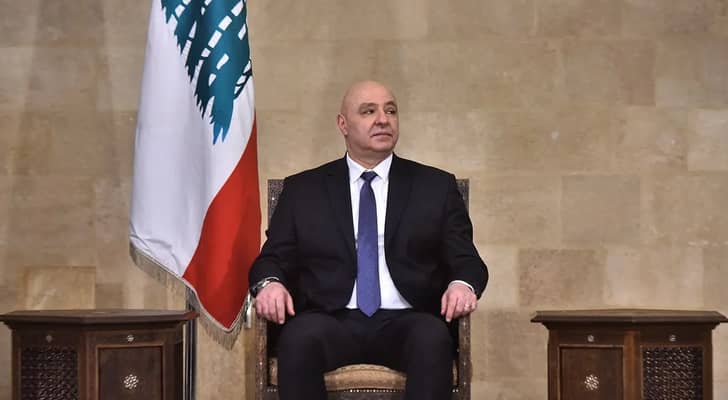
Lebanese President Joseph Aoun demands 'Israeli' withdrawal
Note: AI technology was used to generate this article’s audio.
- Aoun demanded 'Israel' withdraw from Lebanese territory, halt attacks, and free prisoners, while telling Iran-aligned groups to surrender their weapons
- Aoun framed diplomacy as a sovereign tool to restore rights while pledging no internal retaliation or exclusion
Lebanese President Joseph Aoun stated on Saturday that Lebanon's independence remains incomplete 83 years after its founding, calling for a parallel resolution to what he described as two linked obstacles: "Israeli occupation" of Lebanese territory and Iranian-backed armed activity operating outside state control.
Delivering his Independence Day address from the historic Nahr el-Kalb site north of Beirut on the eve of the national holiday, Aoun stated that Lebanon has not yet built the state its citizens deserve, pointing to occupied land, displaced residents, frozen bank deposits, youth emigration, and the absence of an exclusive state monopoly over decisions of war and peace.
"There is no substitute for Lebanon's independence, and no guarantee for Lebanon except its state," Aoun said, arguing that decades of relying on foreign powers and non-state actors had left the Lebanese people -particularly residents of southern Lebanon- paying the price of repeated conflicts since 1969.
Parallel demands on 'Israel'
Aoun stated that his administration is pursuing a national rescue plan that addresses both external occupation and internal armed groups simultaneously, noting that each issue provides a pretext for the other.
Addressing voices within 'Israel' advocating continued presence in southern Lebanon, Aoun demanded an immediate pullout: "Withdraw from every inch of Lebanese territory. Stop your attacks. And return our prisoners to their homes."
He insisted that displaced southern residents will return and rebuild their homes, adding that "occupation does not create security, and destruction does not create peace."
Turning to domestic factions and officials tied to Iranian influence, Aoun delivered an equally direct message regarding non-state weaponry.
While acknowledging past sacrifices and achievements attributed to those arms during an earlier era, he stated that in the subsequent phase they had "exhausted their own people, their communities, their country, and our entire nation" in service of external agendas.
"The time for weapons outside the authority of the state is over," Aoun said. "You must accept this reality. And you must hand over your weapons."
To Tehran, Aoun stated that while Lebanon seeks friendly relations based on mutual respect, "friendship between nations does not grant one the right to interfere in the decisions of another."
Reassurances on internal unity, diplomacy
Seeking to reassure domestic constituencies amid sensitive political debates over disarmament, Aoun pledged that the state would not engage in "persecution, no retaliation, no revenge, and no vindictiveness," emphasizing that constitutional rights and freedoms for all Lebanese communities would remain protected under the law.
He highlighted the Lebanese Army as the sole legitimate military guarantor capable of defending all citizens regardless of sect or region, stating that national security cannot rest on "a multiplicity of weapons and competing decisions," but rather on "one state, one army, and one legitimate authority."
Aoun also defended his reliance on diplomacy, describing it not as surrender or a concession of rights, but as a deliberate path backed by Arab and international support to restore Lebanese sovereignty without turning the country into a "bargaining chip" in regional settlements.