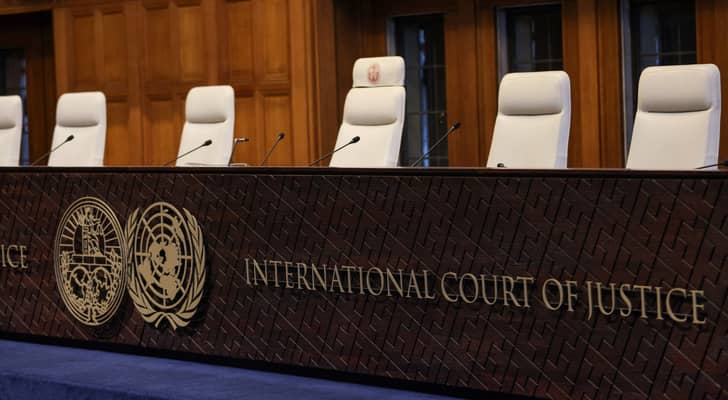
A view of the Great Hall of Justice, the courtroom of the International Court of Justice (ICJ), at the Peace Palace in The Hague, Netherlands, June 18, 2026. (REUTERS/Nicolas Economou)

Gaza genocide case gets boost from ICJ’s Myanmar verdict
Note: AI technology was used to generate this article’s audio.
- ICJ ruling makes Myanmar the first state legally convicted of committing genocide against the Rohingya.
- ICJ dismissed Myanmar's "counterinsurgency" defense
- Finding genocidal intent the only reasonable inference while resisting US sanction threats voiced by Washington's UN ambassador
- Sands noted that rejecting Myanmar's defense keeps South Africa's genocide case against 'Israel' viable by undermining its parallel "counterterrorism" argument
International law professor Philippe Sands, who served as counsel to The Gambia's legal team before the International Court of Justice (ICJ) in The Hague, wrote in The New York Times that Thursday’s historic ruling has made Myanmar the first state ever formally convicted of committing genocide, moving beyond prior international rulings that held only individuals accountable.
In the case brought by The Gambia, the UN's top court ruled that actions carried out by Myanmar's security forces against the Rohingya Muslim minority in northern Rakhine State in 2017 constituted genocide.
Answering the longstanding legal question of whether a state can be found guilty of the crime with what Sands described as a resounding, "Yes, finally."
Details of the ruling, judicial divide
Sands noted that the court relied on harrowing victim testimonies and extensive reports from United Nations fact-finding missions, describing the accounts heard in The Hague as "shocking" across his three decades as a human rights lawyer, and noting that reading the judgment alone took nearly three hours.
The decision, adopted by a 9–6 majority of the 15-judge panel, represents a major boost for the rule of law and reinforces the legal weight of the term genocide, Sands wrote.
Six dissenting judges argued forcefully that while Myanmar committed war crimes and human rights abuses, its actions did not meet the legal threshold of genocide, a debate Sands noted will continue as the ICJ weighs South Africa’s case accusing 'Israel' of committing genocide in the Gaza Strip.
Evolution of 'genocide', strict threshold of intent
In his analysis, Sands traced the legal history of the concept from its coinage to modern jurisprudence:
- Coinage and Nuremberg: Polish jurist Raphael Lemkin coined the term "genocide" in 1944, and it was introduced at the 1945 Nuremberg trials. However, judges omitted it from their final verdicts amid U.S. concerns that the concept could be invoked against Washington by Native Americans and Black Americans.
- The 1948 Convention: Adopted by the U.N. in 1948 (and ratified by the U.S. in 1988), the Genocide Convention established a high legal bar requiring proof of specific "intent" to destroy, in whole or in part, a national, ethnical, racial, or religious group.
- Srebrenica and Vukovar precedents: In 2007, the ICJ ruled that the 1995 massacre of 8,000 Bosnian Muslim men and boys in Srebrenica constituted genocide, though it held Serbia liable only for failing to prevent it rather than committing it. In doing so, the court ruled that genocidal intent must be the "only reasonable inference" drawn from a pattern of conduct—a narrow standard that also led the court to reject genocide claims in Vukovar, Croatia.
Rejecting 'counterinsurgency' claims, US pressure
In the Rohingya ruling, the ICJ majority carefully examined Myanmar’s argument that alternative motives -such as "counterinsurgency," forced displacement, or collective punishment- could be inferred.
The judges rejected that defense, concluding that documented patterns of executing men and boys, mass rape, killing children, burning villages, and attacking fleeing civilians left genocidal intent as the sole reasonable conclusion.
Sands highlighted that the ICJ conducted this factual assessment independently rather than relying on prior criminal tribunal verdicts, as it had in the Balkan cases.
Sands also revealed that the court refused to bow to an implicit threat from the US ambassador to the United Nations, who warned that the ICJ risked facing US sanctions similar to those imposed on the International Criminal Court if it lowered the evidentiary bar for genocide.
Sands countered that it was the Trump administration that had sought to dilute the term through its unfounded claim that South Africa was committing genocide against white farmers.
Direct ramifications for Gaza case
Assessing the broader impact of Thursday's verdict, Sands argued that had the dissenting minority’s approach prevailed, South Africa’s genocide case against 'Israel' would almost certainly have hit a brick wall, given 'Israel's' assertion that its military operations in Gaza are aimed at "counterterrorism", an argument that would have been used to block a finding of genocidal intent as the sole logical inference.
By rejecting Myanmar's comparable "counterinsurgency" justification, Sands concluded, the ICJ has kept the legal avenue open for South Africa -while still requiring Pretoria to meet the same strict threshold of proving intent- demonstrating the court's independence and resolve in the face of political pressure.