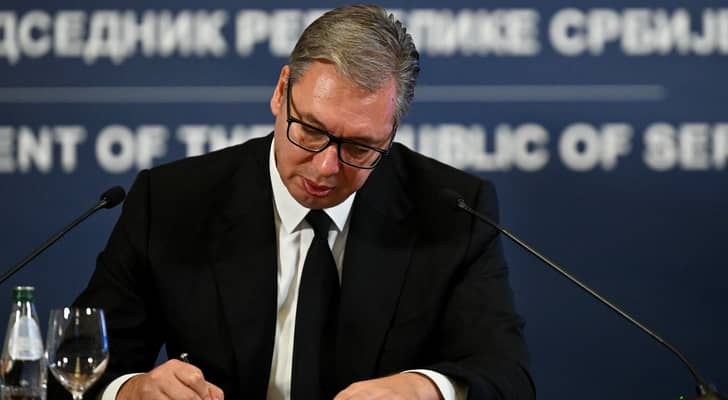
Serbia's President Aleksandar Vucic signs his resignation during a press conference at the Presidential Palace in Belgrade on September 27, 2026. (Photo by OLIVER BUNIC / AFP)

Serbian President resigns to run for Prime Minister
Note: AI technology was used to generate this article’s audio.
- Aleksandar Vučić resigned as Serbian President to seek the prime ministership in the Oct. 25 snap parliamentary election.
- Parliamentary Speaker Ana Brnabić became acting head of state, triggering early presidential elections within 90 days.
- The snap vote follows nearly two years of widespread anti-corruption demonstrations after the fatal 2024 train station collapse in Novi Sad.
Serbian President Aleksandar Vučić announced his resignation on Sunday, stepping down from the presidency to contest the position of Prime Minister in snap parliamentary elections scheduled for October 25.
The move follows nearly two years of widespread, student-led protests across the country.
Speaking from the presidential palace before a crowd of cheering supporters chanting his name, Vučić formally declared his decision to step down from the head-of-state role.
"I declare my resignation from the position of President," Vučić stated from the presidential palace. "Tomorrow morning, I will hand over my duties to the Speaker of Parliament."
Dissolution of parliament
Earlier this month, Vučić formally dissolved parliament and called for early elections on October 25, fulfilling a central demand of the nationwide protest movement.
Parliamentary elections were originally scheduled for December 2027, but persistent anti-government demonstrations forced an earlier vote.
Serbia has been gripped by anti-corruption demonstrations since November 2024, when a roof canopy collapsed at a railway station in Novi Sad, killing 16 people.
Initial public demands for a transparent investigation into the tragedy rapidly evolved into calls for early parliamentary elections, as the incident came to symbolize widespread systemic corruption.
Student-led opposition
The protest movement began with student sit-ins at universities before expanding into broader civil demonstrations.
Since May 2025, organizers have demanded early elections and are currently preparing to field their own dedicated electoral list in the October contest.
The movement poses the most formidable challenge yet to the 56-year-old nationalist politician, who has dominated Serbia's political landscape for over a decade in his roles as both Prime Minister and President.