

Day 212 | Trump rejects 7-day plan to reopen Hormuz
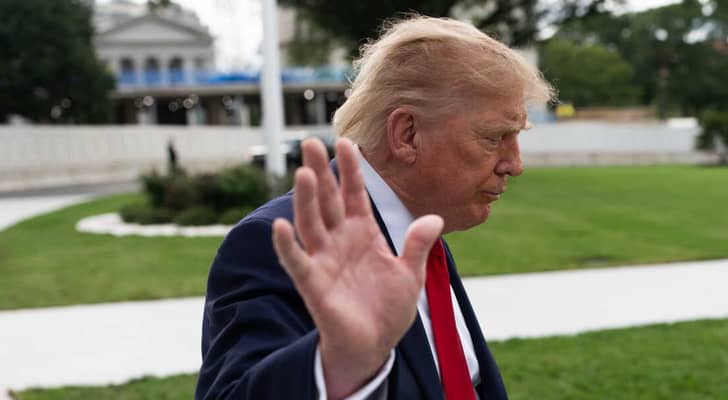
US President Donald Trump confirmed Saturday that he rejected Iran's latest diplomatic offer designed to reopen the Strait of Hormuz and resume negotiations over its nuclear program.
The proposal, which had been introduced during the UN General Assembly, outlined a seven-day timeline to unblock the strategic waterway as a preliminary step toward negotiating a wider peace deal.
The rejection comes amid ongoing regional tensions and economic pressure, with Washington maintaining its stance despite Tehran's efforts to initiate talks.
In an interview with CBS News, Iranian President Masoud Pezeshkian acknowledged a deep "atmosphere of distrust" between Tehran and Washington, but stated that Iran would allow U.N. nuclear inspectors to enter the country as part of a long-term agreement.
Concurrently, Iranian officials mounted a diplomatic offensive against 'Israel' following Prime Minister Benjamin Netanyahu's address to the UN General Assembly.
Iran's deputy foreign minister accused Netanyahu of using the UN stage for "justifying war and aggression," asserting that the mass walkout of international delegates during his remarks "spoke louder than any speech."
US Treasury hails success of isolating Iran economically
- Bessent dispatched global enforcement teams to compel foreign governments into taking direct economic measures against Iran.
- Turkey, Oman, and the UAE suspended Iranian carrier flights and placed regulatory blocks on branches of Bank Melli and Bank Mellat.
- Bessent noted the cumulative economic impact has driven the Iranian rial to historic lows as leadership acknowledges the war's severe toll.
- The Treasury warned that any entity servicing Iranian aircraft risks total exclusion from the U.S. dollar system.
US Treasury Secretary Scott Bessent announced Saturday that Treasury teams deployed across the globe have successfully driven international measures to isolate the Iranian regime economically, commending a wave of foreign actions targeting Iranian banking and aviation sectors.
In a statement published on X, Bessent outlined the scope of the Treasury's diplomatic press to enforce economic restrictions on Tehran.
"Under my direction, teams were sent around the world to engage with countries and demand action against the Iranian regime," Bessent stated on X. "These efforts are bearing fruit."
Commercial flights, banking operations targeted
Bessent highlighted recent regulatory and aviation decisions by regional partners, specifically citing Turkey and Oman's suspension of flights operated by Iran's private carrier, Mahan Air, as well as the United Arab Emirates' comprehensive aviation ban.
The UAE General Civil Aviation Authority (GCAA) confirmed the measure in an official statement issued Thursday, announcing the "suspension of flights by Iranian airlines to and from the state, effective today... until further notice."
Simultaneously, regional regulators moved against Iranian financial institutions.
The Central Bank of the UAE announced measures targeting local branches of Iran’s Bank Melli due to "violations related to anti-money laundering, combating the financing of terrorism, and countering the financing of proliferation."
Additionally, Turkey’s Banking Regulation and Supervision Agency (BDDK) revoked the banking license of Iran’s Bank Mellat, which has faced long-standing Western sanctions.
Total exclusion from US dollar system
Addressing the broader economic fallout, Bessent noted that Iranian leadership has acknowledged the severe consequences of the conflict, pointing out that the Iranian rial has fallen to historic record lows.
The announcement follows an extensive diplomatic outreach effort. Jonathan Burks, US Assistant Secretary of the Treasury for Terrorist Financing, recently concluded a two-week tour spanning the Middle East and Europe.
According to The Wall Street Journal, the US Treasury Department held direct discussions with representatives from over 50 nations.
In an interview with CNBC, Bessent reiterated the administration's stringent enforcement stance, emphasizing that secondary sanctions will apply globally.
"All Iranian airlines will cease operations as of September 23," Bessent told CNBC. "If these planes land, no one will be able to refuel them, provide them landing services, or sell their tickets; otherwise, they will be excluded from the dollar system."
Despite these broad international enforcement actions, smaller Iranian airlines continue to operate international routes, particularly to China, which has refused to comply with American pressure.
Araghchi conditions Hormuz reopening on Iran’s terms
- Despite Trump's public remarks, Araghchi noted Tehran has not yet received formal feedback through third-party intermediaries.
- Final Iranian actions regarding the shipping corridor remain on hold pending official responses delivered via diplomatic channels.
Iranian Foreign Minister Abbas Araghchi said that Iran will not compromise on its established requirements, emphasizing that reopening the Strait of Hormuz remains entirely dependent on the fulfillment of these conditions.
In an official statement addressing recent diplomatic maneuvers, Araghchi reiterated Tehran's stance regarding the strategic maritime passage.
"Our conditions are clear, and any forward movement to reopen the Strait of Hormuz is contingent upon meeting these conditions, and we will not back down from them," Araghchi stated.
Acknowledging early public comments from Washington, Araghchi noted that while US President Donald Trump delivered an initial response, formal communications through diplomatic channels have not yet arrived.
"We saw the first reaction from the US President, but we have not yet received anything from the intermediaries," Araghchi explained.
The foreign minister emphasized that Iranian leadership will delay further decision-making until formal, definitive positions are conveyed through third-party mediators.
"We are waiting for definitive views to be transmitted to us by intermediaries, and we will make our decisions based on that," Araghchi concluded.
Previous day
For coverage of the previous day, visit the link below.
Read more: Day 211 | Iran offers US 7-day plan for Hormuz reopening


