
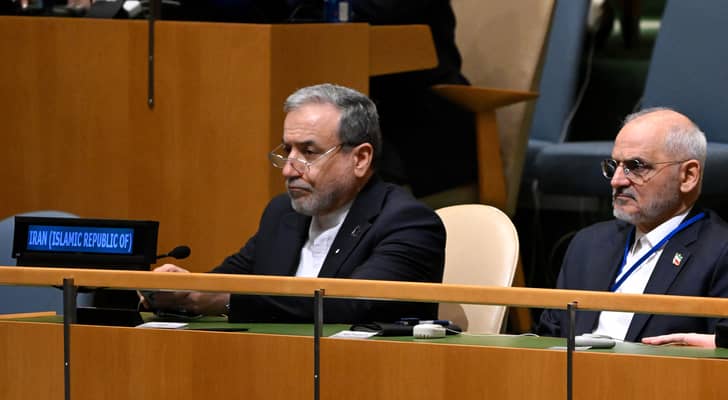
Iran Foreign Minister Abbas Araghchi (L) looks on during the 81st session of the United Nations (U.N.) General Assembly at U.N. Headquarters on September 23, 2026 in New York City. (Photo by ALEXI J. ROSENFELD / GETTY IMAGES NORTH AMERICA / GETTY IMAGES VIA AFP)

Day 211 | Iran offers US 7-day plan for Hormuz reopening
Iranian President Masoud Pezeshkian stated Thursday that Iran aims to reach a diplomatic agreement with the United States ahead of the upcoming US midterm elections in November.
The statement coincided with disclosures from Iran's top diplomat that Tehran has formally submitted a seven-day proposal to reopen the Strait of Hormuz and restart negotiations toward a comprehensive peace agreement.
A US official characterized the ongoing discussions as constructive, though the official stressed that the administration is not rushing the negotiation process.
At the United Nations General Assembly, Iran's deputy foreign minister mounted a sharp critique against 'Israeli' Prime Minister Benjamin Netanyahu following his speech to the hall.
The Iranian official accused Netanyahu of utilizing the UN rostrum to justify "war and aggression" across the Middle East.
Highlighting the diplomatic backlash inside the General Assembly chamber, the deputy foreign minister noted that the widespread walkouts staged by international delegations during Netanyahu's remarks "spoke louder than any speech."
Concurrently, new details emerged regarding a fatal attack on American personnel stationed in the Persian Gulf during the opening days of the war with Iran.
Multiple sources told CBS News that US troops hit by a deadly Iranian drone attack at a small Kuwaiti port had options to relocate to safer, less vulnerable positions in western Saudi Arabia.
According to the reports, intelligence warnings had flagged the location's vulnerability to potential targeting, prompting plans for a transfer; however, the unit's commanding general ultimately rejected the relocation strategy prior to the strike.
Pezeshkian gives Swiss leader ironic book named “American Aid to Iranian People”
Iranian President Masoud Pezeshkian presented Swiss President Guy Parmelin with a booklet titled “American Aid to the Iranian People” during a bilateral meeting on the sidelines of the 81st United Nations General Assembly.
The symbolic gift, handed over after Pezeshkian’s address to the assembly, contains photographs and documentation that Iranian officials say depict US attacks on civilian targets, casualties, sanctions impacts, military strikes, and the killings of Iranian scientists and commanders.
Iranian state media described the booklet as intended to highlight what Tehran calls false claims of assistance by the United States and its allies, framing the title ironically against the backdrop of recent hostilities.
Videos circulated by Iranian agencies showed Pezeshkian handing the volume to Parmelin during their talks in New York.
The meeting was Pezeshkian’s first bilateral engagement following his UN speech, in which he accused the United States and ‘Israel’ of aggression, including attacks on infrastructure and civilian sites, and asserted that Iran had acted in self-defense.
The two leaders discussed regional and international developments, the need to strengthen diplomatic mechanisms to reduce tensions, and ways Switzerland might contribute to dialogue and restoring trust between Iran and the United States.
Pezeshkian outlined Tehran’s position that recent military actions violated international law and humanitarian standards, while expressing Iran’s readiness to expand relations based on mutual respect and resolve disputes through diplomacy rather than force.
Parmelin, for his part, highlighted the longstanding and good relations between Switzerland and Iran.
He recalled Switzerland’s historical role in representing US interests in Iran and its involvement in past diplomatic initiatives.
The Swiss president stressed the importance of maintaining dialogue and using diplomatic channels to manage regional crises, expressing concern over the current situation and Switzerland’s willingness to help reduce tensions and facilitate talks.
In a social media post, Parmelin wrote that during the conversation with the Iranian president, “I reaffirmed our commitment to dialogue and the restoration of trust.”
A Swiss government spokesperson later confirmed that Parmelin received the book but took no position on it at the time, treating it as a standard official gift and taking it back to Bern.
VIDEO - Pakistan PM calls Houthi Mecca attacks “red line” at UN
Pakistan's Prime Minister Shehbaz Sharif says at the UN that further attacks on the Islamic holy city of Mecca would be a "red line" for Islamabad.
"We once again condemn, in the strongest possible terms, the recent deplorable attacks by the Houthis against the Kingdom of Saudi Arabia," Sharif says at the UN's gathering of world leaders in New York.
Iraq seeks exemption from US ban on Iran airlines
The Iraqi government said Saturday it was holding talks with the United States to secure an exemption from the ban on Iranian airlines, which has disrupted travel for patients, students and pilgrims.
All Iraqi airports enforced the ban this week, resulting in major disruption at the airport of the holy city of Najaf, the main destination for Iranian flights to Iraq.
“The Iraqi government is holding direct talks with the American side to exempt certain Iraqi airports from these measures,” the prime minister’s media office said.
An exemption would allow flights to resume “for humanitarian reasons, including medical treatment, education, religious visits, and for the interest of civilians,” it added.
Iranian airlines mainly carry Iraqi Shia pilgrims to Iran’s holy cities or Iranians visiting sacred sites in Iraq.
The flights also serve Iraqi students studying in Iran and patients seeking medical treatment there.
Several Iraqis told AFP that enforcing the US sanctions has left them scrambling for solutions, with some fearing they would lose access to treatment in Iran or others stranded there with little choice but to take the more than 12-hour journey home by land.
Iraq has joined several countries including the United Arab Emirates in enforcing the US ban, after Treasury Secretary Scott Bessent said Iranian airlines would be “shut down” on Wednesday.
Relations between between Iraq and neighbouring Iran, both Shia-majority countries, have long been close, due to religious kinship as well as political and economic interests.
Iraqi airlines stopped flying to Iran at the start of the Middle East war in February.
VIDEO - Iranians hold pro-govt motorcycle rally in Tehran
Volunteers and members of Iran's Basij paramilitary force take part in the government's Jan-Fada, which means "Those Willing to Sacrifice Their Lives," motorcycle rally in Tehran.
Trump rejects 7-day Iranian ceasefire offer: WSJ reports
- Trump rejected Iran's 7-day ceasefire offer, privately planning to resume air strikes after the US midterms.
- Washington refused to lift its naval blockade, using economic pressure to force further Iranian concessions.
- Indirect negotiations proceed via Qatar, though US progress securing tanker transit through Hormuz reduced White House urgency for a deal.
US President Donald Trump has rejected a proposed seven-day ceasefire offer submitted by Iran, The Wall Street Journal reported on Saturday, citing US officials.
According to the officials, US President Trump expressed skepticism during private sessions regarding Iran's willingness to meet his demands.
Trump told aides that he expects the bombing of Iran to resume following the upcoming US midterm elections.
US maintains naval blockade
The Wall Street Journal reported that the United States has informed Iranian representatives and third-party mediators that Trump does not intend to lift the ongoing naval blockade.
US officials assess that sustained economic pressure will ultimately force Tehran to sign an agreement.
Concurrently, American efforts to secure tanker transit through the strategic Strait of Hormuz have diminished the immediate urgency for Washington to finalize a deal with Tehran.
Indirect negotiations continue
Despite the rejection of the temporary ceasefire, Washington and Tehran remain engaged in indirect negotiations through third-party intermediaries, with discussions encompassing the nuclear file.
Officials noted that Trump’s stance could evolve as the war continues, adding that the trajectory of US policy may be influenced by the outcome of the midterm elections.
Pezeshkian tells CBS Khamenei is 'completely healthy'
- Pezeshkian cited deep distrust toward Washington, but confirmed Iran will honor its plan to reopen the Strait of Hormuz if accepted. Nuclear
- He pledged to permit UN nuclear inspectors into Iran, reiterating that building nuclear weapons remains religiously forbidden.
- Speaking as a physician, Pezeshkian affirmed Supreme Leader Mojtaba Khamenei is fully healthy following recovery.
- He rejected claims that Iranian leaders governed from bomb shelters, maintaining operations continued normally.
Iranian President Masoud Pezeshkian stated in an interview with CBS News' "Face the Nation with Margaret Brennan" on Friday that an "atmosphere of distrust" complicates direct relations with the United States, while affirming Iran's commitment to abide by its latest proposal to reopen the Strait of Hormuz.
When asked whether he was willing to meet directly with US President Donald Trump during the United Nations General Assembly in New York -an idea floated by Trump- Pezeshkian indicated he would first need clarity on exact negotiation goals.
He pointed to a history of US military strikes against Iran occurring in the middle of ongoing diplomatic negotiations.
"As long as they don't cease doing what they're imposing on us every day, it's difficult to trust them," Pezeshkian told CBS News. "Every day, they increase the sanctions against us. Every day, they threaten us. Every day, they strike us. And they don't honor what they have put in writing. So if they engage in talks, will they actually follow through?"
Iran agrees to allow nuclear inspectors
Addressing the nuclear file, Pezeshkian confirmed to Brennan that Iran would allow International Atomic Energy Agency (IAEA) nuclear inspectors back into the country as part of broader negotiations.
When Brennan highlighted past instances where UN inspectors were denied full access and pressed whether weapons inspectors would be permitted now, Pezeshkian repeatedly confirmed: "That is absolutely correct."
"If they wish to come in and have inspections, we can reach accords and agreements vis-à-vis that specific topic within the negotiations," Pezeshkian added.
Simultaneously, Pezeshkian denied that Iran harbors ambitions to construct a nuclear weapon, referencing religious prohibitions.
"Developing nuclear weapons is haram," Pezeshkian stated, using the Islamic term for forbidden. "Religiously speaking, they are not allowed to pursue that path."
Update on Mojtaba
Pezeshkian also addressed questions regarding Supreme Leader Mojtaba Khamenei, who has not made public appearances since the US-'Israeli' attack that killed his father, former Supreme Leader Ali Khamenei, earlier this year.
Speaking in his capacity as a medical physician, Pezeshkian stated that the new supreme leader has recovered from face and leg injuries and has "no specific ongoing health issues or challenges."
Pezeshkian disclosed that he recently met twice with Khamenei, including one session lasting over seven hours where they discussed state affairs alongside a six-member consultative team comprising security, parliamentary, and government officials.
Addressing observations about operating in a country actively at war, Pezeshkian rejected assertions that Iranian leadership conducted governance from bomb shelters.
"We were not in a shelter a few months ago," Pezeshkian told CBS. "How did we manage the country? It's not as if we were in a shelter. If we were in a shelter, nothing would have gotten done."
Colombia cuts diplomatic ties with Iran, labels IRGC as “terrorists”
Colombia has formally severed diplomatic relations with Iran, aligning Bogotá more closely with the United States and ‘Israel’.
The decision under President Abelardo de la Espriella, who took office in August, ends more than five decades of ties established in 1975.
The Colombian Foreign Ministry stated that the rupture “responds to the pillars guiding the government’s foreign policy on national and hemispheric security, and the fight against transnational crime,” citing “alleged links of the Iranian government with international terrorist groups and other narcoterrorist groups that threaten the country’s security.”
Officials also pointed to what they said was confirmed human rights violations by Iranian authorities on their own territory, verified attacks on countries not party to the Middle East conflict, the blockade of the Strait of Hormuz, and obstruction of International Atomic Energy Agency (IAEA) efforts to verify Iran’s nuclear program.
“These facts deteriorated Colombia’s trust in the government of the Islamic Republic of Iran,” the ministry said.
In a parallel announcement, Colombia designated Iran’s Islamic Revolutionary Guard Corps (IRGC) a terrorist organization.
The ministry described the force as one that “represses the Iranian population and attacks in covert operations beyond Iran’s borders,” noting it is already classified as such by the European Union, North American countries, and several nations in the Middle East, Latin America, and Oceania.
The IRGC “represents a serious danger to international peace and security,” the statement added.
Consular relations will continue under the Vienna Conventions, with Colombia’s embassy in New Delhi expected to handle residual affairs.
The announcement came shortly after Vice President José Manuel Restrepo addressed the UN General Assembly without mentioning the issue.
Iran’s Foreign Ministry rejected the move as “baseless” and contrary to mutual respect.
It said none of Colombia’s claims hold “validity or logic” and that the decision was taken “solely under the influence of Israel and the United States.”
Tehran vowed “necessary measures” to protect its national interests and accused Colombia of hypocrisy over drug trafficking, citing a recent seizure of Colombian cocaine in Iran.
The step forms part of a rapid foreign-policy realignment under de la Espriella, who has restored ties with ‘Israel’ (broken by predecessor Gustavo Petro) and deepened cooperation with Washington.
Peru severed relations with Iran earlier in September on similar grounds.
‘Israel’s’ ambassador in Bogotá welcomed the decision, stating that Iran’s “activities and links with terrorist organizations and drug trafficking have generated serious security concerns in Colombia and the international community.”
Previous day
For coverage of the previous day, visit the link below.
Read more: Day 210 | US, Iran discuss phased deal to reopen Hormuz and end US blockade


