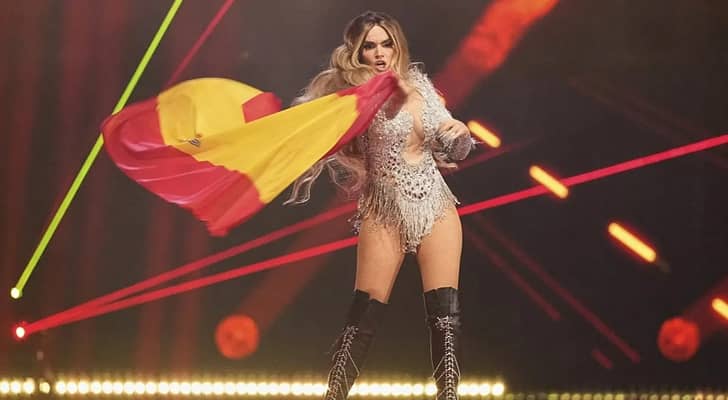
Spain’s performance in the 2025 Eurovision contest.

Spain plans to boycott Eurovision again in 2027 over ‘Israel’
Note: AI technology was used to generate this article’s audio.
Spain’s public broadcaster RTVE plans to extend its Eurovision boycott into 2027 over ‘Israel’s’ continued participation, with the final board decision expected by mid-October.
The head of Spain’s public broadcaster RTVE, José Pablo López, announced on Tuesday that he will propose maintaining the country’s suspension from the Eurovision Song Contest for the 2027 edition in Burgas, Bulgaria.
Speaking before a parliamentary oversight committee in the Senate, López cited ‘Israel’s’ ongoing eligibility despite the humanitarian crisis in Gaza.
“It is deeply painful that Israel’s public broadcaster would continue to participate in Eurovision despite everything, and given this situation that is still being experienced in Gaza,” he said.
Spain was one of five countries—alongside Ireland, Iceland, the Netherlands and Slovenia—that withdrew from the 2026 contest in Vienna in protest at ‘Israel’s’ inclusion.
As one of the “Big Five” (with France, Germany, Italy and the United Kingdom), Spain’s absence carries particular weight because these countries make the largest financial contributions to the European Broadcasting Union (EBU) and automatically qualify for the final.
López stressed that RTVE’s position has remained “firm” and “quite clear,” adding: “We have not looked the other way, so to speak.”
López acknowledged that the EBU has introduced rule changes, including stronger safeguards against external influence, tighter voting limits, the return of professional juries to semi-finals, and new restrictions that could prevent a winning broadcaster from hosting the following year amid armed conflict or geopolitical instability.
He described these as “technical progress” but insisted there remains “unfinished business on the ethical front.” “We are fully aware that not all the objectives have been achieved,” he said.
“We do not make a complacent assessment; we note that there are technical advances, but also a clear outstanding issue on the ethical level.”
The RTVE president further stated: “No one with the slightest human sensitivity can witness the suffering of the Palestinian people without a firm and severe condemnation of what is an intolerable human tragedy.”
He will take the proposal to the RTVE Board of Directors, which is expected to decide by mid-October.
If approved, Spain would sit out the contest for a second consecutive year.
Ireland and the Netherlands have already confirmed they will boycott Eurovision 2027 for the same reason.
Ireland’s RTÉ said participation “cannot be justified given the appalling and ongoing loss of lives in Gaza and the humanitarian crisis there which continues to put the lives of so many civilians at risk.”
Dutch broadcaster AVROTROS described the event as a “platform for division” because a participating country remains involved in a large-scale military conflict.
Eurovision Song Contest director Martin Green said organisers respect RTVE’s process and will await the board’s final decision.
He noted that the EBU had made “significant changes” after listening to members’ concerns and expressed regret that a recommendation against participation is still being made.
The 2027 contest is scheduled for May in Burgas following Bulgaria’s 2026 victory.
The boycott underscores ongoing divisions within the EBU over ‘Israel’s’ place in the competition amid the Gaza conflict.
While most members have continued to support ‘Israel’s’ participation, the repeated withdrawals by several public broadcasters highlight the ethical and political pressures surrounding the event.
Spain’s potential second-year absence would further reduce the contest’s financial and cultural footprint among its major contributors.