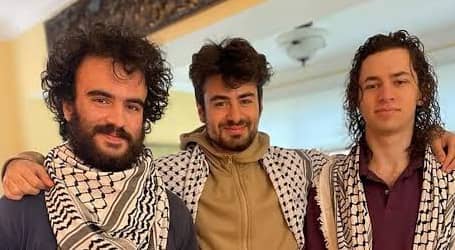
Ali, Awartani, and Abdalhamid before the shooting

Vermont man convicted of attempted murder in shooting of 3 Palestinian students
Note: AI technology was used to generate this article’s audio.
- A jury in Burlington, Vermont found Jason Eaton, 51, guilty on three counts of attempted second-degree murder on Monday, following a six-day trial and roughly two hours of jury deliberation.
- Eaton shot Hisham Awartani, Kinnan Abdalhamid, and Tahseen Ali on Nov. 25, 2023, as the three walked near his home during Thanksgiving weekend.
A Vermont jury on Monday convicted Jason Eaton, 51, of three counts of attempted second-degree murder for shooting three young Palestinian college students near his Burlington home during Thanksgiving weekend in 2023, rejecting his insanity defense after a six-day trial.
The attack occurred on the Saturday evening of Nov. 25, 2023, when Hisham Awartani, Kinnan Abdalhamid, and Tahseen Aliahmad, friends since grade school in the West Bank, were walking along a street near the University of Vermont.
A man confronted them with a handgun and fired at least four rounds before fleeing. Eaton never disputed being the shooter.
All three victims are of Palestinian descent, were speaking Arabic at the time, and two were wearing keffiyehs, details that fueled the case's national attention amid heightened tensions following the start of the war in Gaza roughly two months earlier.
Eaton's attorneys had presented psychiatric testimony arguing he was suffering from a delusional, psychotic disorder after losing his job two weeks before the attack, and that he believed he was receiving CIA messages, and, according to some reports, instructions tied to Mossad, ordering him to "go out and shoot somebody," rooted in a delusion that he was protecting a Jewish family in his neighborhood.
Jurors rejected that defense after roughly two hours of deliberation.
Of the three victims, Awartani, a Brown University student, was left paralyzed from the waist down; Ali, a Trinity College student, was shot in the chest; and Abdalhamid, a Haverford College student, suffered non-life-threatening injuries. Two of the three were treated at the University of Vermont Medical Center and later released; Awartani remains paralyzed.
Eaton stood quietly between his attorneys as the verdict was read and showed no visible emotion. He faces up to life in prison and was ordered held in custody pending sentencing, which has not yet been scheduled.
Speaking to reporters after the verdict, Awartani's mother, Elizabeth Price, said the outcome affirmed Eaton's responsibility for his actions, adding that throughout the trial the family had to hear him repeatedly use hateful language about their sons, language she said reflected clear intent rather than confusion.
The families have maintained from the outset that the shooting was a hate crime, and in a statement said the law "never made him answer for it" even though "we know what he did."
Prosecutors, however, said they lacked sufficient evidence to bring hate crime charges, and jurors reportedly heard some testimony suggesting Eaton's targeting was tied to the victims' Palestinian identity, though that evidence did not translate into formal hate crime counts under Vermont law, which has generally required a defendant to utter a slur during the crime itself.
The case became a flashpoint in the broader national conversation around rising anti-Arab and anti-Palestinian hate incidents following Oct. 7, drawing scrutiny to how state hate crime statutes handle attacks where bias motivation is alleged but not verbally confirmed at the scene.
Read more: Police arrest Palestinian human rights lawyer in Florida