
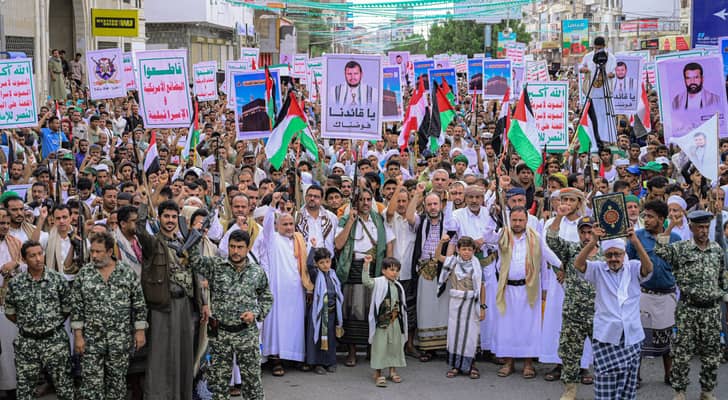
Supporters of the Houthi authorities march with placards in Yemen's western Red Sea city of Hodeida.

Day 205 | Iran sets conditions for US talks as Houthis target Saudi Arabia
Iran has set three conditions for returning to negotiations with the United States, as a widening regional conflict saw Yemen’s Houthis claim missile and drone attacks on Saudi Arabia.
Mohsen Rezaei, secretary of Iran’s Supreme National Security Council, said Tehran had conveyed its conditions to Washington through Qatari mediators and was awaiting a response from US President Donald Trump.
“Our conditions are an end to the war on all fronts, the release of our frozen funds and an end to the naval blockade,” Rezaei told Al Jazeera on Saturday.
Qatar and Pakistan have been involved in efforts to revive indirect negotiations between Tehran and Washington after a memorandum of understanding reached through Pakistan-hosted talks expired.
Rezaei also said Iran had not decided to withdraw from the Nuclear Non-Proliferation Treaty, but warned that US and ‘Israeli’ actions could influence such a decision.
He said Tehran remained committed to a religious ruling against nuclear weapons and had not changed its nuclear doctrine, while adding that future developments could affect its position.
Houthis claim attacks on Saudi Arabia
Yemen’s Houthis said earlier they had launched two operations targeting Saudi Arabia, including “sensitive sites” in Riyadh and Saudi Aramco facilities in the Red Sea port city of Yanbu.
Houthi military spokesman Yahya Saree said the attacks involved ballistic and cruise missiles and drones. The group said the operations were carried out in response to Saudi strikes on Yemen’s capital, Sanaa.
Saudi authorities had issued air-raid alerts in Riyadh and nearby areas earlier Saturday, with residents reporting explosions.
Thick smoke and flames were also seen near King Khalid International Airport, where a fire broke out at a fuel facility.
The Saudi-led coalition said a ballistic missile fired toward Riyadh was intercepted and destroyed. It also said Houthi attempts to target civilian infrastructure in Bisha, Taif, Farasan and Yanbu were thwarted.
No casualties were reported from the intercepted Riyadh missile, according to Saudi authorities.
Iranian official rejects US claims of fuel shortages as “baseless lies”
- Ebrahim Azizi, head of the national security commission in Iran's Parliament, dismissed US claims of petrol queues as "nothing but baseless lies."
- The claims came from US Treasury Secretary Scott Bessent, who told the House Financial Services Committee on Sep. 15 that drivers faced three-to-four-hour waits after tighter sanctions.
A senior Iranian legislator has publicly denied Sunday assertions by a top American official that drivers in Iran are stuck in lengthy queues for petrol, calling the account "nothing but baseless lies."
Ebrahim Azizi, who chairs the national security commission in Iran's Parliament, responded to US Treasury Secretary Scott Bessent on the social platform X. He also directed a warning at Washington: "Take this as a lesson and refrain from repeating your miscalculations, or else the victorious armed forces will give you an unforgettable lesson."
Azizi backed up his rebuttal by sharing a video from Iran Press. According to the outlet, motorists in the country were refuelling in "just three to four minutes rather than waiting for hours."
بار دیگر مشخص شد همه این "به اصطلاح" اطلاعاتتان چیزی جز دروغ های بی اساس نیست.
— ابراهیم عزیزی (@Ebrahimazizi33) September 17, 2026
درس عبرت بگیرید و از خطای محاسباتی مجدد پرهیز کنید وگرنه نیرو های پیروز مسلح، درسی فراموش نشدنی به شما خواهند داد. https://t.co/dJWXlm7Ojd
The exchange traces back to testimony Bessent gave on Sep. 15 before the House Financial Services Committee.
He told lawmakers that after the Treasury Department stepped up its economic sanctions on Iran, drivers there were facing waits of three to four hours at petrol stations.
Azizi's remarks mark a direct contradiction of Bessent's account, with each side presenting a sharply different picture of conditions at Iranian fuel pumps.
Read more: US says Iranian UN officials barred from luxury shopping in New York
Ghalibaf says Hormuz will stay closed until Iran’s conditions are met
- Iran's Parliament Speaker Mohammad Bagher Ghalibaf says the Strait of Hormuz will stay closed until the US fulfils its commitments under the June peace deal.
- The deal is currently defunct.
Iran's Parliament Speaker, Mohammad Bagher Ghalibaf, has reiterated Tehran's position on the Strait of Hormuz. He said the critical waterway will remain closed until the United States fulfils its commitments under the peace deal signed in June, which is now defunct.
Speaking in Parliament, Ghalibaf said Iran has "explicitly conveyed its messages and conditions to the opposing side through intermediaries." He did not say in the remarks provided what those conditions are or who the intermediaries are.
He also said the reopening of the strait and any return to the previous state of negotiations are both off the table for now. "The enemy is well aware that the path of deception and unilateral imposition is closed," he said.
According to Ghalibaf, there will be no opening for either until Iran's conditions are met, the legitimate rights of the Iranian nation are recognised, and American commitments are fulfilled.
Ghalibaf's remarks tie the closure of the Strait of Hormuz directly to the fate of the June peace deal.
Tehran presents the closure as a response to what it says are unmet American commitments rather than a standalone decision.
The deal's collapse has left the two sides without an agreed framework, and Iran says it is now communicating through intermediaries instead of direct talks.
By calling the strait "critical" and linking its reopening to a return to negotiations, Ghalibaf signals that Iran sees the waterway as leverage in any future talks. Since the remarks provided do not spell out Iran's specific conditions or the US response, how the standoff might be resolved remains unclear.
Read more: Iran’s acting defense minister says women are vital to defense industry
US warns Americans in Middle East after Houthi strikes on Saudi Arabia
The US Department of State on Saturday issued a security alert for the Middle East, warning of a potential for rapid escalation following recent attacks by Iran-backed Houthi forces on Saudi Arabia.
In a statement, the department’s TravelGov account said Iranian-supported Houthis have engaged in hostilities against Saudi Arabia, including civilian airports.
“Americans currently in the region should exercise heightened vigilance and remain aware of possible flight cancellations, airspace closures, and other travel disruptions,” it said on X.
“Those outside the region were advised to seriously reconsider travel to or through the Middle East,” it added.
Earlier on Saturday, Houthi military spokesman Yahya Saree claimed the group fired a large number of ballistic and cruise missiles as well as drones at “sensitive sites” in the Saudi capital Riyadh and at facilities of state oil company Aramco in the Red Sea port of Yanbu.
Saudi-led coalition forces said their defenses intercepted a ballistic missile fired toward Riyadh, marking the first such targeting of the capital since the latest escalation of fighting.
Coalition spokesman Maj. Gen. Turki al-Maliki stated that additional attempts to target civilian infrastructure in locations including Yanbu, Taif, Bisha, and Farasan were also thwarted.
Saudi authorities reported no casualties or damage. Residents in Riyadh reported hearing explosions and seeing smoke near the airport area.
Several US embassies in Middle East issue security alerts
Several US embassies in the Middle East issued a warning to its citizens warning of potential escalating tensions, as the Iran-backed Houthis claimed strikes against Saudi Arabia, including one on Riyadh airport.
They include, at the time of writing this article, the embassies in Jordan, ‘Israel’, Iraq, Qatar, Bahrain, Saudi Arabia, Oman, United Arab Emirates, Lebanon.
“Iranian-supported Houthis have engaged in hostilities against Saudi Arabia, including civilian airports. This military conflict has the potential to escalate rapidly,” the warnings said.
“Due to tensions in the Middle East, the security environment remains complex with the potential for unforeseen escalation,” it added.
“Americans currently in the Middle East should exercise heightened vigilance and be aware of potential flight cancellations, airspace closures, and travel disruptions,” it added.
Previous day
For coverage of the previous day, visit the link below.
Read more: Day 204 | Iranians gather for biggest pro-government rally since war began


