WSJ reveals unrecorded US military fatalities amid Iran war
Note: AI technology was used to generate this article’s audio.
- Officials state 22 to 23 US service members have died in the Middle East since February 28, exceeding the 18 listed on the Pentagon's database.
- The disparity includes deaths tied to regional operations during ongoing hostilities and three contractor fatalities, sparking internal criticism over reporting transparency.
- War costs reached $43.6 billion through early September, with over 820 service members wounded and US munition stocks heavily strained.
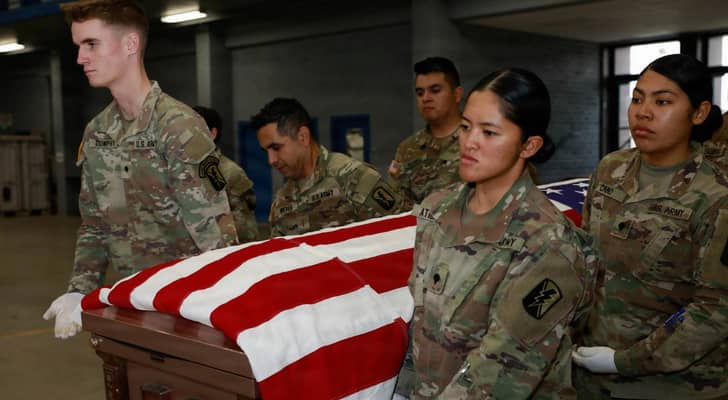
More American service members have died in the Middle East during the ongoing conflict with Iran than the Pentagon has publicly disclosed, according to six US officials familiar with internal War Department casualty accounting data who spoke exclusively to The Washington Post.
Five of the officials stated that at least 22 military fatalities have occurred—four more than the 18 listed in the Pentagon’s official public database, the Defense Casualty Analysis System (DCAS).
A sixth official confirmed that 23 service members have died since February 28, when the Trump administration initiated combat operations in concert with 'Israel'.
While not all undisclosed deaths were directly caused by combat, they involved personnel stationed in the region during active hostilities.
The sixth official added that three US contractors based in the Middle East have also died since operations began.
Officials speaking on condition of anonymity expressed frustration that the additional loss of life is not reflected in the Pentagon's public portal, which currently lists 14 deaths under Operation Epic Fury and four under Overseas Operations following a collapsed July ceasefire.
The Pentagon declined to address questions regarding the accounting discrepancy.
Exclusions and operational reclassifications spark transparency concerns
Proper casualty accounting directly impacts line-of-duty investigations, which determine survivor benefit eligibility for service members' families.
Earlier this year, the administration faced scrutiny after temporarily excluding four fallen service members from the public database while reclassifying renewed hostilities as "Overseas Operations" instead of "Operation Epic Fury."
The public database also excludes by name two service members who died during separate regional missions at bases subject to Iranian attacks:
- Sgt. Devin Seibel: Died May 31 in Irbil, Iraq, in a training accident under Operation Inherent Resolve; his name is absent from the DCAS Inherent Resolve list.
- Maj. Sorffly Davius: Died March 6 in Kuwait following an unspecified medical emergency under Operation Spartan Shield.
More than 820 US service members have been wounded in action since combat began, with many suffering traumatic brain injuries from Iranian counterstrikes on regional bases.
Escalating pressure ahead of midterms
According to a US Central Command document reviewed by The Washington Post, the war cost approximately $43.6 billion through early September, including $28 billion in expended munitions, excluding physical damage to US bases.
High-ranking military leaders have privately warned War Secretary Pete Hegseth that sustained large-scale operations against Iran are unsustainable and risk compromising readiness elsewhere.
The conflict has also severely impacted global energy markets due to Iran's closure of the Strait of Hormuz.
Public opposition continues to grow ahead of the November midterm elections, with a September Reuters-Ipsos poll showing 62 percent of Americans disapprove of Trump's handling of Iran, compared to 28 percent who approve.
On Tuesday, seven Republican lawmakers joined Democrats to pass a war powers resolution aimed at halting the conflict.
Concurrently, Rep. Thomas Massie (R-KY) introduced a maneuver to force a House vote on impeaching War Secretary Hegseth over alleged War Powers Resolution violations, while a group of House Democrats, led by Reps. Pat Ryan and Jason Crow, introduced legislation to prevent the Pentagon from altering troop casualty data.
Senate Democrats have pledged formal investigations into casualty notifications if they take the majority after the midterms.