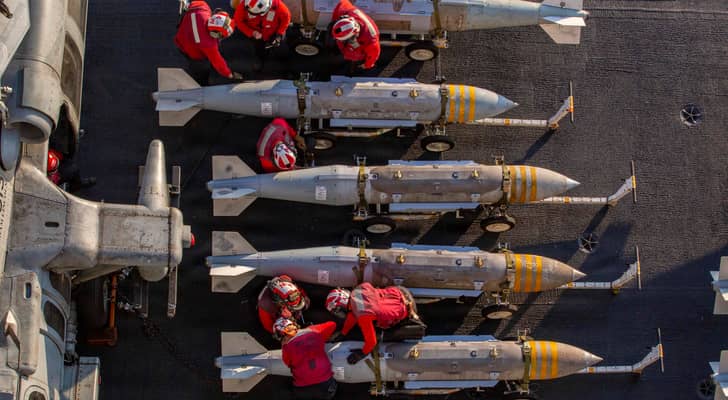
U.S. sailors prepare to stage ordnance on the USS Abraham Lincoln aircraft carrier during Operation Epic Fury while at sea, on Feb. 28, 2026. U.S. Navy handout photo via Getty Images.

Pentagon inspector general confirms US munitions shortages
Note: AI technology was used to generate this article’s audio.
- US spending reached $33.4 billion over four months, including $22.3 billion in munitions and $3.7 billion in lost equipment.
- Confirmed losses include 30 MQ-9 drones, multiple combat aircraft (F-15Es, F-35A, A-10), 12 KC-135 refuelers, and damaged logistics hubs.
A congressionally mandated report released Monday by the War Department Inspector General reveals that the ongoing war with Iran has caused significant US munitions shortfalls and supply chain "bottlenecks".
The report marks the first official public accounting by a government oversight agency on the scope, scale, and costs of the conflict initiated on February 28 by the US and 'Israel'.
Covering the period from the start of the war through June 30, the inspector general noted that the War Department is working to "streamline procurement processes and production lead times, and to stockpile critical materials, components, and selected munitions to respond rapidly to a contingency".
The watchdog's findings contrast with statements from senior leadership. Secretary of War Pete Hegseth has previously denied reports that the US is running low on munitions.
On Monday, US President Donald Trump wrote on Truth Social that the US is "producing more Exquisite and Elite Weapons than at any time in our History," adding that they "are being delivered on a daily basis to our Forces in the Middle East and beyond".
Two weeks prior, Trump posted that the US maintained "virtually unlimited" amounts of ammunition, brushing off reports of stockpiling issues.
Military gear, facility damage
The report provides government confirmation that Iranian forces targeted the U.S. Navy's main regional logistics hub in Bahrain using drones and ballistic missiles.
In total, the watchdog estimates the war cost $33.4 billion through June 30—a figure comprising $22.3 billion in expended weapons, $3.7 billion in equipment losses, and $7.4 billion in other operational expenses.
The calculation does not include repair costs for damaged installations.
The figures offer a baseline compared to broader estimates cited by NBC News in July, where officials indicated total costs ranged between $80 billion and $100 billion, or the War Department's public statement in July citing $37.5 billion.
Equipment losses detailed in the report include the destruction or heavy damage of four F-15E jet fighters, an F-35A Joint Strike Fighter, an A-10 Warthog, 12 KC-135 refuelers, nine other aircraft, and at least 30 large MQ-9 drones.
Furthermore, State Department facilities in Iraq, Kuwait, Saudi Arabia, and the United Arab Emirates sustained more than $208 million in physical damage and project delay costs.
The report does not address an alleged US strike on an Iranian elementary school during the initial hours of the campaign, an incident NBC News reported in June was under internal military investigation.
Logistical strains, troop displacements
More than 20,000 US military and diplomatic personnel have been displaced and relocated since the onset of hostilities.
Medical evaluations for injured service members were frequently conducted on the ground via local ambulances to regional facilities due to airlifts being repositioned over threat concerns.
Additionally, US forces flew up to 5,000 flights from European air bases to support Middle East operations.
While US President Trump initially stated the war would last only weeks, he remarked over the weekend that the conflict might not conclude until "right after" November's midterm elections or shortly before.
The watchdog report omitted assessments of troop morale.
However, following escalating concerns over conditions aboard the USS Abraham Lincoln during an extended deployment, the War Department announced the aircraft carrier is being replaced and is currently returning to its home port in San Diego following a stop in Thailand.
The War Department did not immediately respond to requests for comment regarding the report's release.