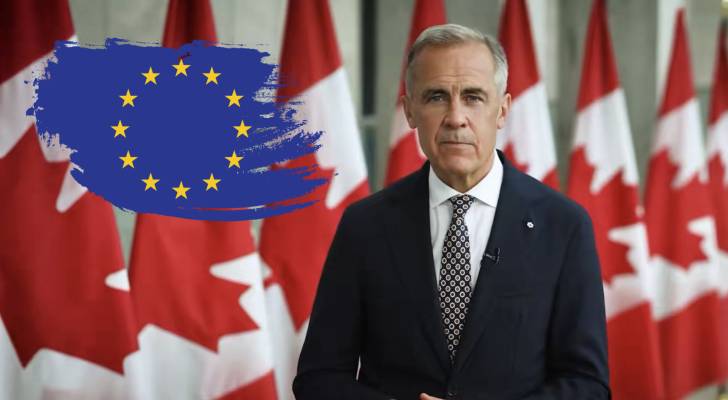
Canada said to float idea of “associate” EU membership after US trade collapse
Note: AI technology was used to generate this article’s audio.
Canadian Prime Minister Mark Carney is accelerating efforts to deepen ties with the European Union, including exploring an unprecedented “associate member” status, as a strategic pivot away from strained relations with the United States amid a severe bilateral trade war.
According to a report by The Wall Street Journal, Carney has held private conversations for months with nearly every major European leader—from France and Italy to Germany, Scandinavia, and others—on integrating Canada and its 41 million people more deeply into the 27-nation bloc.
He has instructed his special envoy to Europe to examine the most ambitious options short of full EU membership or full participation in the common market.
Technical working groups are sketching details of what Carney has described to aides as a fundamental reorientation of an economy and society long dominated by the US.
Carney has even floated the title “Associate Member of the European Union” to European leaders.
Officials on both sides say the EU, typically rigid on membership rules, has shown openness to the idea.
The goal is informal access to Europe’s roughly $21 trillion single market in key areas such as energy, artificial intelligence, critical minerals for batteries and semiconductors, and especially defense.
Discussions have included possibilities like frictionless movement of Canadian goods, services, and workers in those sectors, and even visa-free living and working arrangements for Canadians in Europe, according to two officials familiar with talks involving France.
This push comes as Canada and the US face their worst modern trade conflict, with tariffs and failed negotiations prompting Ottawa to seek alternatives.
Leaders have half-jokingly referred to Canada as the EU’s newest member in response to US President Donald Trump’s past rhetoric about making Canada the 51st state.
Finnish President Alexander Stubb, who speaks regularly with Carney, has asked: “Wouldn’t it be lovely if Canada was the 28th state of the European Union rather than the 51st state of the United States?”
The initiative builds on prior steps under Carney, including a security and defence partnership with the EU that allows Canadian firms to bid on certain procurement contracts, Canada’s participation in the EU’s Security Action for Europe (SAFE) fund, invitations to European Political Community summits as the first non-European leader, and ongoing work to expand the existing Comprehensive Economic and Trade Agreement (CETA).
A Canadian official described the process to the Journal as “tectonic change by working groups and bureaucracy. It’s terribly unsexy but terribly consequential nonetheless.”
Full membership remains off the table due to geography—EU treaties limit accession to “European states”—and Carney has previously stated Canada seeks closer partnership, not membership.
Challenges include regulatory alignment, potential impacts on Canada’s remaining US ties, and the practical hurdles of transatlantic integration.
Yet European leaders have welcomed the overtures, viewing Canada as a like-minded partner sharing values and complementary strengths in resources, technology, and defense.
The talks signal a potential long-term realignment of Western economic alliances.