

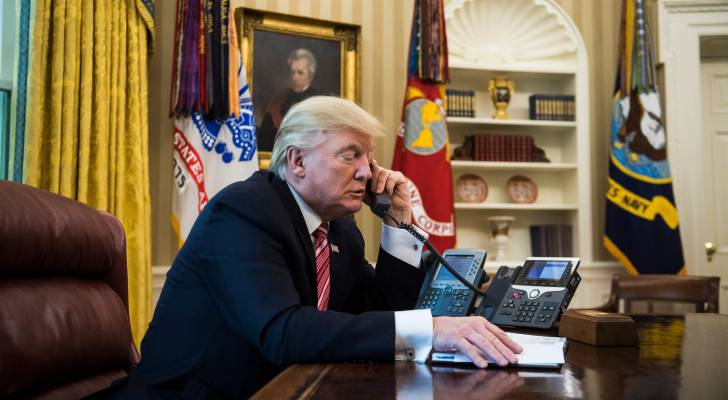
Day 198 | Trump claims Houthis requested US non-intervention
US President Donald Trump claimed that Houthi officials contacted Washington requesting that the United States refrain from intervening in the conflict against Yemen’s internationally recognized government.
The statement follows a swift Houthi offensive that resulted in full control over Yemen’s Red Sea coastline.
In response, Yemeni government forces initiated a series of airstrikes targeting Houthi positions along the western coast.
The rapid territorial shifts come amid heightened regional security concerns, including the temporary suspension of Saudi Arabia's East-West oil pipeline following a drone attack launched from Iraqi territory.
While Saudi Arabia shut down the East-West pipeline as a precautionary measure, Riyadh has deferred direct military retaliation to grant the Iraqi government time to investigate the strikes and prevent future attacks from its territory.
Amid the escalating disruptions to key trade routes, diplomatic efforts are turning toward regional negotiations.
Iran is set to meet with Gulf Arab states in Oman on Monday to hold discussions focused on securing commercial shipping lines through the Strait of Hormuz and reducing broader regional instability.
Report says hardliners defied orders to launch attack that sabotaged Iran-US deal
A group of Iranian hardliners carried out unauthorized attacks on commercial ships in the Strait of Hormuz in early July this year, derailing fragile peace efforts between Tehran and Washington, according to a New York Times report based on interviews with Iranian officials.
President Masoud Pezeshkian, who had been optimistic after negotiating a Memorandum of Understanding with the United States aimed at ending the war and easing economic pressures, learned of the strikes while attending funeral ceremonies for the late Supreme Leader Ayatollah Ali Khamenei.
Iranian forces had opened fire on three vessels, setting a Qatari LNG tanker ablaze and damaging others, sparking international condemnation.
Outraged, Pezeshkian phoned Gen. Ahmad Vahidi, commander of the Islamic Revolutionary Guard Corps, and demanded answers in a raised voice.
Vahidi replied that he had neither authorized nor known about the attacks in advance.
The Supreme National Security Council, central to both wartime decisions and negotiations, was also in the dark.
Investigations by Iranian authorities traced the decision to a fringe hard-line faction led by cleric Hossein Taeb, a former longtime head of IRGC intelligence who was recently appointed to lead the Basij militia.
Taeb had opposed the peace deal with the United States from the start.
Officials said field commanders acted under standing orders empowering them to strike vessels challenging Iran’s claimed control of the strait, without seeking higher approval.
The hard-liners exploited a leadership vacuum.
The new Supreme Leader, Ayatollah Mojtaba Khamenei, has not been seen in public since taking power after his father’s death in the war’s opening strikes, and the authenticity of statements attributed to him has been questioned even by Pezeshkian.
The attacks provoked a swift US military response and ultimately collapsed the Memorandum of Understanding.
“The attack on the ships was orchestrated with the goal to blow up the memorandum of understanding with Trump and to kill the prospects of any future negotiations and deal,” said Alireza Namvar Haghighi, an Iran expert and former official with close government contacts.
The episode triggered some of the most volatile disagreements among Iranian leaders in recent years, with several officials threatening to resign.
Iran wants advanced Geran drones from Russia: report
Iran has asked Russia for advanced Geran drones to bolster its forces in the conflict with ‘Israel’ and the United States, according to Western security officials and a person close to the Kremlin cited by the Financial Times.
Russia’s drone capabilities have advanced significantly through wartime experience in Ukraine, prompting Tehran to seek the improved systems this year.
The Geran series consists of Russian-produced versions of Iran’s own Shahed-136 design, which Moscow received from Tehran early in its war against Ukraine and then refined with better engines, navigation systems, and anti-jamming features.
Senior Iranian and Russian officials began secretly discussing drone deliveries days after ‘Israel’ and the US conducted strikes on Iran in late February 2026, two officials briefed on Western intelligence told the FT.
Processing of the shipments, which also included medicine and food, began in early March and was expected to finish by the end of that month.
Western sources indicated Moscow was in a position to supply models such as the Geran-2.
“The Russians dramatically improved the Shaheds, including modifications to the engines, navigation and anti-jamming capabilities. So these systems are already more advanced than the ones Iran was producing domestically,” said Nicole Grajewski, a professor at Sciences Po who researches the Russia-Iran relationship.
Antonio Giustozzi, a senior research fellow at the Royal United Services Institute, noted that Tehran was not seeking sheer volume.
“They don’t need more drones. They need better drones. They are after the more advanced capabilities,” he said, adding that he had independently heard from sources in the Islamic Revolutionary Guard Corps about the talks.
A senior Western official said Moscow was “stepping in to shore up not only the Iranians’ fighting capabilities but also to underwrite the broader political stability of Tehran’s regime.”
Iran has also sought advanced air-defense systems; the two sides agreed in December 2025 on the delivery of 500 Verba man-portable units and 2,500 missiles, though Russia rejected requests for the more sophisticated S-400.
Kremlin spokesman Dmitry Peskov dismissed the reports as “false news stories” or “a lot of fakes,” while acknowledging ongoing dialogue with Iranian leaders.
Iraq to reopen Iran crossings after drone attack
Iraqi authorities announced on Sunday a timeline to reopen three crossings with Iran, a day after closing them following a drone attack originating from their shared border on a Saudi pipeline.
After the Friday night attack on the East-West pipeline, Baghdad sacked the military commander in Missan province near the Iran border, after authorities determined the drones were launched from there.
The government then closed three crossings, citing the need to reorganize operations and boost intelligence efforts to stop violations.
Two Iraqi security sources told AFP on Saturday that drone launchers were found near the al-Shib border crossing in Missan.
The government's security media cell said Sunday that "after reviewing operations at the border crossings," they would gradually reopen for passengers and trade on a timeline from Sunday until Thursday.
The crossings are Shalamsheh in Basra, al-Shib in Missan, and al-Mandali in Diyala.
Shalamsheh and al-Shib reopened to passengers on Sunday but not to trade, the government media cell said.
No group has claimed responsibility for the attack, and an alliance of Iran-backed Iraqi armed factions said they hadn't struck the pipeline, though Riyadh had previously accused Iraqi groups of targeting its oil infrastructure.
In July, the United States and Saudi Arabia said they had struck Iran-backed fighters in Iraq in response to attacks on Saudi oil facilities.
Pro-Iran armed groups have supported Tehran during the Middle East war, claiming hundreds of attacks on US bases in Iraq and across the region.
Pezeshkian vows Iran “won’t surrender”
Iranian President Masoud Pezeshkian declared on Saturday that Iran will not surrender to pressure from the United States, accusing the US military of attacking civilian infrastructure rather than engaging Iran’s military.
In a post on X, Pezeshkian wrote: “If Americans are warriors, let them face our valiant military forces. Why wage war on civilian infrastructure, food supplies, and livelihoods? If they’re human, why deny people access to water, food, and medicine? Our people can’t be bullied into submission. Iran won’t surrender.”
The statement came as Pezeshkian attended the BRICS Summit in New Delhi, India. It forms part of broader remarks in which he said Iran has stood against the United States and ‘Israel’ and will not yield to what he described as bullying.
If Americans are warriors, let them face our valiant military forces. Why wage war on civilian infrastructure, food supplies, and livelihoods? If they're human, why deny people access to water, food, and medicine? Our people can't be bullied into submission. Iran won't surrender.
— Masoud Pezeshkian (@drpezeshkian) September 12, 2026
One killed in overnight attack on Iranian vessel near Hormuz: state media
One person was killed and three others were injured after an Iranian commercial vessel was struck early Sunday near Qeshm Island, Iranian authorities said, according to state television IRIB.
Amir Taymouri, the governor of Qeshm County, said the vessel was hit at around 5 AM local time in waters near Hengam Island and the Shib Deraz coast of Qeshm Island.
Iranian authorities described the incident as an attack by the "terrorist enemy," but no further details were immediately released and there was no claim of responsibility.
Commercial ship struck by unknown projectile in Hormuz
A commercial vessel transiting the Strait of Hormuz was struck by an unknown projectile, according to an advisory issued by the United Kingdom Maritime Trade Operations (UKMTO).
The advisory, designated as Warning 134-26, confirmed that the incident occurred on September 12, at approximately 23:00 UTC, within the strategic choke point connecting the Persian Gulf and the Gulf of Oman.
UKMTO WARNING 134-26
— UKMTO Operations Centre (@UK_MTO) September 13, 2026
Click here to view the full product.https://t.co/OnrNP6WOlF#MaritimeSecurity #MarSec pic.twitter.com/nhxqzZGwnO
UKMTO verified the report, noting that maritime authorities have initiated an investigation into the attack.
At the time of the warning's publication on September 13, 2026, the condition of the vessel's crew, the extent of structural damage, and potential environmental impacts remained unconfirmed.
UKMTO instructed all mariners operating in the area to proceed with heightened caution and to report any suspicious activity immediately while security forces and relevant authorities investigate the attack.
Iran challenges US forces to face its military directly
- Iran’s president vows the country will not surrender to US.
- Pezeshkian accuses Washington of targeting civilian infrastructure and essential services.
- He condemns restrictions on civilians’ access to water, food, and medicines.
Iranian President Masoud Pezeshkian claimed on Saturday that Iran will not surrender to the United States, accusing Washington of targeting civilian infrastructure and essential supplies to force the country into submission.
In a direct statement published on his official X account, Pezeshkian condemned US tactics amid ongoing regional hostilities, challenging American forces to face Iran's military directly rather than inflicting harm on civilian populations.
"If Americans are warriors, let them face our valiant military forces. Why wage war on civilian infrastructure, food supplies, and livelihoods?" Pezeshkian wrote. "If they're human, why deny people access to water, food, and medicine? Our people can't be bullied into submission. Iran won't surrender."
If Americans are warriors, let them face our valiant military forces. Why wage war on civilian infrastructure, food supplies, and livelihoods? If they're human, why deny people access to water, food, and medicine? Our people can't be bullied into submission. Iran won't surrender.
— Masoud Pezeshkian (@drpezeshkian) September 12, 2026
"Why wage war on civilian infrastructure?"
Pezeshkian’s comments come amid escalating military exchanges and severe economic pressure impacting the Islamic Republic.
The Iranian president highlighted the humanitarian toll of the conflict, pointing to restrictions and strikes affecting food, water, and medical supply networks as evidence of systemic pressure intended to erode public morale.
Pezeshkian reiterated that efforts to force concessions through economic and infrastructural strain would prove futile, emphasizing national resilience in the face of external pressure.
Iraq, Iran coordinate on Saudi pipeline attack probe
Iraqi Foreign Minister Fuad Hussein held a telephone conversation with Iranian Foreign Minister Abbas Araghchi on Saturday to address the fallout from recent strikes targeting Saudi Arabia’s East-West Pipeline.
The two foreign ministers reviewed measures surrounding the incident and the ongoing work of a joint committee established to investigate the circumstances of the attack.
Discussions also covered bilateral relations and the recent closure of several border crossings, examining the reasons behind the decisions and steps to resolve the issue.
Regarding Yemen, the two diplomats reviewed the latest developments, stressing that outstanding issues must be resolved through dialogue and negotiation to reduce regional tensions and enhance stability.
Tehran-Muscat agreement
Turning to the Strait of Hormuz, the ministers discussed the eight-nation summit scheduled for Monday in Oman, which will bring together the Gulf Cooperation Council (GCC) member states, Iraq, and Iran.
Hussein affirmed Iraq's full support for the meeting and confirmed that an official Iraqi delegation will participate.
Concurrently, Iran's Tasnim news agency quoted an Iranian source confirming that the Strait of Hormuz will not be fully reopened under the bilateral understanding reached between Tehran and Muscat.
According to the Iranian account:
- New Routes Established: Tehran and Muscat agreed on specific entry and exit channels. The entry route is situated entirely within Iranian territorial waters, while part of the exit route also passes through them.
- Southern Lane Status: The southern maritime route will remain closed despite US insistence on reopening it, with Tehran tying a full reopening of the strait to Washington fulfilling Iran's conditions.
- Regional Briefing: Iraq will attend Monday's summit in Oman, where GCC countries will be briefed on the outcomes of the Iranian-Omani negotiations and the decisions finalized at the meeting.
Meanwhile, The Financial Times reported on Saturday that the United States has instructed commercial oil tankers navigating the Strait of Hormuz to sail during specific time slots to receive military protection, following an escalation in Iranian attacks targeting vessels transiting at night.
Since May, Washington has provided aerial protection for vessels along a southern path adjacent to the Omani coast.
Citing emails sent by the US Maritime Coordination Center to maritime advisors, the report noted that protected transit windows were reduced starting in early September to two designated daily timeframes.
Previous day
For coverage of the previous day, visit the link below.


