

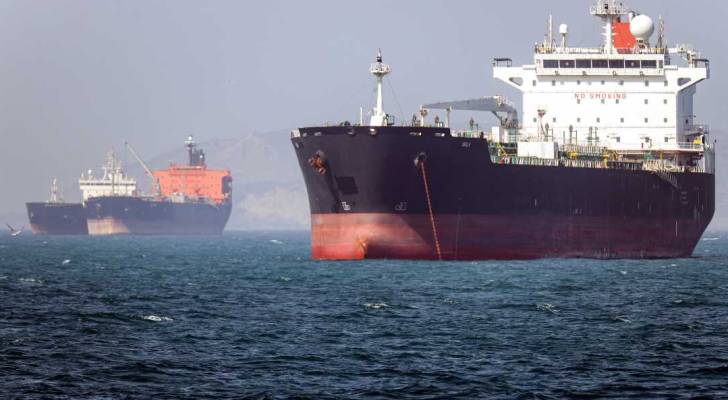
Day 170 | Hormuz standoff, Red Sea port closure deepen maritime crisis
Global maritime trade is facing worsening disruptions across Middle Eastern shipping lanes as US President Donald Trump and Iranian officials exchange sharp rhetoric over the strategic Strait of Hormuz.
Commercial vessels navigating the vital passage face high security risks amid competing claims over maritime control.
Compounding the regional maritime crisis, attacks carried out by Iranian-backed Houthi forces forced a strategic Red Sea port in Yemen to shut down and suspend all operations, further restricting key commercial trade routes.
In southern Lebanon, 'Israeli' airstrikes killed at least 11 people on Saturday, according to Lebanese officials, marking the single deadliest day of bombardment since a ceasefire agreement took effect in June.
The 'Israeli' military stated that the strikes were launched in direct retaliation for an attack by Iranian proxy group Hezbollah that wounded three 'Israeli' soldiers.
Meanwhile, prolonged military operations in the region are placing increased operational strain on American naval personnel.
A CNN analysis highlights that the US Navy is routinely asking aircraft carrier strike groups to extend their deployments beyond standard operational limits, driving heightened concerns over sailor morale and mental health, particularly aboard the USS Abraham Lincoln.
Thread ended
This live thread has ended. Follow our online coverage of day 171 of the war.
Read more: Day 171 | Trump welcomes defense pact between Saudi Arabia, Turkey and Pakistan
Iran won the war militarily and politically, says chief negotiator Ghalibaf
Iran’s Parliament Speaker and chief negotiator Mohammad Bagher Ghalibaf said Sunday that Iran won its war against ‘Israel’ and the US both militarily and politically.
“I say with my whole heart that in this war, both in its military dimension and in its political dimension, we were victorious in the true sense of the word,” Ghalibaf said in statements cited by Iranian media.
“In my first interview during the Ramadan War, in the middle of the war, I pointed out that I don't mean that we destroyed the American army or the Zionist regime's army,” he said.
No. What I mean is that America and Israel, with specific and clear goals, with nine specific, officially declared, written, and repeatedly stated goals, attacked us.”
“But they did not achieve any of these nine goals at any level. This was the biggest total defeat for America and the Zionist regime,” he added.
‘Israel’ tested over 100 countermeasures against Hezbollah drones with little effect: report
‘Israel’ has tested more than 100 countermeasures against Hezbollah’s fiber-optic first-person-view (FPV) drones, yet the cheap, hard-to-detect weapons continue to pose a serious threat to ‘Israeli’ troops operating in southern Lebanon.
According to a report on Hebrew media, Hezbollah has claimed more than 70 explosive-drone attacks since March.
Fiber-optic FPVs have become the group’s primary weapon against ‘Israeli’ forces since a ceasefire took effect in mid-April.
These small drones, often costing just $300–$400 each and assembled in workshops in southern Lebanon and the Bekaa Valley, are controlled via a thin fiber-optic cable rather than radio signals.
This makes them largely immune to electronic jamming and difficult for conventional radar and air-defense systems to detect.
Overnight Friday, an explosive drone struck an ‘Israeli’ combat engineering force, seriously wounding an officer and two soldiers.
One soldier later improved to moderate condition, while the other two remained seriously wounded.
In response, the ‘Iusreli’ military claimed it struck Hezbollah targets in Nabatieh and Ansar, killing two senior commanders, including a Radwan Force battalion commander and a Badr unit leader involved in drone operations.
‘Israeli’ officials have acknowledged the challenge for months.
The military and defense companies have evaluated over 100 detection and interception systems, with some advancing to operational trials.
These include the Iron Drone Raider system, which uses radar and net-firing interceptor drones, new detection kits intended to give troops a few seconds of warning, protective mesh netting, shotguns with fragmenting rounds, and experimental counter-drones that ram, explode near, or net enemy aircraft.
Despite these efforts, effectiveness remains limited.
Troops have reported spotting drones only seconds before impact, and systems such as the Iron Drone Raider have shown insufficient results in field use.
Passive measures like netting over vehicles and positions, adopted in part from Ukrainian battlefield practices, provide partial protection but are not a complete solution.
Prime Minister Benjamin Netanyahu said in May that he had ordered a special project to neutralize the threat: “It will take time, but we are on it. We will continue to ensure Israel’s superiority in every arena.”
‘Israeli’ military Chief of Staff Eyal Zamir has similarly stated that “the drone threat is a challenge, but we will overcome it,” citing ongoing operational and technological solutions.
Pope calls for end to 'Israeli' violence in occupied West Bank
Pope Leo XIV has renewed calls for an end to ongoing violence against Palestinians in the occupied West Bank.
Violence by 'Israeli' settlers and troops has intensified in recent weeks, with scores of Palestinians arrested, injured or besieged.
In a post on social media, the pope also urged the international community to work toward “advancing the two-state solution for a just and lasting peace.”
Saudi Arabia says danger has passed in Jazan
Saudi Civil Defense said Sunday that the danger in the Jazan region in southwestern Saudi Arabia had passed after the Kingdom’s early warning system was activated earlier in the day.
The warning was sent as a notification to residents’ and citizens’ mobile phones, urging them to remain calm, follow safety instructions and move to a safe location, including inside a building.
Authorities also advised people to avoid gathering in crowded areas and refrain from taking photos, according to Saudi Civil Defense’s official social media accounts.
Jazan, located near Saudi Arabia’s border with Yemen, has faced repeated attacks claimed by Yemen’s Houthis.
On August 13, the Houthis said they had targeted an Aramco refinery in Jazan with drones, according to Reuters.
Saudi authorities have not provided further details on what prompted Sunday’s early warning activation.
US pressure limits 'Israeli' response: Hebrew media
'Israeli' news site Walla quoted a security official as saying ‘Israel’s’ freedom to respond has become limited by US pressure amid ongoing negotiations over Lebanon and Gaza.
The official said Washington’s pressure is affecting ‘Israel’s’ ability to respond as talks continue on both fronts.
Iran says it dismantles Starlink data network
Iranian police say they have dismantled a group that provided access to Starlink devices to transmit classified information that allegedly threatened national security.
Police said the main suspect was arrested and had been providing illegal services to selected individuals.
According to Iranian authorities, the suspect enabled the transmission of sensitive information considered a threat to Iran’s national security.
Qeshm airport to resume flights Wednesday
Iran’s Fars news agency reports that flights at Qeshm International Airport will resume next Wednesday after being suspended due to the prevailing circumstances.
Iran offers $30,000 reward for capturing US attackers
Iranian state television quoted the country’s Army chief as saying Iranian forces that capture or kill a US attacker will receive a $30,000 reward from the Iranian people.
Iran vows to defend Strait of Hormuz leverage
Iran’s Army chief, Maj. Gen. Amir Hatami, said Tehran will defend its leverage over the Strait of Hormuz “with all our strength,” regardless of the cost.
Speaking to Iranian state television, Hatami said Iran had long recognized the strategic value of the waterway but that the war prompted Tehran to activate it as a key point of leverage.
He described the Strait of Hormuz as a “geopolitical advantage” granted to the Iranian people and said it would not return to its previous status.
Hatami also referred to the activation of the strait as one of the “legacies” left by the US president.
CENTCOM chief visits USS Abraham Lincoln for the second time amid concerns about morale
US Central Command chief Adm. Brad Cooper visited the USS Abraham Lincoln during a Middle East trip as concerns grow over the mental health and morale of its crew following an extended deployment.
“History will record this deployment as one of the most operationally intense and consequential of the modern era,” Cooper said in a statement released Saturday by the US military.
He thanked the carrier’s crew for their “tremendous dedication and courage.”
The aircraft carrier arrived in the Middle East in January and has since supported the US war against Iran, including a blockade of Iranian ports. Its operational commitments have limited opportunities to make port calls where sailors can rest and supplies can be replenished.
Iran to hold mourning events for Ali Khamenei
Tehran, Qom and Mashhad are set to hold mourning ceremonies marking the 40th day since the burial of former Supreme Leader Ali Khamenei.
According to a statement, Supreme Leader Mojtaba Khamenei, Ali Khamenei’s son, will oversee the ceremonies.
The events are expected to commemorate the former leader as part of Iran’s traditional 40-day mourning period.
Iran targets ‘Israeli’ journalists in phishing campaign
‘Israel’s’ Shin Bet security service and National Cyber Directorate warned Sunday of a new wave of phishing attacks targeting ‘Israeli’ journalists and media professionals.
The agencies said the campaign is aimed at obtaining sensitive information amid recent political and security developments in the region. They said they had identified the attempts and were working to prevent and disrupt them.
According to the warning, attackers typically approach journalists through WhatsApp or Telegram, impersonating familiar figures and tailoring messages to the target’s professional interests and reporting beat.
The messages may contain fake collaboration proposals, interview invitations or requests for conversations. Attackers then encourage recipients to click links to schedule meetings.
Houthis target Yemen’s al-Makha, government forces say
Yemeni government forces say Houthi fighters launched new attacks on the coastal city of al-Makha using missiles and drones.
The forces said their air defenses intercepted a drone linked to the Houthi group.
The latest attacks have raised renewed fears of an escalation into an all-out war in Yemen, years after a 2022 truce largely halted fighting between the Houthis and government forces.
IRGC official says Iran developed ‘new’ air defence structure during war
An Islamic Revolutionary Guard Corps (IRGC) official says Iran adopted a “new air defense structure” during the war, overhauling elements of its command-and-control network, training and tactics.
Speaking in a documentary released by Fars news agency, the official said the changes were based on lessons from earlier fighting and marked a shift away from what he described as a more “classic” air defense model.
The overhaul included changes to tactics, equipment and technical procedures, as well as how information was collected and shared across Iran’s air defense network.
The official claimed the changes helped Iran keep more of its missile and air defense systems operational during the fighting.
IRGC says 85 percent of air defence production survived war
An Islamic Revolutionary Guard Corps (IRGC) official says more than 85 percent of Iran’s air defense production capacity remained undamaged during the war.
Speaking in a documentary published by Fars news agency, the official said attacks on Iran’s military production infrastructure had not reduced the rate of missile and air defense system production and delivery compared with pre-war levels.
He said much of the IRGC’s air defense equipment is produced by its own self-sufficiency organization, adding that production in some areas had increased since the fighting.
The official also claimed Iran’s stock of operational air defense systems is now in a better position than it was at the start of the war.
Previous day
For coverage of the previous day, visit the link below.
Read more: Day 169 | Trump says will “soon” declare Hormuz strait US territory


