“Mentally broken”: USS Abraham Lincoln crew reach breaking point after extended Iran war deployment
Note: AI technology was used to generate this article’s audio.
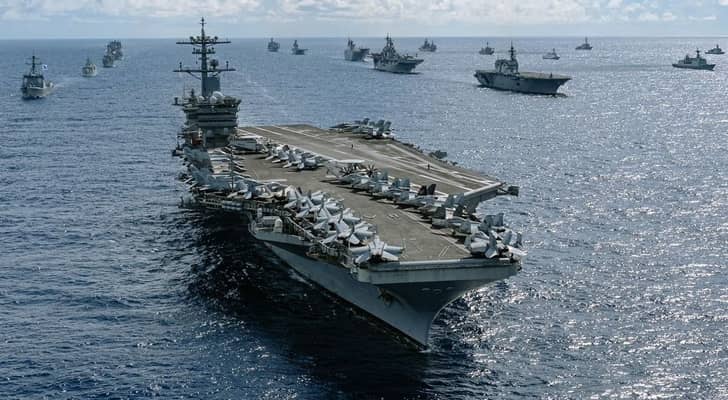
US military families and members of Congress are raising urgent alarms over a deepening mental health crisis aboard the USS Abraham Lincoln, where roughly 5,000 sailors and Marines face a record-breaking deployment tied to US combat operations against Iran.
The San Diego-based nuclear-powered aircraft carrier left homeport on November 21, 2025, for what was expected to be a routine Pacific deployment ending around May.
It was redirected to the Middle East and has remained at sea for more than eight months—now in its ninth—with no publicly announced return date.
The crew has logged about 250 consecutive days underway without a meaningful port call, a modern-era record for continuous time at sea on an aircraft carrier, broken only by brief stops in Guam in December 2025 and Oman in July 2026.
Specialist military outlets Navy Times (Military Times) and Stars and Stripes have reported multiple incidents in which sailors attempted to jump overboard amid exhaustion, declining morale, and sustained operational tempo that included roughly 40 days of continuous combat operations.
Families describe suicidal thoughts as widespread. One parent told Stars and Stripes in July that their son reported “he and his shipmates constantly think about jumping off the ship just for relief.”
At intense town hall meetings last week in San Diego and online, more than 200 family members confronted Acting Secretary of the Navy Hung Cao, Naval Air Forces Commander Vice Adm. Douglas Verissimo, and Naval Surface Forces Commander Vice Adm. Joseph Cahill.
One spouse tearfully told officials she had just received a message from her husband saying “he hopes he doesn’t wake up tomorrow.” Another said the Navy had “broken trust between us and the leadership.”
Annabelle Loma told Navy Times her husband attempted to jump after repeated extensions of the deployment and is now on medical hold.
“He’s scared,” she said.
“He thinks he’ll get a dishonorable discharge, and just because he was burnt out, his 13-year career is ruined, just like that. That’s not fair, that’s not right.”
In a separate incident, Maria Rodriguez said her husband pulled a shipmate back from the edge of the deck as the sailor prepared to go overboard.
Families have also detailed harsh living conditions: moldy showers, broken toilets, laundry out of service for weeks, limited hot water, meals reduced at times to half a cup of rice and two tortillas, and shortages of soap, deodorant, and toothpaste.
“Our mental health and physical health is in danger. We need help,” one sailor wrote in a message shared with Stars and Stripes.
Rep. Mike Levin (D-Calif.) publicized the complaints, describing “moldy showers, broken toilets, laundry down for weeks, long stretches with no hot water, a meal that came down to half a cup of rice and two tortillas. No soap, deodorant, or toothpaste.”
Rep. Jason Crow (D-Colo.) warned that “the strain on our service members and their families is building week by week.”
Sen. Richard Blumenthal (D-Conn.) has pressed Defense Secretary Pete Hegseth and Cao for answers on the extensions, conditions, mental health support, and readiness indicators.
Navy officials have acknowledged the “significant strain.”
Vice Adm. Cahill told families, “We hear you loud and clear [regarding] the impact this has on families, on service members and the long-term ability of us to stand, sustain our forces’ health.”
The service says mental health counselors, chaplains, and doctors are available aboard, with efforts underway to send more support, and that the ship remains mission-capable.
A Navy statement noted that, based on available information, command has not identified an increase in reported suicidal ideation or attempts.
The Lincoln is expected to be relieved by the USS Theodore Roosevelt carrier strike group, though officials have given no firm timeline, citing operational security.
Standard carrier practice calls for port visits every 30 to 45 days for rest and replenishment—opportunities largely denied during this extended war against Iran.