
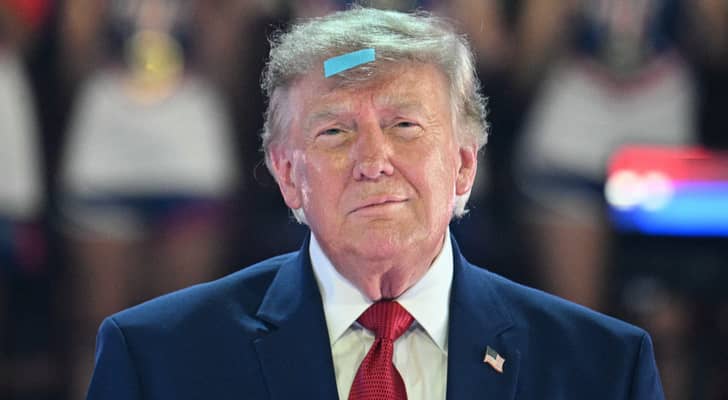
US President Donald Trump attends the 2026 Patriot Games finals at Spire Academy in Geneva, Ohio.

Day 167 | Trump says US will “keep” Hormuz strait control
President Donald Trump on Wednesday said the United States is in control of the strategic Strait of Hormuz and will "keep it."
"The U.S.A. has total control over the Strait of Hormuz. I THINK WE WILL KEEP IT!" Trump wrote on his Truth Social platform. "Our Naval Blockade is being called, by everyone, 'A WALL OF STEEL,' and there is nothing Iran can do about it."
Trump has repeatedly claimed the United States controls the strait, which is vital for the flow of energy and other commodity shipping through the Middle East.
However, Iran says it effectively controls much of the waterway and intends to impose a toll system in response to the US war launched by Trump on February 28.
Late Tuesday, Trump told reporters: "We have total control over the Hormuz Strait right now. They don't have control. We have total control. We own it."
US and ‘Israeli’ forces have heavily bombed Iran's military and killed a swath of the country's leadership so far in the nearly six month war, launched initially with goals including forcing Tehran to abandon its nuclear power program and leadership change.
Iran has resisted with missile attacks on US bases in the region, ‘Israel’ and targets in US-allied Gulf countries.
Its most effective response has been to strike shipping in Hormuz, effectively snarling the trade route, rattling the world economy.
With his political popularity sinking at home ahead of the November midterm congressional elections, Trump has backed off threats to escalate the war in search of a decisive victory.
That leaves the war in a standoff.
However, the Republican says that the United States is prepared to focus on blockading Iranian ports in a strategy that he told Axios was "low-keying."
"We are only semi-negotiating with them. We are just watching Iran with its huge inflation and the fact they have no money," Trump told Axios on Sunday.
Thread ended
This live thread has ended. Follow our online coverage of day 168 of the war.
Read more: Day 168 | Vance says low oil prices are top US goal in Iran conflict
UAE “strongly condemns” Iranian attack targeting two oil vessels in Hormuz strait
The United Arab Emirates on Friday condemned Iran, saying it had attacked two vessels linked to state-owned Abu Dhabi National Oil Company (ADNOC) while they passed through the Strait of Hormuz.
"The United Arab Emirates has strongly condemned and denounced the hostile Iranian attack that targeted two vessels affiliated with ADNOC as they transited the Strait of Hormuz, with no injuries reported," the foreign ministry said in a statement.
Mojtaba Khamenei’s absence fuels infighting between Iranian factions
Iran’s political factions have descended into bitter public infighting over the conduct and aims of the ongoing war, fueled by the prolonged absence of Supreme Leader Mojtaba Khamenei, said a Bloomberg report.
Khamenei, who succeeded his father after the late Ayatollah Ali Khamenei was killed in a US-‘Israeli’ strike in late February, has not appeared in public since assuming the top post in March.
His low profile has created a leadership vacuum that has allowed longstanding rivalries to spill into the open.
President Masoud Pezeshkian recently told state television that he found it “very difficult” to reach the supreme leader, remarks that immediately intensified speculation about Khamenei’s health, security, and effective control.
Days later, Pezeshkian clarified that the two had held a lengthy private meeting lasting “seven or eight hours.”
“It was a very good meeting,” he said, adding that they discussed Iran’s worsening living standards and that Khamenei’s foremost concern was “unity and cohesion” in the country.
The exchange followed weeks of sharp public disputes in Tehran.
Hard-liners have demanded Pezeshkian’s resignation over his support for a fragile peace deal with the United States, while the president has insisted in a lengthy television interview that he will not step down.
The divide pits more pragmatic figures, including Pezeshkian and parliament speaker Mohammad Bagher Ghalibaf, who view military pressure as leverage for a negotiated settlement, against ultra-hardliners who reject compromise and push for total victory and tighter domestic controls.
Analysts say the absence of a visible, accessible supreme leader has removed the traditional referee that Ali Khamenei long provided in internal disputes.
“Mojtaba Khamenei does not make public appearances, is not easily accessible, and reportedly communicates with senior officials through intermediaries. As a result, it’s much more difficult for him to provide clear and decisive leadership or quickly resolve disagreements within the political establishment,” said Arman Mahmoudian, a research fellow at the University of South Florida.
Economist and former Pezeshkian adviser Saeed Laylaz captured the core split: “There’s always been one group that says we need a strategic agreement with the U.S. and there is a group that wants an endless war with the U.S.”
Both camps have sought to claim the new supreme leader’s backing, even as Khamenei remains largely invisible and communicates mainly through intermediaries or written statements.
The power dynamics have shifted since the elder Khamenei’s death.
The Islamic Revolutionary Guard Corps has consolidated greater influence over wartime strategy and key decisions, while the new leader’s reduced public role has left civilian officials struggling to project cohesion.
‘Israel’ stunned by Iran’s rapid military recovery: Hebrew media
‘Israeli’ officials from the military and Mossad have been shocked by the speed of Iran’s military recovery in the months following the early 2026 war, according to a report by The Jerusalem Post.
Four months after the main fighting ended in April, the ‘Israeli’ military is observing a rapid turnaround across multiple areas, most notably in the ballistic missile threat—something officials had not anticipated given the scale of destruction inflicted.
This marks the second time in two years that ‘Israeli’ assessments have been surprised by Tehran’s post-strike resilience.
After limited strikes in October 2024 and a larger campaign in June 2025 that hit around 100 missile and industrial targets, Iran quickly restored high-speed ballistic missile production.
Arsenal estimates rose from roughly 1,300 missiles in June 2025 to about 2,500 by February 2026.
Officials had believed the much larger 2026 campaign—during which more than 2,600 missile and industrial targets were struck and the US and ‘Israel’ conducted around 30,000 attacks—would set Iran back years.
‘Israeli’ officials previously told Hebrew media that “every large and small part of the military industry had been shattered to pieces.”
Yet top officials are now acknowledging that Iran has found innovative ways to prioritize rebuilding specific threats, including missiles, even while large parts of the country remain damaged.
A July Wall Street Journal analysis, citing Planet Labs and Airbus images, showed rapid excavation of buried tunnel entrances at missile bases in places such as Dezful and Kangavar, repaired access roads, and partial reconstruction at facilities like Raja Shimi Industries near Tehran that produce missile components.
Former ‘Israeli’ air defense chief Brig.-Gen. Ran Kochav noted: “They refilled their stockpiles… They have very impressive industrialization and reconstruction capabilities.”
He added that the pace was consistent with Iran’s recovery after the 2025 fighting.
Until recently, debate centered on whether Iran retained 500 or 1,000 long-range missiles capable of reaching ‘Israel’ after the war.
With production restarting, the more pressing issue is the rate of replenishment.
If Iran returns to manufacturing 100–300 missiles per month, it could restore its arsenal to mid-2025 levels by early or mid-2027 and potentially pose a more serious threat by 2028.
Even slower progress could bring the ballistic missile challenge back into play within a few years.
US lost 25% of Reaper drone fleet in Iran war: report
The US military has lost at least 45 MQ-9 Reaper drones in the ongoing war with Iran, equating to roughly 25 percent of its fleet, according to three US officials familiar with the matter, The Washington Post reported.
The aircraft, which cost between $30 million and $50 million each depending on sensors and weapons, have been heavily employed for surveillance and targeted strikes, particularly around the Strait of Hormuz.
The potential taxpayer cost of these losses alone exceeds $1.3 billion.
The Reapers, once central to counterterrorism operations in more permissive environments, have proven relatively easy targets for Iranian air defenses and those of its proxies.
The losses stem primarily from the US-‘Israeli’ campaign that began on February 28.
Earlier tallies, including a Congressional Research Service report, documented around 24 Reapers lost in the initial phase, with the figure rising as hostilities continued through periods of ceasefire and renewed strikes.
Many were shot down in flight by surface-to-air missiles; others were destroyed on the ground in Iranian attacks on regional bases.
Iran has publicly claimed multiple shootdowns, with some confirmed by US officials.
Air Force Chief of Staff Gen. Kenneth S. Wilsbach previously described the MQ-9 as “perhaps the most valuable player” of the campaign.
“No other platform is even close to the MQ-9” in the number of strikes conducted against Iran, he said, noting the value of operating without risking pilots.
Officials have emphasized that the drones fulfilled critical intelligence, surveillance, and reconnaissance orbits despite the attrition.
The fleet has been reduced to roughly 135 aircraft in some earlier assessments, well below the Air Force’s long-standing operational floor near 189 needed to sustain global requirements.
Production of the MQ-9A ended in 2025 after the service declined further orders, leaving limited options for rapid replacement.
General Atomics has parts for only a handful of additional airframes and is promoting its MQ-9B SkyGuardian variant.
The heavy losses have accelerated Pentagon efforts to develop cheaper, more attritable hunter-killer drones that can be expended in high-threat environments without the financial impact of losing $30–50 million platforms.
Programs seeking massed, lower-cost unmanned systems reflect lessons from the conflict, where Reapers excelled in persistence but struggled against modern air defenses designed for contested airspace.
US can maintain Iran port blockade “Indefinitely”, Hegseth says
US Defense Secretary Pete Hegseth said Thursday that the American military has the resources to sustain a naval blockade of Iranian ports for as long as necessary, adding that their Navy has the ability to rotate vessels in and out of the region.
“Indefinitely, the United States Navy can maintain a blockade like that because we’ll rotate ships in and out, as we have, and we’ll continue to,” Hegseth told reporters.
He spoke in Panama after addressing the crew of the guided-missile destroyer USS Gridley, which had previously deployed to the Middle East.
His comments come as negotiations to end the conflict that began with US-‘Israeli’ strikes on Iran on February 28 remain stalled.
The United States imposed the blockade on Iranian shipping and ports after Tehran effectively closed the Strait of Hormuz, a critical chokepoint for roughly a fifth of the world’s oil and liquefied natural gas.
Washington has said the measure targets Iranian traffic while protecting freedom of navigation for vessels heading to or from non-Iranian ports.
President Donald Trump claimed US dominance over the waterway a day earlier.
“The U.S.A. has total control over the Strait of Hormuz. I THINK WE WILL KEEP IT! Our Naval Blockade is being called, by everyone, ‘A WALL OF STEEL,’ and there is nothing Iran can do about it,” he posted on Truth Social.
Since the blockade began, US forces have redirected more than 55 commercial vessels attempting to run it, disabling three ships and boarding two, according to reports.
Hegseth also addressed concerns about conditions aboard the aircraft carrier USS Abraham Lincoln, which has been operating in the region for an extended period in support of operations against Iran.
Reports of shortages, water issues, mental health strains, and limited port calls have drawn scrutiny from lawmakers and families of sailors.
“We make sure every ship, every crew, every captain has everything we can provide them at every single moment. Some deployments are longer than others, and I have more respect and gratitude for those sailors than anybody. What they do in those high seas, in those austere conditions, with less port calls – it’s incredible,” Hegseth said, dismissing the accounts as “completely misrepresented.”
The prolonged deployment of the Lincoln, now stretching well beyond its original schedule with more than 200 days without a port call, has prompted questions from Democratic senators about operational extensions and crew welfare.
US officials maintain that sailors receive necessary support amid the demands of heightened readiness against Iranian threats.
CIA was skeptical of ‘Israeli’ intel on Iranian plot that led to Trump switching planes: report
CIA analysts expressed skepticism over ‘Israeli’ intelligence on an Iranian assassination plot that prompted President Donald Trump to secretly switch planes while leaving Turkey last month, according to a Washington Post report citing current and former US officials.
‘Israel’ relayed the threat information to the CIA ahead of Trump’s July 8 departure from a NATO summit in Ankara.
Agency analysts did not find the intelligence compelling and conveyed their doubts to Trump administration officials.
One official described the reports as “Israeli-derived, not U.S.-generated, and viewed as low confidence.”
Despite the skepticism, the Secret Service and White House proceeded with extraordinary precautions.
Trump publicly boarded the legacy Air Force One in view of cameras, then was covertly transferred via an airport catering truck to a smaller Air Force C-32A military aircraft that flew him and a small group of aides onward, effectively using the larger plane as a decoy.
“The Secret Service has had three near misses with this president, so they’re not taking any chances,” one official told the Post.
“They did what they had to do.” A former official added that the episode “fit a broader pattern of Israeli intelligence reporting that some officials see as designed as much to shape presidential decision-making as to inform it.”
Earlier reporting indicated the ‘Israeli’ information pointed to Iranian proxies discussing the use of shoulder-fired missiles against the presidential aircraft.
US officials later gathered additional intelligence but assessed the scheme as difficult to execute given security perimeters and a lack of confirmed evidence that the required weapons were in place in Ankara.
A constant stream of threats, the ongoing conflict with Iran, and the short timeline left little room for error, officials said.
Trump confirmed the plane change publicly, stating it was directed by the Secret Service.
“It’s really just up to Secret Service. I just follow what they like to do,” he told reporters.
“They wanted me to go on a different flight, a different plane, equal safety. … I do what they say.”
VIDEO - Solidarity rally in Beirut for Lebanese detained in ‘Israel’
Lebanese women hold pictures of people detained in ‘Israel’ during a protest outside the ICRC headquarters in Beirut demanding their release.
"Around 22 Lebanese were detained from their workplaces, including workshops and farms, or from their homes. Another 11 or 12 were captured while fighting against the occupation," says one supporter.
Iranian cell with MANPADS triggered secret Trump plane switch in Turkey: report
A threat from an Iranian cell involving a shoulder-fired missile prompted US officials to use a decoy flight for President Donald Trump’s departure from a NATO summit in Turkey last month, according to officials cited by ABC News.
On July 8, as Trump prepared to leave Ankara after the NATO gathering, US intelligence—drawing from streams that included input involving the NSA, CIA, and Turkish services—detected what officials described as a credible, imminent plot.
Sources said someone had been spotted in the vicinity of the summit with a shoulder-fired surface-to-air missile (a man-portable air-defense system, or MANPADS), and that Iranian operatives knew precise details of Trump’s location, including the specific floor of his hotel.
The Secret Service and military responded with an elaborate last-minute ruse.
Trump publicly boarded the familiar blue-and-white Air Force One (the older VC-25A) in view of cameras, then slipped out the other side into an elevated airport catering truck.
The truck transferred him and a small group of aides to a nearby, less conspicuous Air Force C-32A (a modified Boeing 757) flying under a routine military call sign with tracking systems darkened.
The presidential jet departed separately as a decoy, carrying senior officials, White House staff, and the traveling press corps who were largely unaware of the switch and were instructed to keep window shades closed.
Among those left on the decoy aircraft were Secretary of State Marco Rubio (who sources said was briefed), Treasury Secretary Scott Bessent, White House communications director Steven Cheung, and other aides.
Trump later reunited with the main aircraft for the final leg home after a stop in Britain. The operation remained secret for more than a month until reporting by The Washington Post first brought it to light this week.
Trump addressed the matter for the first time on Tuesday, confirming the switch while downplaying personal concern.
“I go by Secret Service and the military. They wanted me to go in a different flight, different plane,” he told reporters.
“I just have to do what they say.”
He added: “I guess there was a threat out there. I didn’t really ask too much about it. I get a lot of threats.”
Pressed on why the switch left others on the higher-profile jet, Trump insisted the opposite: “I think actually the plane that I flew on was at greater risk… because that would be the plane I think that they would be more likely to go for.”
He further remarked, “I don’t worry about anything, to be honest. Whatever it is, you know my attitude: ‘Whatever.’” and noted that “any consequential president has a lot of threats.”
Iran is “completely broke” from US sanctions and naval blockade: official to Bloomberg
Iran has been left “completely broke” due to the US sanctions and naval blockade, said an unidentified White House official to Bloomberg.
The official added that Trump still has “many levers” he can pull in the coming months against Iran, but gave no further details.
“They’re adapting”: Iran using course-changing missiles to overwhelm US air defenses
Iran has refined its missile tactics against US bases across the Middle East, using advanced weapons that can abruptly alter course to pierce American air defenses.
Recent attacks employed advanced missiles capable of suddenly changing course, which strained and depleted the bases’ defensive systems and forced American forces to expend scarce Patriot interceptors at a rapid rate, according to a report by The New York Times.
Iran has evolved into a more skilled adversary, learning to evade US air defenses while expanding the fight across much of the Middle East and coordinating with allies such as the Houthis in Yemen and militias in Iraq.
At the same time, the Pentagon’s stockpile of interceptors has dwindled sharply, with more than 1,500 Patriot interceptors already expended and fewer than 1,700 remaining, according to people briefed on the numbers who spoke to the NYT.
Iranian officials have described rapid operational improvements under fire.
One official in Tehran told reporters that “the Americans themselves are the main reason behind the improvement of our missiles in recent days,” adding that crews now restore launch sites to operational status in under 30 minutes after earlier strikes that once required up to 15 hours.
Analysts note that systems such as the Kheibar Shekan, capable of terminal-phase maneuvers and last-minute trajectory changes, have featured in recent attacks on US assets.
These adaptations, combined with mixed drone-and-missile salvos designed to overwhelm radars, have increased penetration rates against depleted defenses even as overall launch volumes have fluctuated.
Previous day
For coverage of the previous day, visit the link below.
Read more: Day 166 | US helicopter fired on ship that tried to break Iran ports blockade


