

Day 163 | UAE says Iran targeted tanker as Oman cites progress in Hormuz talks
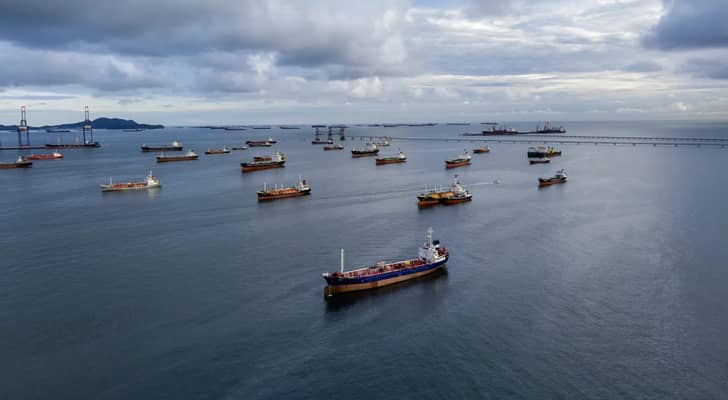
Oman on Saturday described its negotiations with Iran over the future management of the Strait of Hormuz as "positive," while Tehran said the talks were nearing their "final stages," as Abu Dhabi accused the Islamic Republic of targeting an Emirati tanker in the strategic waterway.
Iran has effectively closed the strait since the beginning of the war and is seeking to require ships passing through it to pay "service fees" for transit.
It has repeatedly attacked vessels it accuses of attempting to circumvent the route it has designated.
The United States opposes Iran collecting any fees from ships using the strait, although the memorandum of understanding reached by the two warring countries last June allows the Islamic Republic to "determine the future management of maritime services" in the strait through dialogue with Oman, which lies on the opposite shore.
The Islamic Republic announced Wednesday that it had reached an agreement with Oman on a new transit route through the strait, which has been a major source of tensions with the United States.
Continued attacks in the strait, which was open to navigation before the war, led to the collapse of a ceasefire reached in April. Since then, mediators have sought to persuade both sides to return to the terms of the memorandum of understanding.
The UAE Foreign Ministry on Saturday condemned what it described as "an aggressive Iranian attack targeting an ADNOC tanker with a missile while it was transiting the Strait of Hormuz, with no injuries reported."
Later Saturday, the United Kingdom Maritime Trade Operations agency reported that a vessel was struck by a projectile off the coast of Oman in the Strait of Hormuz, causing a fire that was brought under control without any injuries.
It was not immediately clear whether the British agency was referring to the ADNOC oil tanker or another vessel.
ADNOC, the Abu Dhabi National Oil Company, said in a statement Friday that 15 of its vessels had been attacked in the Strait of Hormuz since the war began, "including three vessels this week alone."
Oman's Foreign Ministry on Saturday condemned "repeated attacks on vessels while transiting the Strait of Hormuz," without explicitly naming Iran.
It said, however, that negotiations with Iran over navigation in the Strait of Hormuz were being conducted "in a positive and constructive atmosphere," and urged all sides to avoid actions that could undermine the progress made.
Day 164 of the US-‘Israeli’ war on Iran
For further updates - visit the link below.
Read more: Day 164 | Pentagon warns of dwindling US weapons stockpiles amid Iran war
Mojtaba Khamenei executes major leadership changes
- Khamenei appoints Zolghadr as political adviser.
- Mohsen Rezaee named representative to SNSC.
- Khamenei praises Zolghadr's previous service.
The Iranian Supreme Leader Mojtaba Khamenei has issued official decrees appointing Dr. Mohammad Bagher Zolghadr as his Political Advisor and appointing Dr. Mohsen Rezaee as his representative to the Supreme National Security Council (SNSC).
Dr. Mohammad Bagher Zolghadr as Political Advisor
In his decree appointing Dr. Zolghadr, Mojtaba Khamenei cited his valuable experience as the basis for the political advisory role.
"In the Name of Allah, the Most Gracious, the Most Merciful.
Dear brother, Dr. Mohammad Bagher Zolghadr,
In view of your valuable experience, I hereby appoint you as my Political Advisor. I hope that in carrying out this responsibility and in advancing the ideals of the Islamic Revolution."
Dr. Mohsen Rezaee to Supreme National Security Council
In a second decree, Mojtaba Khamenei appointed Dr. Mohsen Rezaee to represent him on the Supreme National Security Council, highlighting his veteran military leadership.
"In the Name of Allah, the Most Gracious, the Most Merciful.
Dear brother, Dr. Mohsen Rezaee,
In view of your valuable experience, as one of the pioneers of the glorious eight-year Sacred Defense period, I hereby appoint you as my representative to the Supreme National Security Council. I hope that in carrying out this important responsibility, you attain full success.
Additionally, appreciation is expressed for the round-the-clock efforts of dear brother Dr. Mohammad Bagher Zolghadr."
Hezbollah condemns 'Israeli' burning of South Lebanon forests
- Group alleges destruction of infrastructure and olive groves.
- Hezbollah criticizes Beirut over its response.
- Calls for action against alleged environmental destruction.
Hezbollah's Media Relations issued an official statement condemning 'Israeli' forces for setting fire to wooded areas across South Lebanon, reducing green zones to completely scorched and uninhabitable land.
The group described the ongoing environmental destruction as part of a broader campaign targeting the region's physical and agricultural landscape.
"The Israeli enemy's public setting of fires in wooded areas in South Lebanon, turning them into completely burnt and uninhabitable spaces, constitutes a continuation of urban destruction, infrastructure leveling, and the theft of ancient olive trees," Hezbollah's Media Relations stated.
Hezbollah attacks official 'inaction'
In its statement, Hezbollah directed sharp criticism toward the Lebanese government, claiming that official state bodies have failed to lodge formal complaints against 'Israel' in international arenas.
The group asserted that the state's prior commitments effectively provided 'Israel' with immunity from accountability, enabling further violations.
"This ongoing ecocide takes place amid the authority's inability to even file a complaint or sue the enemy, because it previously granted it a blank check of protection through its commitment not to file any complaints in international forums," the statement read. "Thus, the Israeli enemy persists in its violations, confident in its impunity."
Hezbollah argued that this scenario highlights flaws in how Lebanese officials have managed diplomatic negotiations, claiming that concessions made across various items demonstrate the state's total incompetence in protecting Lebanon's fundamental rights and interests.
The group concluded its statement by urging the Lebanese government, the Ministry of Environment, and all relevant ministries and authorities to speak out and take immediate measures to stop 'Israeli' environmental destruction following the toll already taken on human lives and infrastructure.
Trump may lift Iran naval blockade if Hormuz reopens: WSJ
- Ceasefire extension tied to nuclear curbs and shipping.
- Trump vows to prevent renewed Iranian nuclear activity.
- Washington remains focused on diplomacy.
US President Donald Trump is expected to lift the naval blockade imposed on Iran on the condition that Tehran completely reopens the Strait of Hormuz, according to US officials cited by The Wall Street Journal.
The reported willingness to roll back maritime restrictions comes as Washington assesses potential pathways to resolve the heightened regional tensions and restore global energy traffic through the vital maritime chokepoint.
Ceasefire extension
According to US officials, President Trump may extend the current ceasefire, provided Tehran agrees to curb its nuclear program and ensure the resumption of unhindered navigation in the Strait of Hormuz.
In discussions with senior aides, Trump reaffirmed his firm position regarding Iran’s atomic ambitions, asserting that Tehran will not be able to resume its nuclear activity during his presidency.
Despite the diplomatic deadlock, American officials emphasized that President Trump is exercising patience regarding negotiations and is expected to overcome the current diplomatic crisis through ongoing strategy.
Houthi attack on Yemen’s al-Makha port kills at least 7 people: Army
At least seven people were killed in a Houthi attack on Yemen’s al-Makha port on Sunday morning, according to the country’s military spokesperson.
The Houthis claimed responsibility for the attack, saying they used “a large number of ballistic missiles and drones.”
The group said the operation targeted what it described as “Saudi enemy troops and weapons depots” at the port.
Pezeshkian meets Iran’s leader Mojtaba Khamenei
Iranian President Masoud Pezeshkian met with Supreme Leader Mojtaba Khamenei to discuss military and economic affairs in the country, according to the Supreme Leader’s website.
The meeting focused on the latest developments and key issues facing Iran, including military and economic matters.
Iraq says it foiled drone attack plot
Iraqi authorities have dismantled a network accused of planning drone attacks against unspecified targets, government spokesperson Haider al-Abboudi said.
Al-Abboudi said a joint operation by Iraq’s Counter Terrorism Service and National Intelligence Service infiltrated the network before raiding its members and arresting them.
Authorities also seized equipment from the group, including unmanned aerial vehicles.
Al-Abboudi said the network had “planned to carry out UAV attacks against specific targets,” but provided no details about its members or the locations they allegedly intended to target.
The operation comes after the Kurdistan Regional Government and several Gulf countries reported drone attacks they attributed to Iran-aligned armed groups operating from Iraq.
Sabah al-Nu’man, spokesperson for the commander-in-chief of Iraq’s armed forces, said Friday that Baghdad would not allow Iraqi territory to be used to threaten neighboring countries.
Iran, Oman close to agreeing on new Hormuz route: Araghchi
Iranian Foreign Minister Abbas Araghchi said Sunday that negotiations with Oman on establishing a new maritime route through the Strait of Hormuz have progressed well and reached their final stage.
Speaking to journalists, Araghchi said existing routes through the strategic waterway would be replaced by new ones, with Iranian and Omani specialists currently working on the necessary maps.
“This, of course, does not mean that the Strait of Hormuz is reopening,” Araghchi said.
Araghchi said any reopening of the strait would depend on several other conditions that Iran has conveyed to relevant parties through intermediaries.
He described the talks with Oman as entirely technical and legal, focused on determining maritime routes first established in 1968.
Araghchi said the recent war had highlighted the need to revise those routes, adding that Iranian and Omani experts were working jointly on the changes.
Once finalized, he said, the new routes would be used when the Strait of Hormuz is reopened.
Iran says no talks with US, only messages via intermediaries
Iran is not currently holding direct negotiations with the United States and is only exchanging messages through intermediaries, Foreign Minister Abbas Araghchi said.
Speaking in comments carried by Iran’s Mehr news agency, Araghchi said mediators were working to create conditions for the resumption of talks.
However, he said Tehran would not agree to restart negotiations until Washington addressed what Iran described as violations of a memorandum of understanding between the two sides.
“Efforts are under way to create grounds for negotiations,” Araghchi said, reiterating that there was no possibility of resuming talks until the US corrected what Tehran considers violations.
Araghchi also said changes to maritime routes in the Strait of Hormuz were a technical and legal matter.
He stressed that such changes did not mean the strategic waterway had been reopened.
‘This is not the kind of ceasefire we want to see’ in Gaza, UN official says
A ceasefire may exist on paper in Gaza, but violations continue on the ground, according to Ajith Sunghay, head of the Office of the UN High Commissioner for Human Rights in the occupied Palestinian territory.
“While a ceasefire was declared, there have been numerous violations of international humanitarian law and human rights law,” Sunghay told Al Jazeera.
According to figures from his office, 1,150 people have been killed since the ceasefire announcement, most of them civilians, through bombardment, naval strikes and gunfire across areas of Gaza accessible to Palestinians.
Sunghay said the UN High Commissioner for Human Rights has repeatedly raised concerns over the violations.
“This is not the kind of ceasefire we want to see,” he said.
Asked whether reporting violations to the UN Security Council or the International Criminal Court has made a difference, Sunghay said there had been “small steps” and “minor changes,” but they were insufficient to make Palestinians in Gaza feel that conditions had meaningfully changed.
He said the humanitarian situation remains “extremely difficult” after nearly 1,000 days of war, with Palestinians confined to about 30 percent of the Gaza Strip while the ‘Israeli’ military’s control line continues to shift.
“The bigger problem has not stopped. Urgent action is needed,” Sunghay said.
Houthis claim strikes on Aramco sites in Saudi Arabia's Jizan
Yemen’s Houthi movement said Sunday that it targeted an Aramco facility in Jizan, southwestern Saudi Arabia, with a drone.
Houthi military spokesperson Yahya Saree said the group’s forces “successfully targeted the Aramco refinery in Jizan with a drone,” claiming the strike was accurate.
Saree said the attack was carried out in response to what he described as Saudi drone violations of the airspace over Yemen’s Saada and Hajjah governorates.
Saudi Arabia’s Energy Ministry said firefighting teams from Aramco’s industrial security department had extinguished a fire that broke out early Sunday at a facility linked to the Jizan refinery.
The ministry said the fire was fully contained and that no injuries or deaths were reported among workers or emergency teams.
The incident comes after the Jizan refinery, which has a capacity of 400,000 barrels per day, sustained damage and was temporarily shut down late last month following previous attacks.
Pentagon pushes faster weapons production, CBS reports
The US Pentagon is pushing defense manufacturers to accelerate weapons production as it seeks to replenish ammunition stocks depleted during the ongoing war with Iran, CBS News reported.
Pentagon spokesperson Sean Parnell said the department is focused on increasing ammunition procurement to ensure the US military has the weapons needed for combat.
Parnell stressed, however, that the effort is largely part of a broader modernization drive that began before the current war.
Netanyahu, Katz have approved reconstruction work in Gaza’s Rafah: 'Israeli' media
'Israeli' Prime Minister Benjamin Netanyahu and Defense Minister Israel Katz have approved the start of reconstruction work in Rafah, southern Gaza, according to ‘Israeli’ Army Radio.
The report said the approval was made without a public announcement, nearly three years into the genocidal war on Gaza and as international pressure mounts for the deployment of a multinational stabilization force in the Gaza Strip.
Netanyahu’s office rejected the report, saying it “distorts the facts and recycles old information.”
The office said the work refers to a UAE-backed pilot project launched several months ago inside the so-called “Yellow Line.” The project aims to establish a tent complex in an area outside Hamas control, it said.
According to the Prime Minister’s Office, the ‘Israeli’ military had cleared the area of what it described as “militant infrastructure,” including tunnels.
The office said infrastructure work involving electricity, sewage and water would be supervised by the ‘Israeli’ military, rather than carried out by contractors operating inside Gaza.
The report comes as international efforts continue over plans for Gaza’s reconstruction and post-war arrangements, including a proposed multinational stabilization force.
The Jerusalem Post reported last month that the ‘Israeli’ security cabinet had approved a plan by US President Donald Trump’s Board of Peace to facilitate the deployment of an International Stabilization Force in Gaza and establish a pilot humanitarian zone for Palestinians.
The developments come amid growing international pressure over the future of the Gaza Strip, including reconstruction, humanitarian assistance and security arrangements following the devastating ‘Israeli’ military campaign.
Egypt could join Makkah defense pact, says Turkish foreign minister
Turkish Foreign Minister Hakan Fidan said on Saturday that Egypt could join the newly signed Makkah Joint Defense Agreement, describing the country as a natural partner in the emerging regional security framework.
Saudi Arabia, Türkiye and Pakistan signed the pact on Friday in the Saudi city of Makkah.
The agreement stipulates that an armed attack against any one of the three countries will be regarded as an attack against them all.
Turkish President Recep Tayyip Erdoğan, Saudi Crown Prince Mohammed bin Salman and Pakistani Prime Minister Shehbaz Sharif formalized the deal amid heightened regional tensions.
In an interview with Türkiye’s state-run Anadolu Agency, Fidan explained that the agreement is “technically similar to NATO’s Article 5 on collective defense.”
He stressed its purely defensive character: “There is no common threat that we have put in writing.”
No country that refrains from attacking the signatories is a target, he added, and “Iran is not in the crosshairs of this agreement.”
Fidan expressed confidence that Egypt would come on board. “I believe that at the next stage Egypt will also be among us in the alliance. We already act toward one another as if we were alliance members,” he said.
“There are a few technical issues. Once these are implemented, there is no reason for Egypt not to be part of it.”
He called Egypt a “natural partner on all issues.”
Preparations for the deal had been underway for nearly two years and eight months and involved both the signatories and other regional countries, Fidan noted.
Under the arrangement, a country under attack would request assistance and specify the form of support needed—ranging from intelligence and logistics to ammunition or military units.
The alliance will establish a political and military committee of foreign and defense ministers and chiefs of general staff, with a secretariat based in Saudi Arabia.
Fidan framed the pact as a major step toward regional stability.
“The agreement was the most important step toward bringing lasting stability to this region,” he said. He underscored President Erdoğan’s broader vision: “Under our president’s vision, we should not remain limited to three countries. We should grow and, if necessary, bring all countries under this umbrella.”
Several countries have already shown interest in joining, according to the minister.
Fire breaks out at Aramco facility in Jazan: Saudi energy ministry
Firefighters from Saudi Aramco’s extinguished a fire that broke out early Sunday at a facility affiliated with the company’s refinery in Jazan, the Saudi energy ministry said on Sunday morning.
No injuries were reported in the incident, added the brief statement.
“Relevant authorities are continuing to take the necessary measures to address the incident,” according to the statement.
The ministry did not reveal what sparked the fire.
However, Jazan lies in the southwest corner of Saudi Arabia, near the border shared with an area controlled by the Yemen's Houthis.
In late July, the Iran-backed group claimed an attack on Jazan.
They’ve also targeted several Saudi Arabian oil tankers in the Red Sea.
‘Israel’ prepares for potential solo strike on Iran amid US hesitation: Hebrew media
‘Israel’ is actively preparing for the possibility of conducting independent military operations against Iran, according to a report by Hebrew Channel 13.
The preparations come as the United States shows signs of seeking a diplomatic off-ramp from the ongoing conflict, with senior American officials expressing doubts about further escalation through airstrikes alone.
Channel 13 reported that the ‘Israeli’ military continues to ready options for unilateral action even as Washington waits for a response from Tehran on a potential agreement.
The report follows a CNN story indicating that US Joint Chiefs of Staff Chairman Gen. Dan Caine has been “looking for an off-ramp” from the war with Iran and has discussed the matter with key Trump administration figures, including CIA Director John Ratcliffe, Secretary of State Marco Rubio, and Vice President JD Vance.
According to the CNN reporting, Caine has conveyed concerns that available military options to escalate the conflict could produce counterproductive results and that airpower alone is unlikely to achieve the administration’s stated objectives.
A White House official pushed back on characterizations of internal doubt, describing Caine as “an incredible asset” to President Donald Trump’s national security team and noting the success of previous operations.
Caine’s spokesman declined to discuss private conversations.
Vice President JD Vance was quoted saying that Iran also wants to end the fighting: “Iran also wants to finish, the question is whether it can give what we want.”
American officials had hoped to announce progress on a deal before the weekend, pending Tehran’s reply.
The broader context includes reports of strained US munitions stockpiles after months of fighting.
Reuters and other outlets have noted significant use of precision long-range missiles and interceptors, with shortages cited as one factor limiting further large-scale American strikes.
‘Israeli’ officials have long stressed that they will not allow Iran to restore or expand capabilities viewed as existential threats, particularly ballistic missiles and nuclear-related infrastructure.
Defense Minister Israel Katz has previously directed the military to prepare for a “blue-and-white” (independent Israeli) operation if necessary, stating that any Iranian missile fire at ‘Israel’ would trigger a forceful response and that “there is no equation we will accept in which Iran fires at Israel.”
Earlier comments from Prime Minister Benjamin Netanyahu to ministers have also referenced the possibility of confronting Iran without full US backing, while emphasizing that ‘Israel’ prefers not to reach that point.
Iranian media releases likely old footage of Mojtaba Khamenei
Iranian media has released what it says is footage of Supreme Leader Mojtaba Khamenei “for the first time”.
The footage is undated, but it appears to have been recorded before the start of the ‘Israeli’-US war; as similar footage of the same setting was released in early March.
Mojtaba Khamenei has not made a single appearance or released a voice statement since being chosen as supreme leader, with western intelligence agencies estimating that he’s alive but badly injured.
Pentagon presses defense firms to increase weapons production as Iran war depletes stocks
The Pentagon is urgently pressing US defense companies to sharply accelerate production and delivery of weapons, particularly munitions critically depleted by the ongoing war with Iran, according to a Defense Department memo obtained by The Washington Post.
The directive from Deputy Defense Secretary Steve Feinberg highlights extreme shortages of key systems and underscores tensions over America’s dwindling arsenal amid the prolonged war against Iran.
Outside closed-door meetings and formal guidance, US forces have expended vast quantities of precision munitions.
Independent analysis by the Center for Strategic and International Studies (CSIS) estimated that Patriot interceptors fell from about 2,200 before the conflict to fewer than 827, while THAAD missiles dropped from 452 to under 278.
The United States also fired more than 1,000 Tomahawk cruise missiles, with replenishment of prewar inventories potentially stretching into late 2030 under current production rates.
“The United States has enough munitions for any plausible scenario in the Iran war, but the depleted inventories have created a window of vulnerability for a potential Western Pacific conflict,” CSIS stated in an earlier assessment.
Defense Secretary Pete Hegseth has publicly downplayed the crisis at times, telling lawmakers the munitions issue “has been foolishly and unhelpfully overstated” and that “we have all the munitions needed to execute what we need to execute.”
Yet administration actions—including invoking the Defense Production Act and seeking emergency funding—reveal deeper private concerns.
Feinberg’s memo forms part of a broader push that includes multiyear framework agreements with both traditional primes and newer defense-tech firms.
In meetings with executives, Hegseth has stressed that companies will be “critical to restocking the nation’s supplies.”
The Pentagon has announced deals aimed at aggressively expanding low-cost missile production with firms such as Anduril, Castelion, and others, seeking thousands of affordable strike weapons in coming years.
Major contractors are responding with capacity expansions.
Lockheed Martin is working to triple or more production of Patriot PAC-3 interceptors and quadruple THAAD output, while RTX (Raytheon’s parent) targets higher Tomahawk rates.
These firms have reported soaring order backlogs and raised profit forecasts as demand surges from both US replenishment needs and allied purchases.
“Contractors that are willing to change with us will prosper and grow,” Feinberg has told industry audiences; “those who don’t, and resist it, will be gone.”
Officials acknowledge that full recovery will take years even with accelerated efforts, leaving regional commands in Asia and Europe temporarily less ready for other contingencies.
The administration has sought supplemental funding, including billions specifically for munitions, while encouraging private investment in new plants and production lines.
Hegseth has praised industry moves “so that we’re getting weapons faster than ever.”
Previous day
For coverage of the previous day, visit the link below.
Read more: Day 162 | Saudi Arabia, Turkey, Pakistan sign defence pact amid regional war


