
Saudi Crown Prince Mohammed bin Salman (C), Turkish President Recep Tayyip Erdogan (L) and Pakistani Prime Minister Shehbaz Sharif.

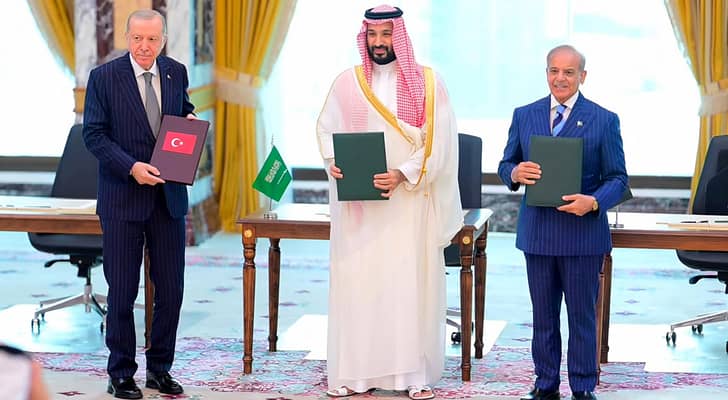
Day 162 | Saudi Arabia, Turkey, Pakistan sign defence pact amid regional war
Saudi Arabia, Turkey and Pakistan signed a joint defence agreement on Friday amid violence in the region from Houthi attacks and the US-Iran war.
Riyadh is looking to strengthen its security ties against the backdrop of war between the United States and Iran, which has drawn in surrounding nations and disrupted shipping through the Strait of Hormuz and the Red Sea.
The war has emboldened Iran and its Houthi allies in Yemen, both of which have attacked Saudi Arabia, while analysts say Washington is now seen as an increasingly unreliable partner.
In a joint statement published by the official Saudi press agency and Pakistan's foreign ministry, the three countries announced the signing of the "Mecca Joint Defence Agreement".
They declared a "shared commitment to further strengthening their collective security and to promoting peace, security and stability in the region and beyond".
Pakistan's foreign ministry said the pact meant an attack on any member would be regarded as an attack on all, adding it was "intended to strengthen collective deterrence".
Ankara nonetheless said later that the agreement was "not aimed at any particular country", according to a post on X by the presidency's communications director.
It added that "the agreement is not in contradiction with the commitments of Turkey's existing international alliances, including those at the heart of NATO," according to a post on X by the government's anti-disinformation service.
Riyadh said "the agreement does not represent an effort to establish a military axis or a sectarian bloc".
Since the onset of the regional war, Saudi Arabia has grown closer to Turkey, Egypt and Pakistan, which have been pushing for mediation and a resolution to the conflict.
Thread ended
This live thread has ended. Follow our online coverage of day 163 of the war.
Read more: Day 163 | UAE says Iran targeted tanker as Oman cites progress in Hormuz talks
Iranian Supreme Leader urges media to avoid highlighting weaknesses
In an excerpt from his message marking the Iranian New Year (Nowruz 1405), Iran's Supreme Leader Mojtaba Khamenei urged national media outlets -regardless of their intellectual, political, or cultural differences- to strictly refrain from addressing or focusing on national weaknesses.
CENTCOM chief arrives in 'Israel' for military talks
The Commander of United States Central Command (CENTCOM) Admiral Brad Cooper has arrived in 'Israel' and is scheduled to meet with the military Chief of Staff Eyal Zamir, alongside senior military officials, according to a report by the 'Israeli' Public Broadcasting Corporation.
Iran's Pezeshkian says "war cannot continue forever"
- Pezeshkian sees opportunity for a deal through talks.
- Iran backs MoU as a peace framework.
- Says negotiations depend on US trust and progress.
- Rejects war, seeks rights and economic relief.
Iranian President Masoud Pezeshkian stated that current circumstances offer a viable opportunity to pursue a negotiated settlement and address outstanding issues, calling the present moment the optimal time to reach an agreement due to national cohesion, strength, and unity.
In a series of statements outlining Tehran's diplomatic stance, Iran's President Pezeshkian emphasized that Iran is actively discussing daily strategy to manage diplomatic channels and move away from the ongoing state of "neither war nor peace".
"Current conditions can constitute an opportunity to continue the path of reaching an agreement and settling issues through talks," Pezeshkian stated. "I believe the current time is the best time for an agreement because there is cohesion, strength, and unity in the country."
Commitment to memorandum
Pezeshkian reaffirmed Tehran's determination to use the Memorandum of Understanding as the cornerstone for resolving the conflict, contingent on a shift in Washington's approach.
Addressing the character of the negotiations, Pezeshkian noted that while the United States is untrustworthy, Iran is attempting to achieve progress and address the underlying issues.
He made clear that Iran's participation will remain proportional.
"We will proceed in negotiations to the extent that the other party proceeds, and if no progress is shown, we will not accept its demands," Pezeshkian warned. "The opposing party must recognize and secure our rights, and we demand nothing except the rights of our country and our people."
Pezeshkian acknowledged the economic and societal hardships facing Iran, stating that his administration is working to ensure pressures on the public do not intensify severely amid current difficulties across all sectors.
Concluding his remarks, the Iranian President reiterated that lasting solutions require diplomacy rather than prolonged conflict.
"Issues are not resolved by war alone, and we seek to move forward on the path of peace based on the terms of the memorandum of understanding," Pezeshkian said. "You cannot fight forever; ultimately, the war must end at some point."
Iran signals maximum oil flow through Hormuz: Vance
- Vance says US will verify, not trust.
- US works on safe maritime traffic plan.
- Washington expects Gulf exports to recover.
US Vice President JD Vance revealed in an interview with Fox News that Iran has told US it will allow maximum oil flow through the strategic Strait of Hormuz, but stressed that Washington will refrain from trusting Tehran's assurances until they are proven on the water.
Vance characterized the regime in Tehran as feeling the strain of ongoing conflict and diplomatic pressure.
"They're HURTING, they want this to be OVER," Vance told Fox News.
Framework for safe navigation
To facilitate safe maritime passage through the critical energy corridor, Vance stated that the US is actively working on organizing operational guidelines for commercial shipping, which requires explicit security commitments from Tehran.
"We're working through how to set up a traffic scheme so the ships can pass through SAFELY," Vance said. "That INCLUDES Iran committing they won't fire at commercial vessels."
The US Vice President reiterated that the primary goal remains restoring global energy flows from the Persian Gulf to levels seen prior to the breakout of hostilities.
"We're in the middle of the game. This thing is not over...our expectation is the same oil and gas come out of the Gulf you saw before the conflict started," Vance stated. "The Iranians told us that...but we don't TRUST, we VERIFY."
Vessel struck by unknown projectile near Oman: UKMTO
- Fire broke out but was extinguished.
- Crew safe; no environmental impact reported.
- Investigation ongoing; ships advised caution.
The United Kingdom Maritime Trade Operations (UKMTO) issued a maritime attack warning (108-26) on Saturday, following an incident reported 18 nautical miles east of Khasab, Oman.
According to the verified advisory, a vessel operating in the area was struck by an unknown projectile. The impact caused an onboard fire, which has since been successfully extinguished.
Vessel, crew safe
UKMTO confirmed that both the vessel and its crew are reported as safe following the attack.
Additionally, there is no reported environmental impact resulting from the strike or the subsequent fire.
Investigation proceeds
Authorities are currently investigating the circumstances surrounding the attack.
In light of the incident, UKMTO advises all vessels transiting through the region to proceed with caution and to immediately report any suspicious activity to UKMTO.
'Israeli' soldier injured by friendly fire southern Lebanon
- 'Israeli' soldier injured in southern Lebanon.
- Soldier wounded by friendly fire in Al-Tiri.
An 'Israeli' soldier sustained injuries during ongoing military operations in southern Lebanon, according to reports published by 'Israeli' news outlets citing official military sources.
Citing the 'Israeli' military, The Times of 'Israel' reported that a soldier was injured in an accident that occurred during operational activity in the southern region of Lebanon.
Providing further details on the incident, 'Israeli' Army Radio reported that the injured serviceman is a member of the 607th Combat Engineering Battalion.
According to 'Israeli' Army Radio, the soldier was wounded as a result of friendly fire ("our forces' fire") during operations conducted in the town of Al-Tiri in southern Lebanon.
Iran says Hormuz agreement ‘very close’, accuses US of violating memorandum
Iranian Foreign Minister Abbas Araghchi said Tehran is “very close to an agreement” over the Strait of Hormuz, while accusing the United States of violating a memorandum of understanding previously reached in Pakistan.
Speaking at a news conference alongside President Masoud Pezeshkian, Araghchi said Iran had been implementing Clause 5 of the memorandum, under which maritime traffic was expected to return to normal within a month.
He said traffic had reached “60 percent of normal conditions within two weeks” before the United States sought to establish new routes through the strait despite warnings from Tehran.
Araghchi said negotiations are now focused on establishing a temporary shipping route before agreeing on a permanent route.
“Before reaching a new route, a temporary route will be considered as the basis for the main route,” he said, adding that talks had taken place between the two countries’ military and naval forces.
UAE says Iranian attack on tanker constitutes ‘flagrant violation’ of UN resolution
The United Arab Emirates has strongly condemned what it described as “Iranian aggression” against an ADNOC tanker while it was transiting the Strait of Hormuz.
In a statement, the UAE Foreign Ministry said the attack constituted a “flagrant violation” of UN Security Council Resolution 2817, which emphasizes freedom of navigation and rejects attacks on commercial vessels in international waters.
The ministry said targeting commercial shipping and using the Strait of Hormuz as a means of pressure or economic leverage amounted to piracy by Iran’s Islamic Revolutionary Guard Corps.
It warned that such actions pose a direct threat to regional stability and global energy security.
Iran's Pezeshkian says US violated Strait of Hormuz clause in memorandum
Iranian President Masoud Pezeshkian said the United States violated a clause concerning the Strait of Hormuz in a memorandum of understanding, adding that Tehran responded to the breach.
UAE-linked Adnoc vessel targeted by missile in Strait of Hormuz
A vessel operated by Abu Dhabi National Oil Company (ADNOC) was targeted by a missile while transiting the Strait of Hormuz on Saturday, the UAE state news agency WAM reported.
No further details were immediately available regarding the extent of the damage or whether any crew members were injured.
The incident comes amid heightened tensions in the Gulf and around the Strait of Hormuz, a key global energy transit route.
UAE authorities are assessing the circumstances of the incident and its potential impact on maritime security and energy shipments in the region.
Iran links Strait of Hormuz reopening to US concessions
Iran has tied the reopening of the Strait of Hormuz to the United States accepting Tehran’s conditions and ending what it described as interference in regional negotiations.
According to Iran’s Tasnim news agency, Revolutionary Guard spokesman Brig. Gen. Sardar Mohbi said the strait would “certainly” reopen once Washington accepts Iran’s demands.
Mohbi said the reopening is subject to mechanisms and conditions set by Tehran and is unrelated to negotiations between Iran and Oman.
“For us, the Strait of Hormuz is not merely an economic waterway, but an element of geographical and strategic power,” he said.
Adviser to Iran’s supreme leader says ‘foreign forces’ must leave region
Ali Akbar Velayati, adviser to Iran’s Supreme Leader on international affairs, has praised the Iranian armed forces, the Iranian people and what he called the “axis of resistance.”
In a post on X, Velayati said the “defeat of America” and ‘Israel’ had reinforced the belief that foreign forces are the “main factor of insecurity” in the region and should leave.
He said regional countries could ensure their own security through greater cooperation.
“Countries of the region, through increased cooperation among themselves, can ensure the region’s security,” Velayati said.
Houthi official says orders for action against Saudis not coming from Iran
A senior Houthi official has said the group does not need instructions from Iran to intensify military action against Saudi Arabia.
Speaking to CNN late Friday, Houthi politburo member Nasr al-Din Amer said what he described as Saudi aggression against the group was sufficient reason for military action against Riyadh.
Amer accused Saudi Arabia of imposing an economic and air blockade on Houthi-controlled areas of Yemen, saying the restrictions had contributed to what he called the world’s worst man-made humanitarian crisis.
“These reasons alone are sufficient to compel us to act more decisively than we have been doing. We do not need any other agendas,” Amer said.
Houthis claim preemptive strikes
Amer said recent Houthi strikes against Saudi forces were preemptive, claiming Riyadh had been preparing a ground operation against Houthi-controlled territory.
On Thursday, the Houthis claimed to have launched a “large-scale” operation targeting Saudi troops with ballistic missiles and drones in several parts of the country. The group did not provide evidence supporting the claim.
Reuters, citing Yemeni government sources, reported that at least 30 Yemeni government troops were killed in Houthi attacks on military camps.
The Houthis, which control large parts of western Yemen including the capital Sanaa, are among the region’s strongest Iran-backed armed groups. The group entered the wider war in March, a month after US and ‘Israeli’ attacks on Iran, by launching missiles toward ‘Israel’.
The Houthis have also been fighting Saudi Arabia for more than a decade, following their seizure of Sanaa and surrounding territory from Yemen’s Saudi-backed government.
Pezeshkian denies rift with Iran’s supreme leader
Iranian President Masoud Pezeshkian has denied reports of disagreements between his government, Supreme Leader Mojtaba Khamenei and the country’s armed forces.
In a televised interview released Friday by the presidency, Pezeshkian said claims of a rift were unfair to both the government and the supreme leader.
He said his administration had acted more closely than any previous government within the framework of the supreme leader’s policies.
Pezeshkian also rejected reports of disagreements between the government, armed forces and diplomatic apparatus over the war and negotiations, saying the government’s approach was “fully consistent” with the country’s military establishment.
At least three Palestinians injured by ‘Israeli’ gunfire north of Khan Younis
At least three Palestinians were injured by ‘Israeli’ gunfire north of Khan Younis in the southern Gaza Strip.
The circumstances surrounding the shooting and the condition of those injured were not immediately clear.
Iran allegedly receives hundreds of anti-aircraft shoulder-fired missiles from Russia and China
Iran has received hundreds of Chinese and Russian shoulder-fired surface-to-air missiles in recent weeks as it works to rebuild air defenses heavily damaged in its conflict with the United States and ‘Israel’, according to Iranian opposition leaders who spoke to the US-funded Arabic-speaking outlet Alhurra.
The opposition figures, from Kurdish and Ahwazi Arab groups, said the Islamic Revolutionary Guard Corps acquired three types of man-portable air defense systems (MANPADS).
These were distributed to military sites, urban centers, and border regions across Iran, with some transferred to allied armed groups in Iraq.
Hamid Motashar, head of the Ahwazi Liberal Party, said Iran received about 400 launchers of the Chinese QW-12 and FN-16 systems, along with ammunition and spare parts, in four air shipments from Urumqi in northwestern China via Pakistani airspace.
He stated the IRGC Aerospace Force deployed the systems in interior regions, including Ahvaz, to protect command centers and military installations.
Motashar also claimed Iranian forces used one of the Chinese systems to shoot down a US-made Lucas drone near Bandar Abbas on July 13.
Separately, three Kurdish opposition leaders reported that Iran received about 300 Russian-made 9K333 Verba MANPADS, with their missiles, in five small shipments delivered across the Caspian Sea.
These systems were deployed near military bases and sensitive facilities in Tehran, Kermanshah, Isfahan, Mashhad, the border with Iraq’s Kurdistan Region, and Iranian ports overlooking the Strait of Hormuz.
Negotiations for the Chinese systems reportedly began during Iranian Foreign Minister Abbas Araghchi’s visit to Beijing in May, accompanied by IRGC and Aerospace Force officials, with the deal signed in mid-June.
Tehran has sought to restore its air defenses since May after ‘Israeli’ Chief of Staff Eyal Zamir said in early March that ‘Israeli’ forces had destroyed about 80 percent of Iran’s air defense systems.
Earlier reporting by Reuters in late July indicated Iran was expected to receive up to 400 Chinese QW-12 and FN-16 MANPADS under a $60-70 million deal via a Hong Kong intermediary, with initial deliveries planned from Urumqi through Pakistan.
China dismissed that report as groundless, and Pakistan denied involvement.
Analyst Farzin Karbasi said Tehran is using ceasefire periods to repair sites and expand defenses with Chinese and Russian support, while also modifying drones with jet engines.
VIDEO - Iranian media footage of destroyed US aircraft
Footage released by Mehr News Agency, showing what they say are US drones and fighter jets destroyed by the IRGC aerospace force.
Top US general reportedly seeking “off-ramp” from Iran war
Chairman of the Joint Chiefs of Staff of the US military General Dan Caine has privately told senior Trump administration officials that the United States needs to find an exit from the ongoing war with Iran, warning that further escalation risks backfiring and that airpower alone is unlikely to achieve the president’s goals, according to three sources cited by CNN.
“Caine is looking for an off ramp,” one of the sources said bluntly.
The general has shared his concerns about limited military options with key figures including Vice President JD Vance, Secretary of State Marco Rubio, and CIA Director John Ratcliffe in recent weeks, aiming to coordinate messaging ahead of meetings with President Donald Trump.
Nearly six months into the conflict that began in late February 2026 with US and ‘Israeli’ strikes intended to prevent Iran from obtaining a nuclear weapon, Caine and other officials view the war as having reached a crossroads.
Trump has repeatedly signaled a preference for air campaigns over ground troops, but sources say Caine and allies privately doubt bombing will force Tehran into a favorable deal.
Caine has carefully raised potential downsides of escalation—including depleted US munitions stockpiles—while assuring Trump that forces could still “absolutely wreck them” if ordered to proceed.
One source described the approach as the general “protecting the military.” A White House official called Caine “an incredible asset” who provides accurate options, while his spokesperson declined to comment on confidential talks or anonymous characterizations.
Recent plans for more aggressive strikes were scaled back after concerns from Caine, Gulf allies worried about Iranian retaliation on energy infrastructure, and shortages of key munitions.
Trump has canceled or paused operations multiple times, most recently citing ally requests and claims of possible talks, though Iran has denied negotiations.
Publicly, Caine has stated that “airpower has its limits.”
Privately, he has been more direct that continued bombing of missile sites, energy targets, or infrastructure is unlikely to produce lasting results and could further alienate Iranians or strain US readiness for other threats.
Iranian oil exports stop as US blockade idles Kharg Island
No tankers have loaded crude at Kharg Island, Iran’s primary oil export terminal, for at least a week, according to recent shipping and satellite data, indicating that a renewed US naval blockade has effectively stopped Tehran’s crude sales.
The Financial Times reported the development on Friday, citing analysis from ship-tracking firms and maritime intelligence providers.
Operations at the island, which handles nearly 90 percent of Iran’s crude exports, halted on July 31, data from Kpler and Energy Aspects show.
Satellite imagery analyzed by Windward confirmed that all three loading berths had remained empty for an extended period.
On Tuesday, only 16 vessels were anchored nearby—the lowest number recorded since early last month.
The United States reimposed the naval blockade on Iranian ports in mid-July after an interim deal, mediated by Pakistan, to reopen the Strait of Hormuz collapsed.
The standstill marks one of the longest interruptions at Kharg since the broader conflict began earlier in 2026, during which Iran had continued loading tankers even amid hostilities.
“The blockade is effective, in the sense that there isn’t much tanker traffic going in or out,” said Richard Bronze, head of geopolitics at Energy Aspects.
He noted, however, that the revenue loss is unlikely to force rapid concessions from Tehran. “It’s pretty clear that the Iranians feel they have the upper hand when it comes to Hormuz, and they are willing to absorb a great deal of economic pain to exploit their advantage.”
United Against Nuclear Iran (UANI) reported that it has identified no tanker loaded with Iranian crude that successfully left the Gulf since July 12.
Iran is still collecting payments from earlier cargoes that departed during a prior ceasefire period and are now arriving near Malaysia for ship-to-ship transfers destined mainly for Chinese refineries.
Twenty-six Iranian-flagged tankers have recently reached those waters, according to the group.
Bronze observed that Tehran may even gain from higher oil prices on those remaining barrels in the short term, but warned that this revenue stream is finite.
“The sand is running out of the hourglass in terms of how long this will continue generating revenue,” he said.
The blockade is also preventing empty tankers from returning to Iranian waters after unloading in Asia, further constraining future loadings.
Storage tanks at Kharg have not filled significantly, Energy Aspects noted, suggesting Iran may already be reducing production at its fields to avoid overflowing capacity.
Brent crude traded just under $82 a barrel on Friday as markets awaited any breakthrough on Hormuz transit.
Iranian and Omani officials have discussed a possible new shipping route, but no concrete progress has materialized, and any viable deal could prompt the US to lift the blockade.


