
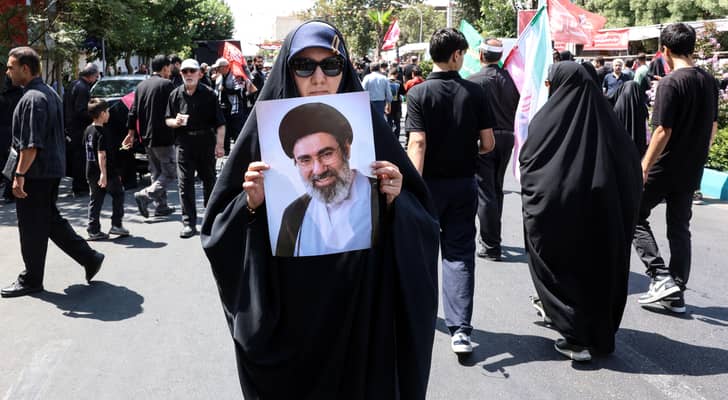
Iranian woman holds a portrait of Iranian supreme leader Ayatollah Mojtaba Khamenei in Tehran.

Day 161 | Iran threatened to “black out” Gulf if US hit power plants
Iran intensified its threats towards its Gulf neighbours last week, conveying messages that it would "black out" the entire region if the United States struck its power plants and rattling off a list of specific targets, two officials told AFP.
The warning followed threats by US President Donald Trump of a massive attack against Iran, which he later walked back over the weekend citing requests from Saudi Arabia, the UAE and Qatar and hope for a breakthrough in talks.
"Iran threatened to black out the Gulf, country by country, if Trump attacked its power plants," a Gulf official told AFP, with another regional official confirming the messaging.
Both spoke on condition of anonymity to discuss sensitive matters.
Trump said the planned strikes would have been "the biggest attack since World War II", with US media reporting he was considering hitting energy infrastructure, as he has repeatedly threatened to do.
Iran conveyed through intermediaries that any attacks on its power plants would trigger strikes on the same targets in the Gulf, the officials said.
It had publicly made such threats before, but the new one was "very serious", the Gulf official said, noting it included "a long list of targets they would attack".
In mid-July, Trump threatened to destroy an Iranian bridge or power plant for every attack on shipping in the Strait of Hormuz, with Tehran warning of an "eye for an eye" response.
The Gulf official said Iran's message said it would hit power plants and water desalination facilities, which the mostly desert region largely relies on for drinking water.
After Trump called off the strikes, Saudi Arabia announced that Crown Prince Mohammed Bin Salman had spoken to the US leader in a call aimed at reducing regional tensions.
The Gulf has borne the brunt of Iran's attacks during the Middle East war, with strikes targeting US assets as well as civilian infrastructure such as energy sites, ports and airports.
Sporadic attacks continued after a ceasefire and subsequent memorandum of understanding were agreed in April and June, respectively.
But the exchanges of fire increased in scale and regularity as the ceasefire fell apart in July, with strikes targeting mainly Kuwait and Bahrain.
Thread ended
This live thread has ended. Follow our online coverage of day 162 of the war.
Read more: Day 162 | Saudi Arabia, Turkey, Pakistan sign defence pact amid regional war
US imposes sanctions on Iran-linked digital asset entities
The US State Department says it has imposed sanctions on six entities and one individual it accuses of supporting Iran’s illicit digital asset activities.
A State Department spokesperson said the measures target networks that Washington claims help Iran evade restrictions and support activities threatening regional security, including attacks on vessels in the Strait of Hormuz.
The spokesperson said the US would continue efforts to deny Iran resources it claims are used to threaten neighboring countries, target shipping, support armed groups, and advance nuclear ambitions.
Washington also announced a reward of up to $15 million for information that helps disrupt the financial mechanisms of Iran’s Islamic Revolutionary Guard Corps (IRGC) and its affiliated networks.
Pezeshkian denies rift between Iran's government, military
Iranian President Masoud Pezeshkian has denied reports of tensions between the government and the country's armed forces, saying Tehran remains united despite internal challenges.
"There is no disagreement between the government and our armed forces," Pezeshkian said.
He acknowledged that Iran faces domestic challenges and differing viewpoints but said such differences were natural.
"We have challenges inside the country, and there are different points of view. It is natural that America and Israel would try to exploit that," he said.
Pezeshkian added that Iran has resolved many issues with neighboring countries, saying relations have become "much better."
The Iranian president also defended the country's memorandum of understanding, saying the government strongly supports it.
"Those inside our country who describe it as a defeat are repeating what Israel wants," he said.
US announces measures targeting ‘financial lifelines of Iran’s ruling elite’
The US government says it has taken steps to dismantle what it describes as a network of currency exchange houses and shell companies allegedly used by Iran to evade sanctions and move hundreds of millions of dollars.
In a statement, US State Department spokesman Tommy Pigott said the US Treasury had taken action against the "illicit" financial networks, but did not identify the entities involved.
Pigott said the measures reflect the Trump administration's continued "maximum pressure" campaign, which aims to cut off resources that Washington claims Iran uses to threaten regional stability, support armed groups, and strengthen its military capabilities.
Iran has previously rejected similar US accusations, describing Washington's sanctions as unlawful and politically motivated.
Yemen’s Houthis claim attack on Marib hit Saudi-backed forces, military equipment
Houthi military spokesperson Yahya Saree says Houthi forces carried out attacks targeting Saudi-backed forces, military depots and equipment near Yemen’s central city of Marib.
In a statement posted on Telegram, Saree said the group would continue to target what he described as Saudi military mobilisations and forces supporting the siege on Yemen.
The statement came after Yemen’s internationally recognized government said Houthi attacks on Marib killed at least two civilians and injured 14 others.
ADNOC says 15 vessels attacked since start of war, including three this week
The Abu Dhabi National Oil Company (ADNOC) says 15 of its vessels have come under attack since the start of the US-‘Israeli’ war against Iran, including three incidents reported this week.
The company said the attacks killed one crew member and injured 20 others, adding that it is taking “all necessary measures” to protect its personnel, assets and operations.
In a media statement, ADNOC called for the protection of freedom of navigation and the safe, uninterrupted movement of commercial shipping through international waterways.
Iranian MP dismisses Saudi security pact with Pakistan, Turkiye
An Iranian lawmaker has criticized the reported security agreement between Saudi Arabia, Pakistan, and Turkiye, arguing that it will not provide lasting security for Riyadh.
Ebrahim Rezaei, a member of Iran's Parliament and the National Security and Foreign Policy Commission, made the remarks in a post on X on Friday, calling on Saudi Arabia to reconsider its regional approach.
"Saudis must know that a paper agreement with Turkiye and Pakistan will not bring them security, just as years of one-sided nursing to the Americans did not bring them security," Rezaei wrote.
He added: "Reform your policies so that you do not need to beg for security from others."
Rezaei's comments came amid heightened regional attention over the reported defense cooperation framework involving Saudi Arabia, Pakistan, and Turkiye.
Iranian official says Hormuz framework has been agreed with Oman
An Iranian official says Tehran and Oman have agreed on a framework of understanding regarding the Strait of Hormuz, according to state media.
Hassan Ghashghavi, a member of parliament and spokesman for the Iranian Parliament's National Security Commission, told the official IRNA news agency that the general framework of the agreement has been finalized, with the final text and details to be announced soon.
Ghashghavi added that the agreement still requires approval at higher levels before it is finalized. The announcement comes amid ongoing regional attention on the strategic waterway, a key route for global oil shipments.
Two killed, 14 wounded in Houthi strikes on Marib, says Yemen’s health minister
Two civilians were killed and 14 others were injured in Houthi attacks targeting the central Yemeni city of Marib, according to Yemen's internationally recognized government.
Health Minister Qasim Buhaibeh said the casualty toll is preliminary, indicating that the number of victims could change as authorities continue to assess the aftermath of the attacks.
Earlier, Yemeni state media reported that the army intercepted and shot down multiple Houthi drones launched toward Marib. Explosions were reported in the area during the aerial assault.
Lebanese soldier wounded in 'Israeli' attack on army bulldozer
A Lebanese soldier was slightly wounded after an 'Israeli' attack targeted an army bulldozer in the southern town of al-Mansouri, the Lebanese army said.
The bulldozer was clearing roads and removing rubble when it came under attack, according to Lebanon's National News Agency (NNA).
Mossad chief sacks two senior officials over failed Iran “regime-change” plan
‘Israel’s’ Mossad director Roman Gofman has fired two of the spy agency’s most senior officials linked to an ambitious but unrealized plan to topple Iran’s Islamic leadership, according to a Hebrew Channel 12 report.
The officials are the head of the Mossad’s Intelligence Directorate, who took up the post in December, and the head of the agency’s Iran Division.
Neither was named in the report.
Security sources told Channel 12 that the pair had conceived and drafted the covert proposal, which was presented to US President Donald Trump.
The plan envisioned Kurdish ground forces entering Iran under heavy ‘Israeli’ and American air cover, with Iranian minority groups helping to oust the clerical leadership and install alternative figures.
Reports earlier indicated that former Iranian president Mahmoud Ahmadinejad had been discussed as a potential successor, though that element reportedly unraveled after an ‘Israeli’ strike intended to free him from house arrest wounded him and prompted doubts.
Gofman, who assumed the role in early June 2026 after serving as Prime Minister Benjamin Netanyahu’s military secretary, is said to have held the officials accountable because the plan was never executed on the ground as intended.
Officials framed the departures as mutual agreements stemming from poor working chemistry with the new director from the outset, describing them as part of a broader reorganization of the Mossad.
Both individuals are expected to remain in the agency in other capacities.
The Channel 12 report stressed that the two officials had made “invaluable contributions to Israel’s security.”
One source critical of the decision noted that Gofman himself had been a key supporter of what it called “regime-change” efforts against Tehran.
The moves come amid ongoing regional tensions and follow earlier leadership changes at the agency, including the earlier departure of the longtime deputy director.
At Gofman’s inauguration, Netanyahu told the new director that he would “remove Iran’s regime from the world.”
Gofman himself has spoken of the Iranian “Shiite axis” having suffered significant blows and has reportedly explored new approaches to undermine Tehran’s government.
Ghalibaf mocks Trump’s “theater diplomacy”
Iranian Parliament Speaker and chief negotiator Mohammad Bagher Ghalibaf on Thursday criticized US President Donald Trump’s approach to talks with Tehran, calling it repetitive “theater diplomacy.”
In a post on X, Ghalibaf wrote: “‘Massive attack coming… wait, never mind, they want to negotiate.’ That’s theater diplomacy on loop. Using bullying + broken promises + fake news as leverage is a failed strategy. Acknowledge the facts and fulfill your commitments. We don’t need more theater.”
The remarks come amid fragile US-Iran negotiations following a June 2026 memorandum of understanding that paused hostilities after earlier fighting.
Disputes persist over Strait of Hormuz transit, nuclear issues, sanctions relief, and regional security, with Trump repeatedly threatening major strikes before citing progress in talks and holding off.
“Massive attack coming… wait, never mind, they want to negotiate.”
— محمدباقر قالیباف | MB Ghalibaf (@mb_ghalibaf) August 6, 2026
That’s theater diplomacy on loop.
Using bullying + broken promises + fake news as leverage is a failed strategy.
Acknowledge the facts and fulfill your commitments. We don’t need more theater.
Saudi Arabia, Turkey, Pakistan to sign joint defense pact: AFP
Saudi Crown Prince Mohammed bin Salman, Turkish President Recep Tayyip Erdoğan, and Pakistani Prime Minister Shehbaz Sharif are set to sign a joint defense agreement in Jeddah on Friday, a source close to the Saudi military told AFP, as regional tensions continue to rise.
Speculation has been mounting for months that the three Sunni Muslim countries are seeking to form a stronger alliance amid growing instability across the region.
The source, who spoke on condition of anonymity because they were not authorized to speak to the media, said: "Saudi Arabia, Pakistan, and Turkey will sign a joint defense agreement in Jeddah on Friday."
The source added: "This has been under discussion for a long time, but recent developments in the region have accelerated the process."
Sharif and Pakistan's Army Chief, Asim Munir, arrived in Saudi Arabia on Thursday for a visit lasting until Saturday, while Erdoğan is scheduled to arrive on Friday, according to the Turkish presidency.
Saudi Arabia and Pakistan are already bound by a joint defense agreement announced in 2025.
The deal sparked widespread speculation, particularly over whether it could include a clause related to nuclear cooperation, given that Islamabad possesses nuclear weapons.
Last January, a source close to the Saudi military told AFP that Turkey would not join the Saudi-Pakistan defense agreement, after a Turkish official indicated at the time that Ankara was holding talks to join the alliance.
Saudi Arabia braces for “imminent” coordinated attack by Iran-backed groups: Reuters
Saudi Arabia expects imminent coordinated attacks from both its northern and southern borders by Iraqi armed groups and Yemen’s Houthis, operating under the supervision of Iran’s Islamic Revolutionary Guard Corps, an unidentified senior Saudi official said on Thursday, cited by Reuters.
Speaking on condition of anonymity, the official cited intelligence reports from Saudi Arabia, the United States and other regional countries indicating that civilian and economic sites could be targeted.
These include energy infrastructure, ports and airports. Saudi authorities have also observed the movement of drones and missiles, pointing to coordinated operations from both directions.
The official described the reported threats as particularly alarming at a time when Riyadh continues to pursue de-escalation and a negotiated settlement.
Contacts with all parties, including Iran, and mediation efforts “appeared to be moving in the right direction,” the official said, adding that the planned attacks could be intended to disrupt those diplomatic efforts.
Saudi-US cooperation remains “very high” at all levels, including operationally with US Central Command, according to the official, who stated that the kingdom is prepared to take all necessary measures to respond to any aggression.
Tensions have escalated sharply in recent weeks.
On July 29, Saudi Arabia conducted joint strikes with US Central Command against Iran-backed groups in Iraq after blaming them for drone attacks on Saudi oil facilities.
The Iraqi groups vowed to respond.
From the south, Yemen’s Houthis imposed what they call a naval blockade on the kingdom in the Red Sea and claimed a series of attacks on Saudi shipping and military targets.
Saudi forces have answered with strikes on military sites in Yemen.
Earlier assessments by Saudi Arabia and regional partners indicated that Houthi fighters had already joined Iraqi armed groups in launching attacks from Iraqi territory against Saudi oil facilities in the kingdom’s eastern province, the main crude-producing hub.
Those operations, officials said, were supervised by the IRGC, reflecting deepening coordination among Iran-aligned groups.
Saudi-led coalition says 11 civilians injured in Houthi attack
Eleven civilians were injured in a Houthi “projectile” attack targeting civilian areas in Saudi Arabia's Najran region, the Saudi-led coalition said on Friday.
According to the coalition, seven of the injured are Saudi nationals, including a woman and a child.
The remaining casualties include one Yemeni national, two Egyptian nationals and one Pakistani national.
The coalition accused the Houthis of firing “indiscriminate projectiles” at civilian sites, describing the attack as a "terrorist" act and a flagrant violation of international humanitarian law and customary international law.
It added that it would continue taking "deterrent measures" against Houthi attacks to protect civilians.
Previous day
For coverage of the previous day, visit the link below.
Read more: Day 160 | Iran, Oman agree on Strait of Hormuz shipping route


