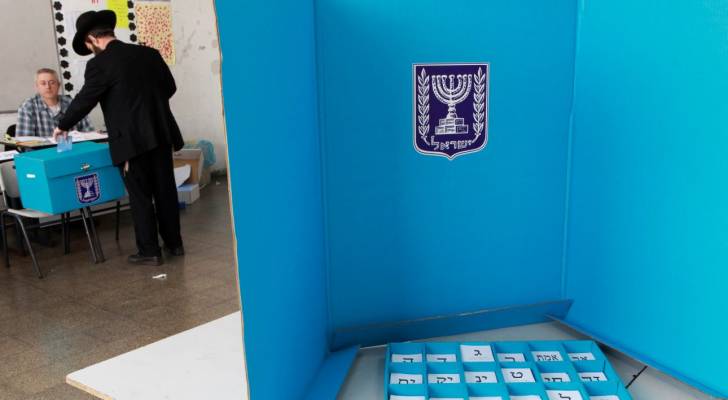
Ahead of 'Israeli' elections, poll projects war deadlock
Note: AI technology was used to generate this article’s audio.
- Majority doubt victory in Gaza and disarmament.
- Most voters rate Defense Minister Katz negatively.
- 51% of voters support resuming war against Iran.
A new survey conducted by Midgam for 'Israel's' Channel 12 ahead of the October 27 Knesset elections shows the anti-Netanyahu Zionist opposition camp just short of a parliamentary majority.
In the primary baseline scenario, the Zionist opposition parties win 56 seats, while 'Israeli' PM Benjamin Netanyahu's coalition bloc receives 50 seats.
The centrist Zionist Home list (led by Chili Tropper and Yoaz Hendel) garners 4 seats, while the Arab-majority parties Ra'am and Hadash-Ta'al secure 5 seats each.
Because Zionist Home has indicated it would join an anti-Netanyahu Zionist coalition, the Zionist opposition bloc reaches 60 seats, one seat shy of the 61 needed for a majority in the 120-member Knesset.
Potential alignment
The survey tested a second scenario involving a potential joint effort between Yesh Atid MK Yoav Segalovitz and the Arab party Ra'am.
In this scenario, The Democrats drop by one seat to 9, while Ra'am gains one seat to reach 6.
This shift brings the Zionist opposition to 55 seats, while Netanyahu's bloc remains at 50, Zionist Home stays at 4, and Ra'am rises to 6.
Segalovitz has indicated he would join Ra'am only if the party recognizes 'Israel' as a Jewish and democratic state and supports civil service for Arab citizens as an alternative to military draft.
If these conditions were met and Zionist opposition leaders agreed to include Ra'am, the anti-Netanyahu bloc would reach 65 seats.
However, front-runner Gadi Eisenkot and former Prime Minister Naftali Bennett have both indicated they would not bring Ra'am into a coalition, even though Bennett previously included Ra'am in his 2021–2022 governing coalition.
The poll's minimal shift suggests voters were likely not informed during questioning that Ra'am would have recognized 'Israel' as a Jewish state under this scenario.
Skepticism on war goals
When asked who is best suited for Prime Minister, respondents placed Netanyahu and Eisenkot in a direct tie at 37% each.
In a separate matchup, Netanyahu leads Naftali Bennett by a narrow margin of 38% to 37%.
On regional policy, public opinion remains split regarding Iran:
- 35% believe the threat from Iran has lessened as a result of 'Israeli' policy.
- 28% believe the threat is unchanged.
- 27% believe the threat has grown.
- 51% favor renewing the war against Iran, compared to 34% who are opposed.
The surveys also found that 62% of respondents do not believe 'Israel' will ever achieve Netanyahu’s promised “total victory” in Gaza, compared to 25% who do.
Large majorities also do not believe that Hamas or Hezbollah will ever agree to disarm — by 63% to 23% as regards Hezbollah; 72% to 18% as regards Hamas.
Low marks for Defense Minister
The survey evaluated public approval of Defense Minister Israel Katz, with 57% giving him a "bad" grade for his performance, compared to 34% who rated it "good".
Additionally, 47% of respondents viewed Katz's attempt to remove 'Israeli' military Central Command chief Maj. Gen. Avi Bluth as inappropriate, while only 17% deemed the attempt appropriate.
The Midgam survey polled 503 respondents and carries a 4.4% margin of error.