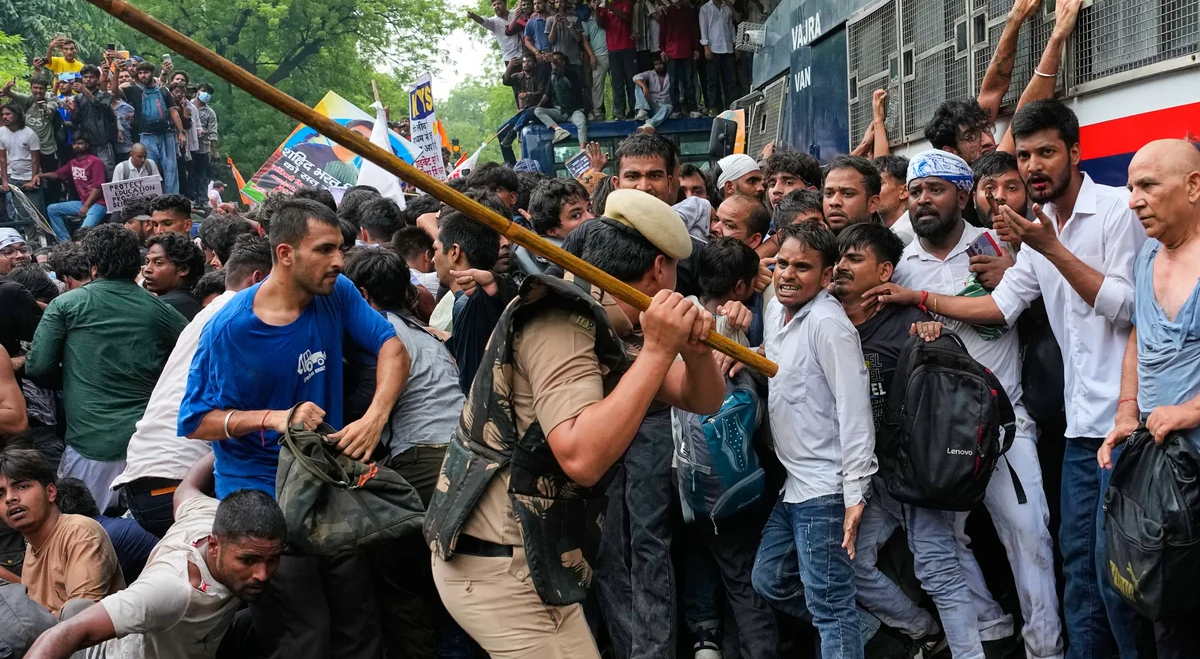
Police clash with student protesters in New Delhi over exam leak outrage
Note: AI technology was used to generate this article’s audio.
Violent clashes erupted in India's capital on Monday after thousands of students attempted to march toward Parliament to protest examination scandals, with riot police firing tear gas, using water cannons, and carrying out baton charges.
The confrontation, centered around Jantar Mantar in New Delhi, marked the largest street demonstration in the capital in five years and coincided with the opening day of Parliament's monsoon session.
The protests were organized by the youth-led Cockroach Janta Party (CJP) movement, which emerged online in May and has since grown into a nationwide campaign demanding accountability over alleged examination irregularities, including the leak of the NEET-UG medical entrance exam paper that forced more than two million candidates to retake the test.
Police deploy tear gas, batons
Authorities blocked roads leading to Parliament with multiple layers of steel barricades, citing security measures and prohibitory orders in place around the parliamentary complex.
Police said protesters attempted to breach the barricades and refused repeated orders to disperse. Security forces responded by firing tear gas, deploying water cannons, and carrying out baton charges.
As the clashes intensified, some demonstrators threw stones at police.
More than 100 people, including police officers and protesters, were reportedly injured during the violence.
Rights groups, including Amnesty International, questioned the "legality, necessity, and proportionality" of the police response.
Protest movement gains momentum
Despite the crackdown, demonstrators continued gathering at Jantar Mantar on Wednesday, with crowds swelling to several thousand, according to AFP correspondents.
The movement has spread beyond New Delhi, with demonstrations taking place in cities including Mumbai, Bengaluru, and Patna, where police also used tear gas and water cannons to disperse protesters.
Opposition lawmakers, including Rahul Gandhi of the Congress Party, condemned the police action and demanded the government apologize for Monday's crackdown. Gandhi told reporters that students had his full support and pledged to defend their future.
Students demand accountability
The protests were sparked by a series of examination controversies, most notably the leak of India's NEET-UG medical entrance examination paper. Demonstrators are demanding the resignation of Education Minister Dharmendra Pradhan, accusing the government of failing to protect the integrity of the country's examination system.
In his first public remarks since the clashes, Pradhan said the government remained committed to reform and addressing students' concerns.
"We owe them answers, reforms and accountability," he said in a social media post, adding that students deserve "certainty over chaos, solutions over slogans and responsibility over disruption."
Police remain heavily deployed around Jantar Mantar as protesters continue their sit-in, vowing to maintain pressure on the government until their demands are met.
Modi defends education minister
Critics say Prime Minister Narendra Modi's refusal to dismiss Education Minister Dharmendra Pradhan despite mounting protests over repeated exam paper leaks follows a long-established pattern of resisting calls to sack senior ministers embroiled in controversy.
Since taking office in 2014, Modi has largely stood by cabinet members facing public outrage over issues ranging from mob lynchings and student protests to deadly violence and other major controversies, with opponents arguing that his government rarely holds ministers politically accountable.
The current student-led protests have intensified demands for Pradhan's resignation, but Modi has given no indication he will remove him, reinforcing what critics describe as his reluctance to yield to public or opposition pressure.