
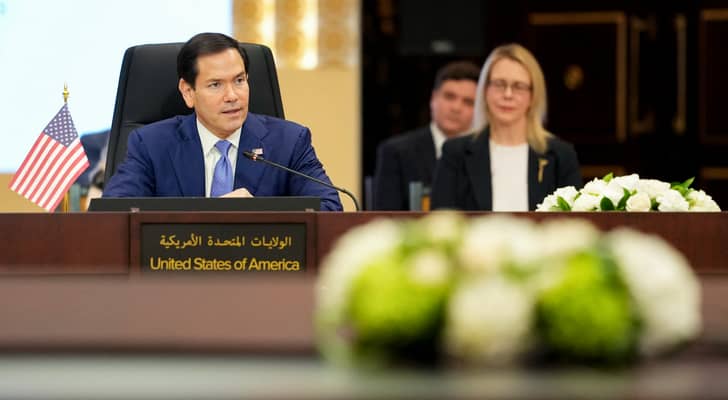
US Secretary of State Marco Rubio speaks during a meeting with foreign ministers of the Gulf Cooperation Council Member States in Manama.

Day 119 | US says wants deal with Iran, but not “at any price”
Top US diplomat Marco Rubio said Thursday that there were limits to what Washington would accept in any deal with Iran, warning that permitting Tehran to charge fees in the Strait of Hormuz would open the door to "total chaos".
Rubio was in Bahrain as part of a regional tour to reassure Gulf partners hit hard by Iran during the Middle East war, which began on February 28 with a massive US-‘Israeli’ campaign of strikes against the Islamic republic.
The United States and Iran have signed a preliminary deal to end the conflict, embarking on negotiations expected to touch on thorny issues including Tehran's nuclear programme, sanctions relief and global energy flows through the Hormuz.
But the Gulf and ‘Israel’ also have longstanding concerns about Iran's support for its allies in the region and its missile programme, and it remains unclear whether those topics will be addressed in the talks.
After meeting with Rubio on Thursday, foreign ministers from the Gulf Cooperation Council emphasised that "lasting regional peace and security requires addressing the full spectrum of Iran's threats, including its ballistic missiles, drones and support of proxies".
Earlier, Rubio had acknowledged that while the US wants "a deal, we don't want a deal at any price".
"We want to ensure... that there is no part of this deal that's undertaken that in any way undermines the security, the stability or the prosperity of any of our partners in the Gulf region," he added.
Rubio also sought to reassure the energy-rich Gulf states that the Hormuz strait, which they have relied on for decades to export oil and liquefied natural gas, would remain toll-free.
The Revolutionary Guards on Thursday warned that any unauthorised crossings would be "dealt with".
The US and its allies have flatly rejected the introduction of fees or tolls, with Rubio reiterating Washington's position that Hormuz should be considered an international waterway and therefore not subject to charges.
Thread ended
This live thread has ended. Follow our online coverage of day 120 of the war.
Read more: Day 120 | US strikes Iran targets after attack on cargo ship
US launches strikes on Iranian targets after Hormuz drone attack
- The operation targeted missile, drone, and coastal radar sites.
- The action followed a June 25 drone strike on the M/V Ever Lovely.
- CENTCOM called the attack a ceasefire violation and a threat to maritime navigation.
US Central Command forces executed a series of military strikes against targets inside Iran on Friday.
The high-profile aerial campaign serves as a direct, powerful retaliation for an unprovoked drone assault launched by Iranian forces against a commercial shipping vessel transiting the strategic Strait of Hormuz a day prior.
American combat aircraft focused their firepower on disabling critical military infrastructure, successfully striking multiple Iranian missile and drone storage facilities, as well as several coastal radar stations along the strategic corridor.
Targeting M/V Ever Lovely
The Pentagon's decision to launch retaliatory strikes follows a maritime crisis on June 25, when an Iranian one-way attack drone directly struck the commercial cargo ship M/V Ever Lovely.
The vessel, a large Singapore-flagged cargo container, was targeted while exiting the Strait of Hormuz along the Omani coast.
While the vessel sustained damage from the exploding munition, maritime logs indicate it was able to maintain propulsion and continue along its path.
CENTCOM officials immediately classified the drone strike as an unwarranted act of aggression against neutral international commerce.
— U.S. Central Command (@CENTCOM) June 26, 2026
Ceasefire violation
Defense officials emphasized that the Iranian military's actions represent a flagrant breach of international maritime norms and standing diplomatic arrangements between Washington and Tehran.
"The unwarranted aggression against commercial shipping by Iranian forces clearly violated the ceasefire," CENTCOM stated in an official release. Military leadership added that Tehran's dangerous behavior directly undermined the core principles of global freedom of navigation at a time when international commerce is heavily dependent on the vital trade lane.
In the wake of the kinetic exchange, CENTCOM confirmed that American naval and air forces have intensified their presence in the region.
US assets are currently providing direct safe-passage coordination and security support to civilian cargo carriers moving through the strait.
The Pentagon warned that its forces will remain highly vigilant and heavily deployed to ensure that every aspect of the ceasefire agreement with Iran is strictly obeyed and kept in full effect.
US military launches targeted strikes in the Strait of Hormuz, U.S. official tells Axios
According to Axios Correspondent, citing an American official, the United States military has launched a series of dynamic strikes in the strategic Strait of Hormuz, following repeated drone attacks against commercial shipping vessels in the vital global maritime corridor.
Explosion rocks southern Iran near Strait of Hormuz
An explosion of unknown origin detonated in the Taheriyeh area of Sirik, a southern Iranian coastal city situated along the highly strategic Strait of Hormuz, state television reported.
Iranian authorities confirmed that the precise source and cause of the blast remain entirely unknown as emergency teams investigate the maritime sector.
Trump warns of imminent response to Iranian drone strike in Hormuz
US President Donald Trump sharply condemned Iran for targeting a commercial vessel in the Strait of Hormuz on Thursday, warning that Tehran "should not have done that" and adding that the world will learn of the United States' response very soon.
Lebanese President thanks US President for hosting talks
- Joseph Aoun welcomes the Washington framework deal as a step toward restoring full Lebanese sovereignty.
- Praises Lebanese negotiating teams for their work on the agreement.
- Honors Lebanese citizens for their resilience during war and displacement.
Lebanese President Joseph Aoun released a comprehensive official address following the signing of the historic border treaty in Washington, D.C., framing the accord as a triumph for national independence.
Aoun extended his direct appreciation to the United States administration, specifically thanking President Donald Trump for the critical diplomatic role Washington played in hosting, sponsoring, and guiding the difficult negotiation track to its successful conclusion.
"The framework agreement signed today is the beginning of the road to harvest the fruits of our people's sacrifices," Aoun stated via the presidency's official communication channels.
Aoun emphasized his absolute commitment to building a future where the central government maintains an exclusive monopoly on authority, free from occupation, captivity, dependency, or foreign guardianship.
توجه الرئيس جوزاف عون الى الادارة الاميركية وعلى رأسها الرئيس دونالد ترامب، بالشكر على ما بذل من جهود في استضافة المفاوضات ورعايتها ودعم موقف لبنان للوصول إلى الخطوة التي أعلنت اليوم.
— Lebanese Presidency (@LBpresidency) June 26, 2026
كما شكر جميع الدول الشقيقة والصديقة التي رافقتنا خلال هذه المفاوضات الصعبة، داعمة مواقف الدولة…
Honoring negotiators public resilience
Aoun lauded the exhaustive precision displayed by the Lebanese negotiating delegation throughout the arduous bilateral process.
He expressed his deep admiration for the committee of military officers and career diplomats stationed in Washington and Beirut, praising them for reviewing the text meticulously, "moment by moment and word by word," to safeguard the legal rights of the state.
Aoun then turned his attention to the domestic front, dedicating a significant portion of his address to honoring the resilience of the civilian population.
He praised the profound national solidarity displayed by citizens who absorbed the harshest conditions of military aggression, mass displacement, and infrastructural destruction.
Aoun emphasized that the unity shown during the peak of the crisis proved that the populace stands as "one people under a single flag."
Pledge for territorial liberation
Looking forward to the execution phase of the Washington framework, Aoun issued a solemn national vow to complete the restoration of Lebanese administrative control.
He promised displaced families that they would inevitably return to their liberated lands and completely rebuild their homes with dignity.
"We swear to continue working until this is fully achieved," Aoun declared, affirming that the ultimate goal of his administration remains the realization of an independent state that tolerates no partners in its sovereignty over its territory and its people.
The Lebanese presidency concluded by stating that this territorial integrity is a binding covenant and a fundamental duty shared by every free and responsible citizen in Lebanon.
Netanyahu claims Lebanon framework agreement 'major victory'
-
Netanyahu says Hezbollah members and displaced residents will not return to the security belt.
'Israeli' Prime Minister Benjamin Netanyahu praised the newly signed Washington framework agreement on Friday, characterizing it as a historic achievement that systematically dismantles Iran's strategic ambitions in the Levant.
Following the diplomatic breakthrough in the United States, Netanyahu emphasized that the treaty codifies 'Israel's' long-term security requirements while permanently severing Tehran's leverage over Beirut.
"We have achieved a great accomplishment for 'Israel'," Netanyahu stated. "This framework agreement is a powerful blow to Iran, which persistently attempted to force a unilateral withdrawal upon us from southern Lebanon."
Enforcing security belt, civilian bans
Netanyahu drew an uncompromising line regarding 'Israel's' immediate military deployment along the northern frontier, clarifying that the signing of the framework does not mean an immediate exit for 'Israeli' ground forces.
The prime minister asserted that the 'Israeli' military will maintain its absolute presence within the southern Lebanon security belt until a total disarmament of Hezbollah is achieved.
Furthermore, Netanyahu announced strict rules of engagement regarding the demographics of the buffer zone under their supervision.
"We will not allow the return of Lebanese residents or Hezbollah to the security belt area currently under our control," Netanyahu declared, establishing a strict exclusion zone along the immediate border.
Two pilot zones
Detailing the tactical transfer of territory to the central government in Beirut, Netanyahu outlined the precise boundaries of the conditional "pilot zones" designed to test the Lebanese Armed Forces (LAF).
According to the prime minister, 'Israel' will allow the Lebanese army to assume administrative and security control over exactly two designated testing sectors.
He clarified the strategic rationale behind their selection: the first pilot zone is located entirely outside 'Israel's' active security belt, while the second sits within an expanded perimeter that the 'Israeli' military has determined it has no operational desire to occupy.
Netanyahu concluded by emphasizing that the framework legally ensures that neither Iran nor Hezbollah will have any future role or influence in the sovereign governance of Lebanon, positioning the deal as a total restructuring of northern border dynamics.
'Israel' to remain in 'Yellow Line' until Hezbollah disarmament: Hebrew media
- 'Israel' and Lebanon are nearing a US-mediated framework agreement.
- Draft includes mutual recognition of sovereignty.
- 'Israeli' forces would withdraw from select areas as the Lebanese army takes control.
'Israel' and Lebanon are on the verge of signing a historic framework agreement at the White House to formally de-escalate the border conflict.
According to 'Israeli' Army Radio and diplomatic sources close to the negotiations, the bilateral treaty will be finalized within Friday, marking a major geopolitical shift in the Levant.
A core component of the agreement includes a mutual diplomatic pledge, with both nations signing an explicit, binding recognition of each other's territorial sovereignty.
According to sources thoroughly briefed on the parameters of the text, 'Israel' has agreed to a series of coordinated military pullbacks from southern Lebanon.
However, these redeployments are structured around a highly conditional "pilot program" rather than an immediate or total evacuation.
Under this joint framework, the Lebanese Armed Forces (LAF) will progressively enter designated model zones to assume full administrative and combat control.
The deployment serves as a direct test of Beirut's capability to secure the frontier and suppress non-state military factions.
Progress regarding the "pilot zones" and the joint operational framework has advanced rapidly in Washington, and negotiators are currently waiting for the final signatures from leadership in Beirut, 'Tel Aviv', and Washington to activate the timeline.
Despite the phased withdrawal mechanism, the agreement guarantees a substantial 'Israeli' military footprint inside Lebanon for the foreseeable future.
Reports from 'Israel's' Channel 12 News confirmed that the treaty explicitly permits 'Israeli' forces to remain entrenched within the strategic "Yellow Line" border sector.
According to the channel's defense sources, the duration of the 'Israeli' presence inside the Yellow Line is tied directly to a strict security metric.
Troops will not vacate the zone until Hezbollah is completely stripped of its weapons infrastructure.
This clause addresses 'Tel Aviv's' core demand for a long-term buffer mechanism, ensuring that its military retains a physical presence to police the border until the central government in Beirut successfully achieves the total disarmament of independent militias in the south.
'Israel', Lebanon reach framework agreement: Axios
According to Axios, citing both 'Israeli' and Lebanese officials, a formal framework agreement has been successfully reached between 'Israel' and Lebanon to resolve the ongoing military standoff.
Trump says Iran launched four drones at ships in Hormuz
- One drone hit a commercial cargo ship, causing limited damage.
- US forces intercepted the other three drones.
- Trump called the attack a ceasefire violation.
US President Donald Trump announced on Truth Social Iran targeted maritime traffic in the Strait of Hormuz by launching at least four one-way attack drones at traversing vessels.
One of the loitering munitions directly struck the upper deck of a large, expensive cargo ship.
While the strike caused physical damage to the structure, the vessel remained operational and was able to safely proceed along its shipping route.
United States military forces responded to the aerial assault by successfully knocking down the three other incoming drones before they could impact their targets.
Trump did not disclose the specific identities or flags of the targeted commercial vessels but heavily criticized Tehran for the maritime escalation.
"Obviously, this is a foolish violation of our Ceasefire Agreement," Trump stated.
The drone strikes represent a direct challenge to the recently established diplomatic framework intended to halt hostilities between Washington and Tehran.
Sources to Roya: "Pilot zones" remain key disputes in Lebanon-'Israel' talks
- 'Israel' seeks a permanent military presence in parts of southern Lebanon.
- Proposal would transfer some areas to the Lebanese army in phases.
- Lebanon rejects 'Israeli' demand for unilateral military intervention rights.
High-level political sources revealed on Friday that the current diplomatic track between Lebanon and 'Israel' has hit critical bottlenecks. The primary disputes center directly on the geographic boundaries of a proposed northern buffer zone and the operational mechanism behind localized "pilot zones."
According to detailed information provided to Roya News, the negotiations have stalled over how and when territorial control along the border will be transferred, as well as 'Israel's' demand to maintain a long-term military footprint inside sovereign Lebanese territory.
10-kilometer buffer zone
The most significant point of contention remains 'Israel's' absolute insistence on keeping its military forces stationed within a newly proposed northern buffer zone.
Political sources confirmed that 'Israel' wants this buffer zone to carve deep into the frontier, extending approximately 10 kilometers into the heart of southern Lebanon.
Lebanese negotiating teams have completely rejected this parameter.
Beirut views a permanent, deep foreign military presence within its borders as a fundamental and unacceptable violation of its national sovereignty and territorial integrity.
Pilot zones framework
The second major structural obstacle involves the implementation of "pilot zones", specific sectors where 'Israel' intends to gradually hand over security responsibilities to the Lebanese Armed Forces (LAF) according to highly rigid, timed phases.
The strategic goal of these pilot zones is to directly test the capability of the Lebanese army to assert full administrative control and successfully suppress any military presence or activities by Hezbollah.
However, diplomatic reports indicate that 'Israel' is conditioning this transfer on retaining the explicit right to launch immediate, unilateral military interventions the moment any party breaches the agreed-upon de-escalation terms.
This demand has made finalizing a binding treaty exceptionally difficult, as Lebanon refuses to codify a mechanism that allows for foreign military incursions.
UAE authorities withdraw missile alert, says situation safe
UAE residents received an official emergency alert warning of an imminent missile threat on their mobile devices, on Friday.
A second emergency alert was issued shortly afterward, reassuring the public that the situation had returned to fully normal parameters.
UAE authorities subsequently clarified the error, releasing an official statement advising citizens and expatriates to "please disregard the previous warning" following the alarm.
'Israel' issues first evacuation order in south Lebanon since ceasefire
'Israel' drops evacuation leaflets over a southern Lebanese town near the 'Israeli'-held zone, marking the first such order since the ceasefire with Hezbollah took effect.
IRGC Navy warning forces three oil tankers to turn back in Strait of Hormuz
Iran's Islamic Revolutionary Guard Corps warned that vessels may transit the Strait of Hormuz only through routes approved by Tehran, according to state broadcaster IRIB, as tensions over navigation through the strategic waterway continue.
“The only law that governs this region is still the law of the Islamic Republic of Iran and the Revolutionary Guards Navy,” an IRIB reporter said, according to the broadcaster.
Iranian state television also reported that the IRGC Navy forced at least three foreign oil tankers attempting to cross the Strait of Hormuz “without authorization” to turn back after issuing warnings.
The latest warning follows an attack on a Singapore-flagged vessel on Thursday by an unidentified projectile. The incident prompted the United Nations to suspend its mission to rescue 11,000 sailors stranded in the Strait of Hormuz.
Tehran has not claimed responsibility for the attack but has repeatedly warned that vessels should not transit the strategic waterway without authorization from Iran.
Safe passage through Hormuz by ‘parallel routes’ cannot be guaranteed: Iran’s deputy FM
Iran’s deputy foreign minister Kazem Gharibabadi said safe passage through the Strait of Hormuz cannot be guaranteed for vessels operating under “ambiguous arrangements” or “parallel routes” that are not coordinated with Iran as the coastal state.
In a statement posted on X, Gharibabadi said maritime security frameworks must be based on coordination with Iran and in line with paragraph five of the Islamabad Memorandum of Understanding.
“Otherwise, the outcome will be the suspension of the designated parallel route,” he said.
He added that safe transit cannot be ensured for vessels using “ambiguous arrangements, parallel routes, or decision-making outside of Iran’s considerations as the coastal state.”
Gharibabadi stressed that any credible framework must align with the 14-point MoU between the United States and Iran, which stipulates that Iran “will conduct dialogue with the Sultanate of Oman to define the future administration and maritime services in the Strait of Hormuz in discussion with other Persian Gulf littoral states in line with the applicable international law and the sovereign rights of coastal states of the Strait of Hormuz.”
Lebanon welcomes Franco-Italian plan for post-UNIFIL security force in south Lebanon
Lebanese President Joseph Aoun welcomes Franco-Italian plan to form a post-UNIFIL multinational force in southern Lebanon as UNIFIL’s mandate nears expiry and calls for continued international support for Lebanon’s sovereignty and stability.
Hezbollah chief says 'Israel' must 'unconditionally' leave Lebanon
Hezbollah leader Naim Qassem said Friday that the US-Iran deal signed last week was a declaration of defeat by 'Israel' and America, after the agreement also reduced fighting between his group and 'Israel'.
"They wanted a major war... to eliminate our existence," Qassem said in a televised address to mark Ashura, a day of mourning for the death of a key figure in Shia Islam.
"We were able to stop this aggression and achieve a great victory... We have shattered the Israeli-American project and entered a new phase," he added. Iran "was able to reach the memorandum of understanding, which is an official declaration of the defeat of America and Israel".
'Israel' army announces two officers, two soldiers were wounded in south Lebanon clash
The 'Israeli' military said two officers and two soldiers were wounded during a clash in southern Lebanon yesterday, claiming that it launched strikes on infrastructure in the Beit Yahoun area following the incident.
“Very strong” nuclear verification needed in Iran after war: IAEA head
A "very strong" verification system is needed in Iran following the Middle East conflict to ensure that the country does not develop nuclear weapons, the UN atomic watchdog chief said Friday.
"I think the objective of this (recent US-Iran) agreement is to ensure that there is no development of nuclear weapons in Iran. The government of Iran has declared quite clearly that this is not their intention," Rafael Grossi told reporters in Japan.
"But of course intentions are not enough. We have to have a very strong verification system in place... as soon as is practicable," Grossi said.
VIDEO - Italy’s Meloni comments on use of US military bases for Iran war
During a press conference following a bilateral meeting with French President Emmanuel Macron in Antibes on the French Riviera, Italian Prime Minister Giorgia Meloni comments on the "authorised" use of US military bases in Italy in relation to the Iran war.
“We did not take part in the conflict with Iran. If we had, frankly, it would not explain this sense of disappointment that is repeatedly expressed by the US President, as you know, quite often,” Meloni said.
“We fulfilled our commitments by allowing the use of bases for activities that were not kinetic in nature but logistical and technical. And when requests went beyond that scope, as you know, because it has been widely reported, we did not grant authorisation for their use,” she added.


