

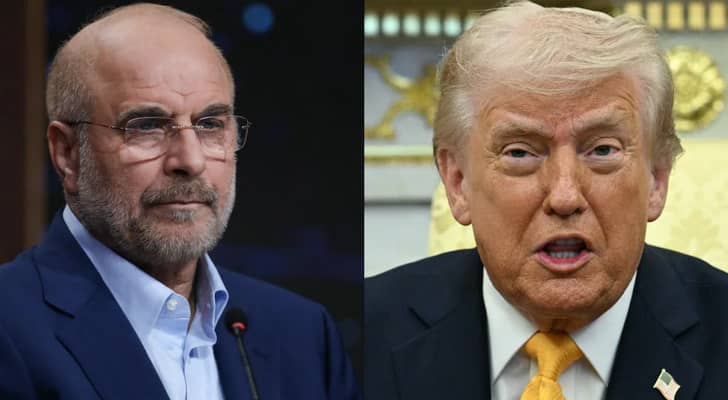
Day 116 | Iran clashes with US over terms of frozen funds
US President Donald Trump said that any frozen Iranian funds slated for release will not be granted as unrestricted cash. Instead, the money will be tied directly to the American agricultural sector.
However, the announcement was immediately met with a fierce rhetorical clash over the financial terms of the deal. While US President Trump asserted that the unfrozen capital would be ring-fenced "exclusively" to purchase agricultural products and food from American farmers, the Governor of the Central Bank of Iran swiftly and publicly issued a flat denial.
In a direct pushback against the White House narrative, the Governor of the Central Bank of Iran stated that the signed legal texts regarding the release of the frozen funds carry absolutely no clauses binding or forcing Tehran to purchase agricultural inputs from the United States.
According to Iran's top banking authority, the operational flexibility of the agreement extends far beyond the agricultural limits outlined by US officials.
The Governor emphasized that for the "second batch" of unblocked funds, the Central Bank is legally entitled to purchase any non-sanctioned goods and commodities on the global market, choosing whichever trading partners it sees fit.
Iranian Parliament Speaker Mohammad Bagher Ghalibaf officially announced that negotiators in Switzerland successfully secured an agreement to release $12 billion of Iran's blocked global assets.
Thread ended
This live thread has ended. Follow our online coverage of day 117 of the war.
Read more: Day 117 | Trump insists Iran agreed to allow nuclear inspections, Tehran denies
‘Israeli’ Merkava tank targeted near Beaufort Castle in southern Lebanon
Hezbollah has published footage it said shows an 'Israeli' army Merkava tank being targeted by an Ababil loitering drone near the historic Beaufort Castle in southern Lebanon on June 12.
US grants Iran team early entry before Egypt match
- Policy change follows reported security concerns involving alleged IRGC-linked traveler.
The US Department of Homeland Security has granted a rare administrative concession to the Iranian national football team, allowing the squad to cross the border forty-eight hours prior to their upcoming World Cup match against Egypt.
The policy shift comes amidst mounting complaints from team management regarding severe logistically imposed exhaustion and tight border controls.
Iran's presence at the tournament marks a highly volatile historical milestone, as they are the first national team to compete in a World Cup hosted by a foreign state with which their country is actively locked in a military conflict.
"For the Iranian team's third match in Seattle on Friday, the team has been permitted to come into the U.S. two days before the match," a DHS spokesperson told ABC News on Tuesday.
However, federal authorities made it clear that the core security protocols governing the team's controversial visa status remain rigidly non-negotiable.
"The Iran team will still be required to leave the day the match ends," the spokesperson added, emphasizing that overall tournament safety frameworks will be strictly maintained.
Due to political friction and geopolitical sensitivities, Team Melli was denied permission to establish a traditional base camp on American soil, forcing them to set up operations across the southern border in Tijuana, Mexico.
Under the previous operational guidelines enforced during matches in Los Angeles, the squad was blocked from entering the US until the night before a game and was legally required to self-deport back to Mexico immediately after the final whistle.
Iran’s head coach, Amir Ghalenoei, did not hold back his frustration following his side's grueling 0-0 draw against Belgium at SoFi Stadium.
While praising his players for executing a "beautiful game," Ghalenoei stated that his roster was being subjected to unsustainable physical strain due to short travel windows, lack of preparation time, and visa barriers.
The Iranian football federation had already announced plans to lodge a formal complaint with FIFA after US authorities rejected their initial requests for an expanded travel window ahead of the Los Angeles fixture.
The political apparatus in Washington has pushed back against allegations of competitive unfairness.
Andrew Giuliani, the executive director of the White House World Cup task force, defended the administration's baseline efforts to accommodate the roster.
"I think that the United States has been more than fair," Giuliani told ABC News. "We've gotten visas for all 31 of the players, gotten visas for every coach, so that way there can be competitive balance. So, I would respond by saying that they're welcome for our hospitality."
Giuliani did acknowledge, however, that multiple visa applications submitted for accompanying Iranian officials had been systematically denied.
The rationale behind those targeted rejections was highlighted by US Homeland Security Secretary Markwayne Mullin.
Speaking to Fox News, Mullin revealed that US intelligence intercepted an individual with direct ties to the Islamic Revolutionary Guard Corps (IRGC) attempting to board the Iranian team's private flight from Mexico to Los Angeles.
The close security encounter solidified the administration's insistence on maintaining an uncompromising security ring around the delegation as they head northwest to Seattle's Lumen Field, where Iran following an opening 2-2 draw with New Zealand—will look to keep their tournament hopes alive against Egypt.
US Senate to curb Trump Iran military action
US Senate has successfully passed a resolution calling on President Donald Trump to immediately suspend all military operations against Iran unless explicit authorization is granted by Congress.
VIDEO - Hezbollah chief demands full 'Israeli' withdrawal 'according to a timetable'
Trump: IAEA inspectors will be in Iran at an ‘appropriate time’
US President Donald Trump said International Atomic Energy Agency (IAEA) inspectors would be deployed to Iran “at the appropriate time” and that there was “no rush,” adding that “there is no way” Iran will obtain a nuclear weapon.
He said the US is working on a “great deal” after what he described as the destruction of Iran’s capabilities, claiming Tehran is not in a strong negotiating position and that it had been placed in an unprecedented situation not seen in 47 years.
Trump said inspectors would be “on the ground in Iran at the right time,” and rejected Iranian claims that no IAEA visits were scheduled, saying: “They’re wrong, they know they’re wrong… if they were right, I’d cancel the meetings right now.” He also said the situation with Lebanon was progressing well.
Rubio says US won't accept tolls or fees in Strait of Hormuz
US Secretary of State Marco Rubio said Tuesday that no country is allowed to impose tolls or fees on the Strait of Hormuz, as Iran seeks to extract revenue from the vital waterway.
"It's an international waterway. No country is allowed to charge tolls or fees on an international waterway. That's existing international law," he said as he arrived in the United Arab Emirates.
"I don't think we have anybody to convince around here in that regard. I think all the countries in this region would agree with us."
Pezeshkian sets redline on ballistic missiles in future talks
- Pezeshkian praises Pakistan’s key role in mediation and MoU.
- Holds talks in Islamabad with Shehbaz Sharif and General Asim Munir.
- Declares Iran’s ballistic missile program is not open to negotiation.
- Says regional peace and cooperation are essential for long-term stability and growth.
Following his highly anticipated arrival in the Pakistani capital on Tuesday, Iranian President Masoud Pezeshkian expressed deep gratitude for Islamabad’s central role in facilitating backchannel negotiations between Tehran and Washington.
The intense mediation pipeline successfully yielded a landmark regional Memorandum of Understanding, temporarily halting a catastrophic conflict in the Middle East.
However, while celebrating the current diplomatic breakthrough, the Iranian President utilized his joint platform in Islamabad to issue a fierce, unyielding warning to Western interlocutors.
Pezeshkian firmly shut down any possibility of incorporating Iran’s defense infrastructure into the upcoming technical negotiations, drawing a strict boundary around the state's military sovereignty.
Pezeshkian praised the massive personal capital and structural energy invested by Pakistan's top political and military brass to push the highly volatile peace track past the finish line.
"We highly value Pakistan's role in facilitating negotiations and reaching the Memorandum of Understanding," Pezeshkian announced. He singled out the joint efforts of Prime Minister Shehbaz Sharif and Pakistan Army Chief Gen. Asim Munir, stating that both leaders "exerted massive efforts in the negotiations, and we deeply appreciate their critical role."
The praise follows a series of intense, high-stakes sessions in Switzerland and Islamabad, where Pakistani and Qatari diplomats successfully managed to carve out a fragile 60-day extension to the regional ceasefire. Pezeshkian confirmed that his current visit included exhaustive, direct reviews with Pakistan's civilian and defense leadership regarding the rapidly evolving security developments across both the region and the wider global stage.
No concessions on national defense
The most critical element of the President's address focused on the next phases of the 60-day diplomatic process, which aims to transition the temporary Islamabad MoU into a permanent, legally binding treaty.
Responding to domestic pressures and external narratives suggesting that Western powers intend to utilize upcoming sessions to strip Tehran of its deterrent capabilities, Pezeshkian issued a definitive, unconditional refusal.
"We are firmly holding onto our elements of strength in the upcoming negotiations," Pezeshkian stated unequivocally. "No negotiations have taken place regarding our ballistic missiles, and absolutely none will take place in the future."
The statement serves as a direct strategic alignment with remarks made by other senior Iranian officials, who have consistently maintained that the signed text of the MoU explicitly governs economic sanctions relief, nuclear inspection mechanisms, and maritime safety corridors, while leaving Iran's sovereign defense systems completely untouchable.
Looking beyond the immediate transactional details of the US–Iran deal, Pezeshkian framed the current diplomatic pivot as an opportunity to fundamentally rewrite the security architecture of the region.
He emphasized that the long-term economic and social viability of the area must be driven from within, rather than mandated by external Western powers.
"We firmly believe that the progress of the West Asia region depends entirely on peace, security, and deep regional cooperation," the President concluded, urging neighboring states to lock arms under the new framework to foster lasting stability.
Rubio: Lebanon ceasefire separate from Iran deal
Negotiating and maintaining a ceasefire in Lebanon will be kept separate from any broader agreement with Iran, US Senator Marco Rubio said on Tuesday, as he arrived in Abu Dhabi on the first leg of his Gulf tour.
“That process is separate. It’s separate because Lebanon is a sovereign country. It has a government, and when it comes to Lebanon and what’s happening inside of Lebanon, we’re going to negotiate and deal directly with the Lebanese government,” Rubio told reporters.
He said issues related to Lebanon’s internal situation would be handled directly with Beirut, stressing that the country’s future lies with its elected leadership.
“There’s an Iranian issue with regards to Lebanon, and that is their support and sponsorship of Hezbollah. And so that factor will be discussed as part of our conversations with the Iranians,” he said.
“But as far as the future of Lebanon, the future of Lebanon belongs to the Lebanese people through their sovereign, elected government. And that’s who we’re going to be working with.”
Sharif to Khamenei: You secured peace, while keeping dignity
- Shehbaz Sharif says Iran secured a ceasefire and MoU while preserving its dignity.
- Warns external actors are trying to undermine the U.S.-Iran agreement.
- Says the Islamabad MoU contains no provisions on Iran’s missile program.
- Criticizes what he describes as double standards on regional missile capabilities.
Pakistani Prime Minister Shehbaz Sharif has delivered a powerful defense of the newly brokered US–Iran diplomatic breakthrough, revealing that his direct message to Iran's Supreme Leader Mojtaba Khamenei emphasized that Tehran has successfully secured a ceasefire while keeping its national dignity entirely intact.
Serving as a chief guarantor and mediator for the historic "Islamabad Memorandum of Understanding" alongside Qatar, Sharif used a major public address on Tuesday to outline the boundaries of the pact and push back against external factions attempting to derail the regional truce.
"My message to the Iranian Supreme Leader is that his country has reached a ceasefire and a Memorandum of Understanding, and has fully preserved its dignity," Sharif announced, reflecting on the marathon diplomatic sessions recently concluded in Bürgenstock, Switzerland.
Addressing 'Spoilers'
Reflecting on how close the region came to an all-out, catastrophic military confrontation, Sharif praised the unified stance of regional heads of state who supported the intense mediation pipeline.
"This war could have destroyed everything," the Prime Minister warned, adding, "We highly commend the support of the region's leaders to achieve this peace."
However, Sharif transitioned quickly to a firm warning regarding an ongoing counter-campaign to dismantle the diplomatic progress.
He explicitly called out external "spoilers" and hostile foreign parties that are actively working to collapse the agreement before it can transition into a permanent treaty over the next 60 days.
According to the Pakistani premier, these disruptive states are deliberately weaponizing Iran's defense apparatus as a political tool to freeze the peace tracks.
International double standards
In a major revelation regarding the technical contents of the secret negotiations, Sharif confirmed that the text of the Islamabad MoU strictly focused on immediate de-escalation parameters, such as lifting naval blockades and reopening critical shipping lanes, while avoiding broader defensive categories.
"The Memorandum of Understanding did not address the issue of Iranian ballistic missiles," Sharif clarified.
Sharif then launched a fierce rhetorical critique against Western and regional critics who have demanded that any permanent settlement must strip Iran of its long-range artillery capability.
He framed these external demands as a hypocritical and unsustainable framework for Middle Eastern security.
"There are countries that want to disrupt this agreement, and I say to them: they cannot possess ballistic missiles without Iran doing the same," Sharif asserted. "Double standards cannot be accepted. It is completely unreasonable for some to possess ballistic missiles while Iran is forbidden from having them."
By publicly aligning with Tehran on its right to maintain a baseline missile deterrent, Pakistan has signaled that its role as a guarantor extends to protecting the core sovereignty of both signatories. Sharif concluded by reiterating Islamabad's long-term diplomatic commitment to the corridor: "We would like to continue our role until a truly lasting peace is fully realized."
Rubio lands in UAE on first leg of Gulf tour
US Secretary of State Marco Rubio landed in Abu Dhabi on Tuesday, the first stop on a tour of the Gulf states hit hard by Iran's retaliatory campaign.
Rubio is to meet Emirati leaders on Wednesday, before heading to Kuwait following by Bahrain for a meeting of the Gulf Cooperation Council, as he seeks to reassure US allies after the signing of an initial US-Iran deal last week.
Lebanon’s Aoun says recent developments prove negotiation choice was right
Lebanese President Joseph Aoun said recent developments had validated Lebanon’s decision to pursue negotiations, as a fifth round of Lebanon-'Israel' talks began in Washington.
Aoun also rejected 'Israel's' occupation of south Lebanon and other foreign interference, alluding to Iran.
"We accept nothing less than an end to the Israeli occupation and at the same time, the fall of foreign tutelage, because our only option is our national sovereignty and our sole wager is on the Lebanese state," Aoun said, according to his office.
He also expressed hope that the new round of talks would be "decisive along the path of achieving what we seek for the good of our nation and people", namely "the full restoration of Lebanon's sovereignty over every grain of its soil".
Fifth round of US-sponsored Lebanon-'Israel' talks begins
The fifth round of US-sponsored talks between Lebanon and 'Israel' has begun at the State Department in Washington, DC, according to our colleagues on the ground.
Lebanon’s President Joseph Aoun said the latest round could prove decisive.
Iran announces three-day holiday in Tehran for Ali Khamenei's funeral
Irani announced Tuesday three days of public holidays in the capital Tehran for late supreme leader Ayatollah Ali Khamenei's funeral ceremonies, state television reported.
"The farewell ceremony and prayers for the martyred leader's body will be held on Saturday and Sunday, July 4th and 5th, in Tehran's Grand Mosalla, and the funeral will be held on Monday, July 6th, and Tehran province will be off for these three days," IRGC commander Hassan Hassanzadeh, in charge of the funeral ceremonies, was quoted as saying.
Earlier, state media said Tehran would be on holiday on July 4 and 5, while the whole country will follow suit on July 6.
Ben-Gvir says 'Israel' can say no to Trump, should not accept Lebanon ceasefire
‘Israeli’ National Security Minister Itamar Ben-Gvir said ‘Israel’ is capable of rejecting requests from U.S. President Donald Trump if it believes doing so is necessary.
Speaking to ‘Israeli’ outlet Arutz Sheva, Ben-Gvir said ‘Israel’ could “of course” refuse an appeal from Trump, underscoring what he described as the country's ability to make independent decisions.
Addressing the situation in Lebanon, Ben-Gvir firmly rejected the prospect of a ceasefire, saying there should be “no ceasefire” and “under no circumstances”.
He also expressed confidence that the right-wing governing coalition could remain in power after ‘Israel’s’ elections later this year, although he acknowledged that political efforts would be needed to secure that outcome.
Iran agreed to highest level nuclear inspections long into future: Trump
In a post published on Truth Social on Tuesday, US President Donald Trump claimed that Iran has "fully and completely" agreed to highest level nuclear inspections long into the future.
"If they did not agree to this, there would be no further negotiations! Based on this and other major concessions being made by Iran, I have agreed to allow the Hormuz Strait to remain open, with no further naval blockade," Trump added.
These comments don't seem to be having a noticeable impact on the US Dollar's (USD) performance. At the time of press, the USD Index was trading at its highest level since May 2025 at 101.25, rising 0.25% on the day.
Sharif says Tehran-Washington memorandum to become long-term agreement
Pakistani Prime Minister Shehbaz Sharif said the memorandum of understanding signed between Tehran and Washington is expected to evolve into a long-term agreement within 60 days.
Sharif's remarks suggest that the current framework, which outlines interim understandings between the two sides, could pave the way for a more comprehensive and lasting accord.
Iran and Oman formed "joint committee" to discuss Hormuz, Iran's top negotiator says
Iran and Oman have formed a joint committee to discuss the Strait of Hormuz, Iran’s chief negotiator, Mohammad Bagher Ghalibaf, said Tuesday on Telegram.
Following the Iranian delegation’s trip to Muscat, “Iran and Oman formed a joint committee to discuss the Strait of Hormuz, with more details to be provided in a joint statement to be released,” he said.
Omani Foreign Minister Sayyid Badr Albusaidi said earlier that he and Ghalibaf had “constructive discussions on the recent Iran-US (Memorandum of Understanding), especially the Strait of Hormuz paragraph.”
“We affirmed commitment to international law and toll-free safe passage,” Albusaidi wrote on X.
Shipping companies remain cautious about sending their vessels through the Strait of Hormuz amid conflicting signals about the agreement between the US and Iran and the presence of dozens of mines.
Traffic has however steadily increased but is still well below pre-war levels. The increase came as Iran and the US agreed to set up a hotline for the strait to “prevent and resolve any misunderstandings” with countries as ships transit the chokepoint, according to Iran’s top negotiator.
Iran’s Araghchi travels to Pakistan for talks: Iranian broadcaster
Iranian Foreign Minister Abbas Araghchi arrived in Islamabad on Tuesday as part of an official visit alongside Iranian President Masoud Pezeshkian.
According to Iran's state broadcaster IRIB, Araghchi traveled to Pakistan after a visit to Muscat and was received in Islamabad by Pakistani Foreign Minister Ishaq Dar and other officials.
Netanyahu says 'Israel' should free itself from arms dependency on US
'Israeli' Prime Minister Benjamin Netanyahu said that ‘Israel’ has carried out strikes against Iran and its regional allies, stressing that the operation is not yet over.
Speaking about military strategy, Netanyahu said he values U.S. support but insisted that ‘Israel’ must reduce its reliance on Washington and develop an independent weapons system.
He said ‘Israel’ has dealt a blow to Iran and its proxies across the region, describing the campaign as ongoing rather than concluded.


