
Iranian President Masoud Pezeshkian and US President Donald Trump

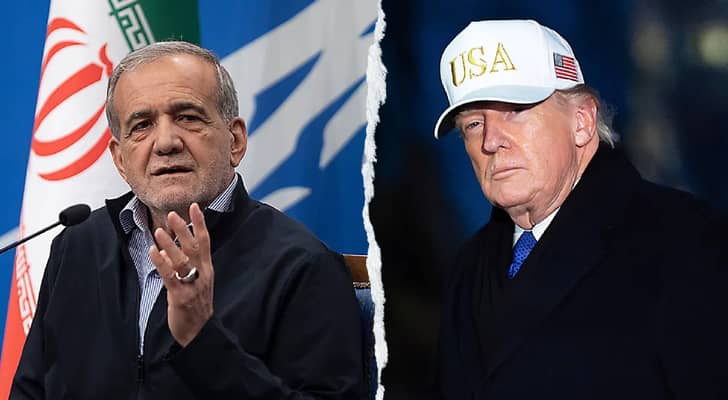
Day 117 | Trump insists Iran agreed to allow nuclear inspections, Tehran denies
Iranian President Masoud Pezeshkian drew an absolute boundary around the country's defense architecture. Pezeshkian firmly declared that no negotiations have occurred regarding Iran's ballistic missile program, adding unequivocally that none will take place in the future.
Concurrently, US President Donald Trump announced that the United States will halt its naval blockade of the strategic Strait of Hormuz, confirming that global energy transit has stabilized.
While Trump insisted that Tehran has formally agreed to allow international nuclear inspectors back into the country, senior Iranian officials have publicly broken with the White House narrative, explicitly stating that no such inspection agreement has been reached.
The diplomatic friction in the Middle East coincided with a dangerous military escalation along the Lebanese border. In the southern town of Nabatieh al-Fawqa, 'Israeli' troops opened fire on a crowd of residents, killing two people and wounding several others.
Hezbollah immediately released a statement condemning the attack, labeling the killings a "blatant" violation of the active ceasefire agreement targeting defenseless civilians. The incident marks the most severe disruption to the local truce since its implementation, threatening to collapse parallel stabilization tracks across the region.
Thread ended
This live thread has ended. Follow our online coverage of day 118 of the war.
Read more: Day 118 | US promises to protect Gulf states' interests in Iran talks
Trump criticizes EU again for not providing military support
- Trump says the US did not need assistance and achieved its objectives quickly.
- Dismisses claims that US missiles struck an Iranian school.
- Says congressional efforts to end the war will not affect ongoing Iran talks.
President Donald Trump criticized European nations during a meeting with the Secretary General of NATO Mark Rutte on Wednesday, revealing that the United States received no support from Europe regarding the war with Iran.
Trump specifically named Italy, Britain, Germany, France, and Spain, stating he was disappointed that these traditional allies failed to even offer assistance.
"We did not need any help in our war and we crushed Iran in the first week," Trump stated.
He added that while American forces did not require foreign intervention, it would have been nice for allies to show a willingness to help.
Trump also noted that the war in Ukraine has caused significant weaknesses in both European and American defense production.
He told reporters he has not yet reviewed the official report concerning a recent attack on an Iranian school.
Trump expressed uncertainty over whether officials would resolve the issue, but strongly minimized the possibility of American responsibility.
"Missiles were raining down from everywhere at the time of the Iranian school incident," Trump said, concluding it is highly unlikely that American missiles caused the damage.
Turning to international politics and defense summits, Trump announced he altered his initial plans to skip the upcoming NATO summit in Ankara and will now attend.
He also celebrated recent global electoral trends, noting that many candidates he endorsed won their races, including in Colombia.
Trump offered a critical assessment of the United Kingdom, labeling the front-runner for the British prime minister position as too liberal and predicting the candidate will likely block North Sea oil drilling.
Domestically, Trump downplayed legislative efforts to restrict his military authority or force a diplomatic conclusion.
He insisted that a pending vote in Congress to end the war with Iran will have no bearing on his administration's foreign policy, even if lawmakers pass the measure.
"The vote in Congress to end the war with Iran, even if non-binding, will not affect our negotiations," Trump asserted.
Trump concluded his briefing on an optimistic note regarding the diplomatic track, stating that the United States is currently achieving excellent progress and delivering a great performance in active negotiations with Tehran.
US says 20 million oil barrels crossed Hormuz in 24 hours
- US says Gulf oil flows are reportedly above pre-conflict levels.
- Washington pledged to keep the strait open and protect global energy shipments.
- US says it will not allow disruptions to global oil supplies.
Global energy transit through the Strait of Hormuz has experienced a significant surge, with 72 vessels exporting an estimated 20 million barrels of crude oil over the last 24 hours, U.S. Energy Secretary Chris Wright announced.
The major maritime movement indicates that oil exports originating from the Persian Gulf have officially risen above the baseline levels recorded before the outbreak of regional hostilities.
However, Wright noted that the complete normalization of global shipping lanes has faced technical delays due to naval mines deployed by Iran throughout the strategic chokepoint.
Naval mines slow export
According to Wright, the current volume of oil departing the Gulf demonstrates the resilience of global supply chains, though the physical extraction and clearing process remains complicated.
The primary obstruction to a seamless transition is the residual presence of Iranian-planted mines, which have slowed the full, unrestricted movement of commercial shipping.
Wright acknowledged that Tehran's aggressive maritime posturing had previously achieved a degree of tactical success by intimidating commercial vessels and discouraging international shipping companies from entering the waterway.
Unconditional security guarantee
In response to the lingering security threats, the United States issued an absolute security mandate, decoupling the defense of global energy corridors from ongoing diplomatic negotiations with the Iranian government.
The Energy Secretary stated unequivocally that the United States will step in to guarantee the uninterrupted flow of oil through the Strait of Hormuz, emphasizing that American protection forces will maintain the shipping lanes regardless of whether a formal bilateral agreement is finalized with Tehran.
"We will not allow the world to be deprived of energy," the Secretary declared, reaffirming Washington's commitment to neutralizing maritime threats and safeguarding international commerce through the vital global transit artery.
Lebanon, 'Israel' discuss troop withdrawal south Lebanon
- 'Israel' and Lebanon are holding US-mediated security talks at the Pentagon.
- Disputes remain over withdrawal maps and timelines.
- 'Israel' seeks to retain forces in strategic buffer zones near the border.
Direct, high-stakes military negotiations between delegations from 'Israel' and Lebanon are currently underway at the Pentagon under US mediation.
The talks are heavily focused on practical blueprints for a phased 'Israeli' military withdrawal from parts of southern Lebanon.
According to senior diplomatic sources cited by the 'Israeli' Public Broadcasting Corporation (Kan), the two sides engaged in a detailed exchange of tactical maps.
However, the session revealed sharp, immediate differences regarding the velocity of any troop redeployment and the specific boundary configurations of the contested zones.
The current negotiations build upon a U.S.-backed framework aimed at gradually returning sovereignty to the central government in Beirut through the Lebanese Armed Forces (LAF).
Sources close to the Pentagon sessions indicate that the immediate objective is not a comprehensive 'Israeli' evacuation of southern Lebanon.
Instead, the negotiators are focused on a partial, localized withdrawal from designated "pilot zones."
Under this phased arrangement, 'Israeli' forces would pull back from specific border areas, allowing the Lebanese army to deploy exclusively and test compliance with the disarmament of non-state actors.
However, the pace and structure of this transition remain major sticking points. 'Israeli' media reported that its forces recently secured additional geographic positions along the 8-to-10-kilometer-deep security zone specifically to hold them as leverage for these negotiations, intending to evaluate the LAF's enforcement capabilities before committing to further movements.
Deep divisions over geography and timelines
The exchange of maps highlighted a fundamental mismatch in strategic expectations. While the Lebanese delegation is pushing for a definitive, time-bound roadmap leading to a total 'Israeli' withdrawal to internationally recognized borders, 'Israel' is fiercely resisting a complete exit.
The 'Israeli' defense establishment maintains that any early or unconditioned withdrawal would be viewed as a tactical victory for Hezbollah.
Just hours before the details of the map exchange emerged, 'Israeli' Defense Minister Israel Katz publicly doubled down on a hawkish line, asserting that the military would not fully abandon its buffer positions in the south, even under pressure from international partners.
The Pentagon meetings are expected to continue through the week as working-level technical teams attempt to bridge the gaps between 'Israel's' insistence on long-term operational freedom of maneuver and Lebanon's demand for full territorial integrity.
Haredi-led vehicle convoys disrupted traffic across 'Israel'
- Haredi-led vehicle convoys disrupted traffic across 'Israel'.
- Protesters opposed military conscription of yeshiva students and arrests of draft evaders.
- Demonstrations were organized by ultra-Orthodox political and religious groups.
- Security forces deployed heavily amid ongoing military manpower concerns.
Severe traffic gridlock crippled 'Israel’s' primary transit corridors on Wednesday afternoon as thousands of ultra-Orthodox "Haredi" men launched coordinated vehicular protests across the country.
The mass mobilization aims to directly challenge the mandatory military conscription of religious students and the state's aggressive crackdown on draft evaders.
According to reports from the Jerusalem Post and local traffic authorities, travel ground to a halt along Highways 1, 4, 6, and 471, in addition to more than 25 other critical intersections.
Organizers stated that mass convoys simultaneously departed at 4:00 PM from 19 distinct hubs spanning from Safed in the north to Arad in the south, including major departures from Jerusalem, Bnei Brak, and Beit Shemesh.
The massive demonstration was centrally organized by the Hasidic Agudat Yisrael association, with high-profile participation from hardline anti-conscription groups including the "Jerusalem Faction." Members of the Knesset from ultra-Orthodox parties personally led several of the slow-moving vehicular columns.
The ultimate destination for the convoys was the Neve Tzedek (Beit Lid) military prison in Kfar Yona, where multiple Haredi yeshiva students are currently incarcerated for evading mandatory military service.
Organizers issued a stern ultimatum via the Kan public broadcaster as the vehicles took to the roads:
"If there is any disruption to even one of the convoys, we will all get out of the vehicles and block all the roads at the same time."
In response, the police department deployed massive reinforcements along central junctions, attempting to forcibly divert civilian commuter traffic to secondary routes.
Law enforcement officials expressed severe concern that flash blockades during the evening rush hour could cause the country's interconnected highway system to completely collapse.
תיעוד: עימותים אלימים בהפגנות החרדים בערד; גורם בחסידות גור אומר לנו: "אם צריך נשלח כוחות משלנו להגן על עצמנו - התירו את דמנו"@GLZRadio pic.twitter.com/ormPKtCsWU
— מרדכי הלפרין (@MHlpryn) June 24, 2026
In an official communiqué released by the protest's organizing committee, the demonstrators framed their civil disobedience as an absolute religious duty to protect their way of life from state overreach.
The committee explicitly demanded the "immediate release of all detainees of the Torah world," an end to the systemic tracking and profiling of yeshiva scholars, and the revocation of what they termed "tyrannical decrees" targeting religious households.
"We will not stand idly by while our brothers are thrown into prisons simply for studying the Torah," the statement declared, urging the wider Haredi public to resist the current defense establishment policies.
The intensifying street friction highlights a deep-seated political and social crisis that has pushed the governing coalition to the brink of fracturing.
For decades, the ultra-Orthodox community enjoyed sweeping exemptions from compulsory military service, a status quo that has been systematically dismantled by recent judicial rulings and government directives.
As security forces brace for unannounced flash protests throughout the night, the underlying math of the crisis remains unchanged.
The military faces an acute shortage of combat personnel due to ongoing multi-front operations, while the religious parties maintain that forcing their youth into uniform will permanently destroy their reclusive cultural fabric.
Rubio: 'Israel' remains in Lebanon because of Hezbollah's attacks
- Rubio warns sanctions will return if Iran violates the interim agreement.
- Reaffirms opposition to any transit fees in the Strait of Hormuz.
- Says 'Israel' is fully informed, while Lebanon-'Israel' border talks remain a separate track.
Launching a critical diplomatic tour of the Gulf, US Secretary of State Marco Rubio revealed that specialized technical committees will return to Switzerland on June 29 to resume high-stakes negotiations with Iran.
The working-level talks will focus tightly on hammering out the granular nuclear verification and sanctions-relief mechanisms embedded in the newly signed bilateral Memorandum of Understanding (MoU).
Rubio confirmed that the landmark Swiss accord has initiated a rigid 60-day implementation clock.
However, he heavily conditioned the durability of the deal, issuing an explicit warning from the Trump administration that Washington is prepared to pivot back to aggressive economic containment at a moment's notice.
"President Trump expects Iran to remain fully committed to the talks, and he wants a clear, solid deal," Rubio told reporters in Abu Dhabi. "Iran must abide by the Memorandum of Understanding. If they do not, the President has numerous options at his disposal, chief among them an immediate return to maximum-pressure sanctions."
Hormuz free of tolls
A primary objective of Rubio's Gulf tour is assuring close partners -including the UAE, Saudi Arabia, and Kuwait- that the White House has not compromised their security or economic interests to secure the temporary truce with Tehran.
Addressing recent rhetoric from Iranian state hardliners suggesting that Tehran could seek to monetize or restrict maritime traffic in the Persian Gulf once the 60-day window closes, Rubio drew an uncompromising line.
"We demand that navigation through the Strait of Hormuz return to being completely free, a stance backed by the entire international community," Rubio asserted. "Let me be entirely clear: there will be absolutely no fees or transit tolls imposed in the Strait of Hormuz."
Coordinating 'Israeli' red lines
Rubio also addressed the geopolitical friction points surrounding Washington's closest regional ally, clarifying the level of intelligence sharing between the White House and Tel Aviv.
He dismissed speculation that the US had sidelined 'Israeli' defense interests to push through the interim agreement with Tehran.
"'Israel' is fully aware of everything we are doing regarding the Memorandum of Understanding," Rubio stated. "They are completely in the loop, and they are intimately aware of the specific red lines that President Trump has established."
The Secretary of State explicitly defended the strategic rationale behind 'Israel's' current military footprint in the Levant, noting that "Israel is present in Lebanon because Hezbollah systematically targets it with rocket fire."
Independent Lebanon track
Crucially, Rubio signaled that the United States is treating the stabilization of Lebanon as an entirely separate diplomatic track, isolating it from the broader nuclear portfolio being negotiated with Iran.
"Today we are pursuing a second track, which consists of direct negotiations between the government of Lebanon and 'Israel,' and we are hopeful it will succeed," Rubio announced.
In a direct effort to diminish Tehran’s historic proxy leverage over Beirut through Hezbollah, Rubio vowed that Washington would deal exclusively with the sovereign state apparatus to restore order along the southern border.
"We will directly assist the Lebanese government in extending its legitimate authority and sovereignty over the entirety of its territory, completely free from any external foreign interference," Rubio concluded.
Rubio: Technical committee slated to resume Swiss talks on June 29
US Secretary of State Marco Rubio has announced that working-level technical teams are scheduled to return to Switzerland on June 29 to hammer out the complex implementation details of the newly signed bilateral Memorandum of Understanding with Iran.
Netanyahu says 'more work needs to be done' in Lebanon
- Netanyahu says 'Israel' is creating a permanent buffer zone in southern Lebanon.
- Says 'Israeli' forces will remain deployed despite international pressure.
- Claims 'Israeli' operatives have conducted multiple missions inside Iran.
- Vows Iran will not obtain nuclear weapons.
'Israeli' Prime Minister Benjamin Netanyahu issued an uncompromising national address on Wednesday, declaring that 'Israeli' forces are actively establishing a fortified military buffer zone across southern Lebanon.
He further disclosed that 'Israel' has executed extensive intelligence operations directly inside Iranian territory to derail Tehran's atomic program.
The statements signal Tel Aviv's refusal to align with regional de-escalation parameters being negotiated by the United States and Iran in Bürgenstock, Switzerland.
Netanyahu made it clear that 'Israel' will maintain its frontline territorial captures, independently enforcing its own security boundaries.
Netanyahu’s announcement solidifies the 'Israeli' military long-term deployment along its northern border.
He explicitly rejected any diplomatic framework demanding a withdrawal behind the Blue Line.
"We are establishing a security buffer zone in southern Lebanon to prevent Hezbollah from launching attacks against us," Netanyahu announced. Addressing the ongoing military clearance operations targeting underground complexes and rocket storage facilities near the border, he added: "There is still what we must do in Lebanon."
The prime minister firmly repeated that 'Israeli' forces will not abandon these captured zones.
The military footprint, which field commanders indicate extends deeply into Lebanese border towns, is being treated by 'Israel' as a non-negotiable insurance policy to guarantee the safe return of displaced residents to northern 'Israel'.
Operations inside Iran
In a rare and explicit public acknowledgment, the 'Israeli' leader turned his focus to the head of the "Axis of Resistance," directly linking the ground battles in Lebanon to an ongoing shadow war against the Iranian state apparatus.
Netanyahu revealed that 'Israel' has stepped up its intelligence and sabotage operations inside Iran's borders over the past year.
"We have carried out numerous operations inside Iran, and we are actively seeking to prevent it from possessing a nuclear weapon," Netanyahu disclosed, hinting at clandestine industrial sabotage and cyber-warfare initiatives targeting nuclear enrichment hubs.
Nuclear redline
Netanyahu framed Iran’s nuclear ambitions as an ultimate, non-negotiable threat to the state's survival, positioning his government as a structural barrier against Tehran's geopolitical expansion.
"Iran obtaining a nuclear weapon is an existential threat to us, and we will prevent it," Netanyahu vowed.
He concluded his address by linking his personal political longevity to 'Israel's' defense posture, issuing a definitive ultimatum to both regional adversaries and international allies:
"Iran will not obtain a nuclear weapon as long as I am Prime Minister, and we will retain our security buffer zones in southern Lebanon."
Netanyahu calls urgent security meeting over Syria, Lebanon
According to 'Israeli' Army Radio, Prime Minister Benjamin Netanyahu is convening a restricted security cabinet meeting tonight to review pressing developments on the Syrian and Lebanese fronts, driven by growing panic in Tel Aviv over reports that US President Donald Trump has proposed deploying Syrian military forces into Lebanon.
'Israeli' soldiers seek healing for "PTSD" through yoga: Hebrew media
- Dozens joined a yoga gathering in Tel Aviv on International Yoga Day and the summer solstice.
- Event was organized by Brothers in Yoga.
- Activists called it “wellness-washing” that overlooks civilian suffering in Gaza and Lebanon.
- Rights advocates cited disparities in access to mental health support.
Hebrew media reported that 'Israeli' soldiers are getting treatment for what they claim is "psychological trauma"
A high-profile wellness event took place on a luxury rooftop overlooking Tel Aviv. Dozens gathered for a trauma-sensitive yoga session organized by 'Brothers in Yoga,' a non-profit founded by Neta Margalit.
The initiative, heavily promoted in local media, aims to provide somatic healing to 'Israeli' soldiers allege to struggle with combat-induced Post-Traumatic Stress Disorder (PTSD) stemming from recent operations and prior wars.
However, the image of soldiers engaging in mindfulness and spiritual healing against a serene city skyline has triggered intense global controversy.
Human rights defenders have sharply denounced the event, pointing out the stark cognitive dissonance of an occupying military seeking inner peace while simultaneously orchestrating campaigns that inflict catastrophic physical and psychological trauma on millions of civilians in Gaza and Lebanon.
Soldados sionistas organizaron una convención de yoga en "Israel", para tratar el trauma de haber asesinado a niños palestinos tras volver del genocidio en Gaza.
— Daniel Mayakovski (@DaniMayakovski) June 24, 2026
Los jipis sionistas por la mañana hacen la postura del saludo al sol y por la tarde ametrallan a un niño de 4 años… pic.twitter.com/SrqvIE8emm
'Wellness-Washing', victimhood narrative
The controversy centers on what critics describe as a cynical effort to reframe active combatants -who wield advanced weaponry- as the primary victims of the conflict.
During the event, organizers and correspondents lamented the psychological toll on soldiers, explicitly blaming "the world's reaction to the war" for exacerbating their alleged PTSD.
To international observers, this framing shifts accountability away from the state's military actions and onto global public opinion.
Opponents argue that using yoga to rehabilitate troops so they can return to active combat zones is a perversion of the practice.
The 'Brothers in Yoga' initiative focuses heavily on the somatic connection, how the body stores trauma.
Yet, human rights organizations point out that the asymmetric distribution of this trauma is entirely ignored by such public relations campaigns.
While 'Israeli' soldiers receive structured psychiatric care, holistic therapies, and institutional support, the populations of Gaza and Lebanon are subjected to what psychologists call "continuous traumatic stress."
In Gaza, over two years of relentless bombardment have obliterated the mental health infrastructure entirely.
The event has ultimately intensified allegations of cultural and political double standards.
Human rights groups argue that campaigns centering on the mental health of soldiers serve to humanize the mechanisms of occupation while hiding the victims of that occupation from view.
By focusing the narrative on the emotional well-being of the forces causing the destruction, critics argue that the wellness industry is being co-opted to sanitize state violence, transforming a structural humanitarian crisis into a selective story of domestic resilience.
Trump says US inspectors to join IAEA nuclear inspections in Iran
US President Donald Trump said American inspectors will join the International Atomic Energy Agency in inspecting nuclear sites in Iran.
In remarks to Fox News, Trump said Iran has agreed in principle to allow nuclear inspectors into its territory, but stressed there is “no rush” regarding their deployment.
He added that the inspectors would work alongside the International Atomic Energy Agency as part of ongoing monitoring efforts.
Trump says Iran has told the US no tolls are being sought at the Strait of Hormuz
US President Donald Trump said Iran has informed Washington that it is not seeking tolls, insurance costs, or any other charges from ships passing through the Strait of Hormuz.
In a post on his Truth Social platform, Trump said negotiations with Tehran would end immediately if the information proved inaccurate.
“If this is false information, negotiations would end immediately,” he wrote.
Trump also said no money has been transferred to Iran and that no Iranian assets have been released by the United States.
However, he added that Washington plans to release a portion of Iranian funds under US control to finance purchases of agricultural products from the United States, including corn, wheat, and soybeans.
According to Trump, the funds would be used exclusively to purchase food for Iran, which he said is “desperately needed” in the country.
35 ships prepare to cross Hormuz as 25 vessels transit strait
Maritime tracking data cited by Reuters indicates that 35 commercial vessels are preparing to transit the Strait of Hormuz, while two cargo ships completed the passage during the past 12 hours.
Separately, maritime analytics company Kpler reported that 25 vessels crossed the strait on Tuesday.
Iran's Pezeshkian invites Modi to Khamenei funeral ceremonies
Iranian President Masoud Pezeshkian has formally invited Indian Prime Minister Narendra Modi to attend the state funeral and burial ceremonies of Iran’s Supreme Leader, Ali Khamenei.
According to the announcement, the ceremonies were originally planned for March but were postponed because of the conflict in the region.
The events are now scheduled to take place over several days in July across multiple cities in Iran.
Iran says UN nuclear inspections will occur after ‘final’ deal with US
Iran’s Deputy Foreign Minister Kazem Gharibabadi has said access for United Nations inspectors to nuclear sites will only be determined within the framework of a final agreement with the United States.
In a post, Gharibabadi said inspections are conditional on “the other party’s practical action in terminating all sanctions,” linking nuclear oversight to broader economic and diplomatic negotiations.
He added that during recent talks in Switzerland, Iranian officials did not meet International Atomic Energy Agency (IAEA) Director General Rafael Grossi, despite what he described as Grossi’s request for engagement.
The statement comes after Grossi said inspections of Iranian nuclear facilities are expected to proceed regardless of timing.
“Whether this happens today, after tomorrow or in one week or in 10 days, it’s important but not essential. This is going to happen,” Grossi said.
Iran says deal to end US-'Israel' war a ‘declaration of US defeat’
Mohammad Bagher Ghalibaf, head of Iran’s negotiating team, has described the agreement between Iran and the United States as “America’s declaration of defeat,” escalating political rhetoric around the Islamabad-mediated understanding.
Speaking at a conference in Azerbaijan broadcast on Iranian state television, Ghalibaf said the outcome reflected Iranian strength rather than foreign pressure.
“The Islamabad understanding was not the result of pressure and coercion, but rather the result of the resistance and authority of the brave Iranian nation,” he said.
He added that the agreement should be viewed as a political outcome favourable to Tehran.
“That is why the Islamabad memorandum of understanding became a declaration of America’s defeat,” Ghalibaf said.
Iran’s parliament speaker says withdrawal of foreign forces ‘a strategic goal’
Senior Iranian official Mohammad Bagher Qalibaf has said Middle Eastern countries should independently shape the region’s security architecture without external military involvement.
Speaking during a visit to Baku, Azerbaijan, Qalibaf described the withdrawal of foreign forces from the region as a “strategic objective,” arguing that their bases in West Asia contribute to instability.
He said Iran envisions a future built on “interaction rather than confrontation,” stressing cooperation among regional states on the basis of non-interference and respect for sovereignty.
Qalibaf added that Iran remains committed to supporting its allies and strategic partners under difficult conditions, reiterating calls for a ceasefire and an end to what he described as the war in Lebanon.
He also repeated Tehran’s position that 'Israel' should halt its attacks and end its occupation of southern Lebanon, saying regional stability cannot be achieved without addressing ongoing conflicts.
Pakistan announces release of 52 Iranian sailors through diplomatic efforts
Pakistan has announced that its diplomatic engagement with Tehran helped secure the release of 52 Iranian sailors by the United States and the United Kingdom.
The Foreign Ministry said the development reflects the importance of recent international contacts and coordination efforts aimed at easing maritime and diplomatic tensions.
Officials credited sustained communication with both Iranian and Western counterparts for facilitating the outcome, without providing further details on the circumstances of the sailors’ detention or release.
Pakistan announces new round of Iran-US technical talks next week
Pakistan’s Foreign Ministry has said that a new round of technical-level negotiations between Tehran and Washington is set to resume next week, under a mediation framework involving Pakistan and Qatar.
A spokesperson said expert-level discussions between the two sides remain ongoing, despite periodic pauses taken by participants during the process.
The ministry added that the technical talks continue under a broader diplomatic channel aimed at maintaining dialogue between Iran and the United States.
According to the statement, Islamabad is coordinating with both sides to ensure the implementation of the memorandum of understanding linked to the process.
Oman coordinates fee-free transit in Strait of Hormuz
The Maritime Security Centre in Oman has said the country is coordinating with the International Maritime Organization to enable the passage of ships through the Strait of Hormuz without fees.
The statement highlighted efforts to streamline maritime movement through one of the world’s most sensitive shipping lanes, which connects major energy exporters with global markets.
Officials said the coordination with the global maritime body is intended to reduce operational costs and improve traffic flow for vessels transiting the corridor.


