
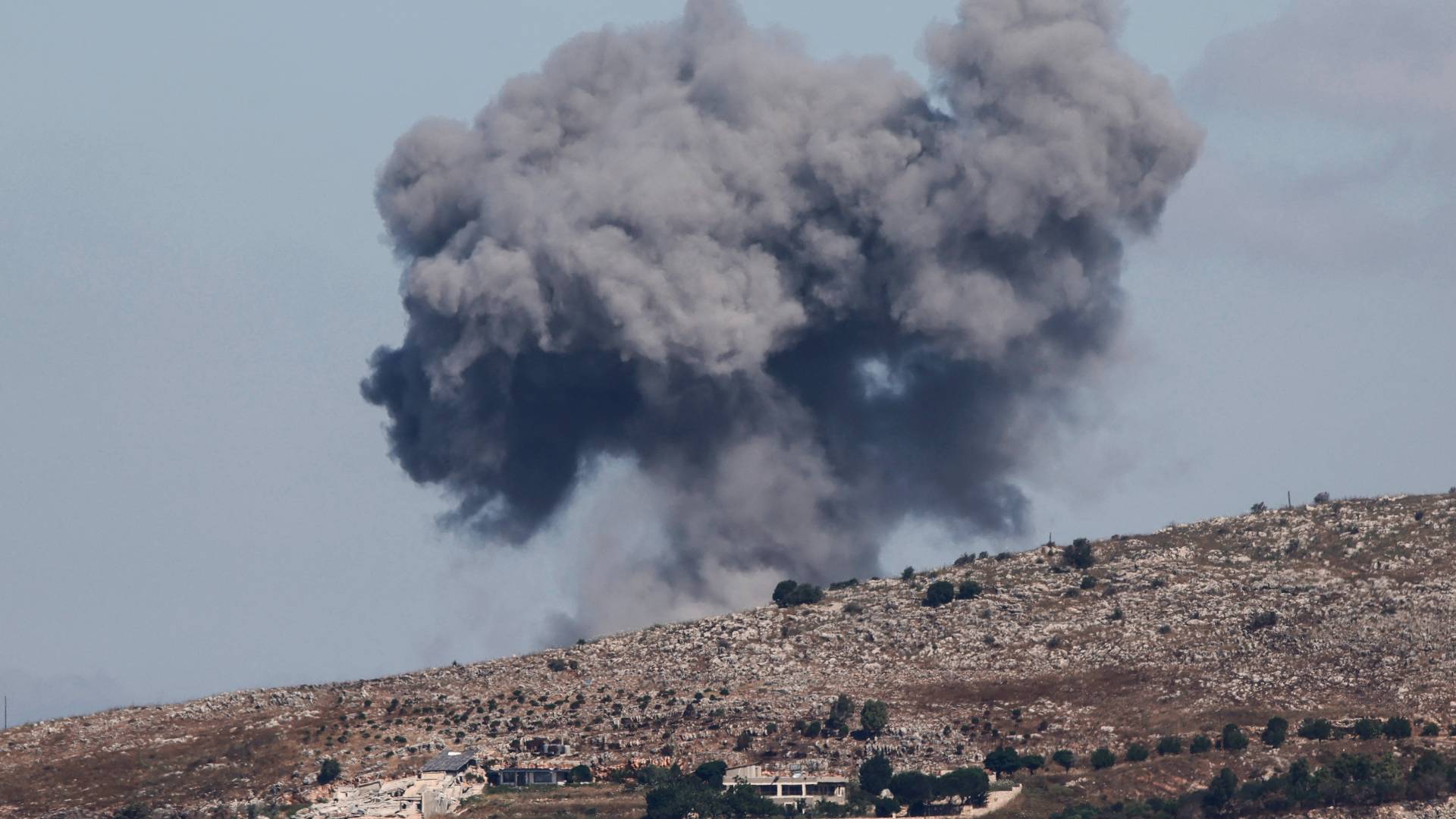
A photograph taken from the southern Lebanese region of Marjayoun shows smoke rising following an ‘Israeli’ airstrike.

Day 113 | ‘Israel’ & Hezbollah agree ceasefire as US-Iran deal under strain
‘Israel’ and Hezbollah agreed a ceasefire on Friday, a US official said, after deadly exchanges between the two sides in Lebanon once again put a deal to end the Middle East war under strain, less than two days after it was signed.
Lebanese authorities reported 47 people were killed in ‘Israeli’ airstrikes and ‘Israel’ announced the deaths of four of its soldiers, the highest combined casualty count since the US and Iran struck their deal.
Talks that were scheduled to take place between the US and Iran in Switzerland to build on the deal and work towards a lasting settlement were postponed, with no new date announced, but US Secretary of State Marco Rubio and Lebanon's President Joseph Aoun held a call.
The deal signed this week by President Donald Trump and his Iranian counterpart Masoud Pezeshkian aims to end a war that began on February 28 with US-‘Israeli’ strikes that killed supreme leader Ayatollah Ali Khamenei.
The agreement was also meant to halt the fighting in Lebanon, which Iran has always insisted should be covered under any accord, turning ‘Israel's’ ongoing campaign there into a source of frustration for Washington.
‘Israel's’ military said Friday that it had struck more than 80 Hezbollah targets in Lebanon and killed dozens of members of the Iran-backed group.
Thread ended
This live thread has ended. Follow our online coverage of day 114 of the war.
Read more: Day 114 | US & Iranian delegations to meet for talks in Switzerland
Trump says Hormuz will be toll-free even after 60-day ceasefire
- Trump warns US could impose tolls if the peace deal collapses.
- Says any future tolls would compensate for US regional protection.
US President Donald Trump declared that no tolls will be permitted in the Strait of Hormuz during an even after the 60-day ceasefire period is over.
The statement adds an aggressive financial warning to the ongoing diplomatic track between Washington and Tehran, with Trump asserting that the restriction on transit fees will extend indefinitely beyond the two-month window, unless the United States itself decides to levy them.
Trump warned that if a comprehensive agreement with Iran is not fully finalized, the US will unilaterally implement tolls on shipping traffic to recoup expenditures for its military footprint in the region.
US to demand reimbursement as ME 'Guardian Angel'
The mandate marks a sharp rhetorical shift in how the White House plans to handle navigation rights in the Persian Gulf chokepoint, where approximately a fifth of the world's petroleum products pass.
Trump explicitly stated that any future maritime fees would serve as a mechanism for foreign nations to reimburse the American treasury.
"There will be NO TOLLS in the Hormuz Strait for 60 days during the Cease Fire Period, and there will be NO TOLLS after the 60 day period has expired, unless they are imposed by and for the United States of America," Trump wrote.
The US President further elaborated that these retroactive and future fees would cover the vast expenditures incurred by the US military, describing the nation's armed forces as the "Guardian Angel to the countries of the Middle East" for purposes of cost recovery.
The ultimatum comes as international shipping lanes prepare to resume normal operations following months of intense regional conflict and naval blockades.
Two 'Israeli' soldiers killed, 12 injured in Hezbollah drone strike
- Troops were inside a fortified bunker during the attack.
- Sgt. Nir Ben Ari confirmed among the dead; wounded evacuated to hospital.
- Separate incidents report additional soldier fatalities, including Yoav Klein and Dor Gedalia Ben Simhon.
A targeted strike by Hezbollah utilizing a combination of rockets and kamikaze drones has caused significant casualties among elite 'Israeli' forces operating in southern Lebanon.
According to a report by the 'Israeli' Broadcasting Corporation (KAN), the high-stakes attack resulted in the deaths of two soldiers and left 12 others wounded.
KAN highlighted that the casualties belonged to an elite military unit and were positioned inside a heavily fortified bunker near the town of Kfar Tibnit when the strike took place.
Military names casualties
Following the incident, the 'Israeli' military released an official announcement confirming the names of the casualties after their families had been properly notified.
The military statement verified that among the soldiers killed in the Kfar Tibnit bunker engagement was Sergeant First Class Nir Ben Ari.
The 'Israeli' military further detailed that the remaining 12 injured personnel were swiftly evacuated from the scene to an undisclosed hospital to receive necessary medical treatment.
Heavy losses across separate engagements
The deadly drone and rocket strike adds to a growing list of military casualties for 'Israeli' forces operating along the northern front.
In a separate, severe combat incident detailed by the 'Israeli' military, Staff Sergeant Yoav Klein was killed in action.
The command confirmed that Lieutenant Colonel Dor Gedalia Ben Simhon also fell during the exact same engagement.
The military noted that two additional soldiers lost their lives alongside Staff Sergeant Klein and Lieutenant Colonel Ben Simhon, though their identities remain withheld from the public pending final security clearance and family notifications.
'Israel' strikes south Lebanon despite reported ceasefire
Fresh military escalations have shattered regional diplomatic efforts as 'Israeli' artillery units launched a bombardment targeting the Ali al-Tahir area in southern Lebanon.
The renewed shelling caught local observers by surprise, as it directly contradicts a formal cessation of hostilities publicized hours prior.
According to Hebrew media reports, 'Israeli' Prime Minister Benjamin Netanyahu, Defense Minister Israel Katz, and 'Israeli' military Chief of General Staff Eyal Zamir, had collectively announced an 'Israeli' military ceasefire in Lebanon.
However, the subsequent artillery strikes on the ground have effectively compromised those official assertions.
Ceasefire announcement amid Hormuz closure
The political backdrop leading up to the brief operational pause highlights an intense geopolitical standoff.
The initial 'Israeli' announcement to halt firing in Lebanon was explicitly triggered by a dramatic maritime directive from Tehran.
Just prior to the political shifts in Tel Aviv, the naval wing of Iran's Islamic Revolutionary Guard Corps (IRGC) had enacted a total shutdown of the Strait of Hormuz, completely barring transit through the world's most critical energy chokepoint.
While international observers initially viewed the subsequent Netanyahu-Katz ceasefire decree as a tactical de-escalation response to the Iranian maritime blockade, the artillery fire blanketing southern Lebanon's Ali al-Tahir district indicates that frontline military operations remain highly volatile and active.
Netanyahu, Katz order halt to Lebanon fire, retain occupied zones: Reports
Acting on direct instructions from Prime Minister Benjamin Netanyahu and Defense Minister Israel Katz, the 'Israeli' army has ceased offensive operations in Lebanon while maintaining its troop presence in all currently controlled territories. According to channel 12 reports.
US-Iran talks to launch tomorrow in Switzerland: Pakistan FM
- US-Iran technical talks set for June 21 in Bürgenstock, Switzerland.
- Delegations from both countries will attend.
- Pakistan and Qatar will serve as mediators.
- Pakistan pledges continued support for the diplomatic process.
Pakistan's Ministry of Foreign Affairs has announced that high-stakes, technical-level talks between the United States and Iran are scheduled to take place in Bürgenstock, Switzerland, on Sunday.
According to an official diplomatic document released by the ministry, the upcoming meeting serves as a direct follow-up to the recent signing of the Islamabad Memorandum of Understanding.
The discussions are aimed at advancing the framework and preliminary agreements established under the accord.
Pakistan, Qatar co-mediate
The diplomatic document reveals that the negotiations will not be conducted in isolation, highlighting a concerted multilateral effort to stabilize relations.
Representatives from both the United States and Iran will sit down together alongside a dedicated mediation team consisting of officials from Pakistan and Qatar.
The inclusion of both mediating nations is intended to provide a neutral ground for technical teams to dissect the operational finer points of the agreement.
The statement concluded by emphasizing Islamabad’s ongoing commitment to the peace process, with the Ministry of Foreign Affairs verifying that Pakistan will continue to actively facilitate the diplomatic track in its capacity as mediator to ensure the core tenets of the memorandum are fully realized.
Iran accuses US of MoU breach over failure to stop 'Israeli' attacks in Lebanon
Iranian Foreign Ministry Spokesperson Esmaeil Baghaei announced that the initiation of negotiations aimed at reaching a final peace accord is strictly conditional upon the immediate and continuous implementation of five foundational clauses outlined in the joint memorandum of understanding (MoU).
Baghaei clarified that a diplomatic meeting originally scheduled for Friday in Switzerland was officially canceled after the presidents of both nations executed a digital signature on the MoU.
The completion of this digital signing process effectively removed the sense of operational urgency that had previously been attached to the gathering.
Negotiations frozen over non-compliance
According to the official spokesperson, the text of the agreement establishes a clear, legal linkage between forward diplomatic progress and real-world compliance.
Baghaei pointed specifically to Clause 13 of the agreement, which dictates that launching the formal negotiation track toward a finalized formula is explicitly contingent upon the opposing side activating and sustaining its written obligations under Clauses 1, 4, 5, 10, and 11.
The Foreign Ministry verified that this operational prerequisite has not yet been fulfilled.
Baghaei attributed the current deadlock entirely to the opposing side's failure to adhere to its written commitments, stating that the entire diplomatic file remains frozen until the practical implementation of this specific clause is achieved.
Diplomatic efforts over strict enforcement
Shifting focus to the parameters of Iran's ongoing diplomatic movements, Baghaei underscored that future field visits and diplomatic engagements will be heavily administrative and enforcement-driven rather than exploratory.
The primary objective of the upcoming diplomatic track will be to demand compliance and conduct field follow-ups, forcing the opposing side to execute what was formally agreed upon through official channels.
Baghaei concluded by stating that the next diplomatic steps are aimed specifically at clarifying the exact mechanisms and methods by which the counterparty will fulfill these stalled commitments.
He emphasized that the true benchmark for measuring the success and credibility of any political agreement lies solely within its transition into practical, real-world implementation.
Iran shuts down Hormuz, upon 'Israeli' violations in Lebanon
In a major escalation threatening global energy supply lines, Iran's Khatam al-Anbiya Central Headquarters officially announced the complete closure of the strategic Strait of Hormuz to all maritime traffic.
The military command stated that the blockade is a direct response to Washington’s blatant bad faith and failure to implement the first clause of the war-ending peace agreement.
Tehran additionally cited the continuous, non-stop ceasefire violations by the 'Israeli' regime in southern Lebanon, highlighting the brutal killing and displacement of hundreds of thousands of innocent civilians and the refusal of 'Israeli' occupation forces to withdraw from southern Lebanese territory.
Warning that this initial blockade is merely the first step in holding its adversaries accountable, the Khatam al-Anbiya Headquarters declared that if the aggression continues, further tactical steps will be planned and executed to compel the enemy to honor its binding commitments.
Hezbollah says confronted 'Israeli' forces' 'infiltration attempt' in south
Hezbollah on Saturday said its fighters confronted overnight 'Israeli' forces as they tried to infiltrate towards strategic hills that overlook the southern city of Nabatieh.
"Again, under the cover of the ceasefire, the enemy last night carried out an infiltration attempt towards the Ali Taher hills," the group said in a statement, adding that fighters ambushed the 'Israeli' troops and "confronted them with appropriate weapons".
Hezbollah "declares that while it is committed to the ceasefire, it will not be lenient in confronting any enemy attempt.... to expand its occupation," the statement added.
Trump claims Iran was “completely defeated militarily” in social media post
Donald J. Trump, in a post on his Truth social account, wrote that “Radical Left fools and Dumocrats” realize how well his administration performed in its “War against Iran,” claiming the country was “completely defeated militarily.”
He criticized former President Barack Obama, saying he “just kept giving them $Billions in cash” and did not use what he described as a “depleted military” to confront Iran, which he called “the World’s number one sponsor of terror.”
Trump added that Iran had “ZERO respect” for Obama and also referred to President Joe Biden as a “weak and ineffective leader,” claiming his opponents were “100% correct” in that assessment.
He further stated that Iran “got away with ‘murder’ for 47 years” until his presidency, saying “Then it all changed. AMERICA IS BACK!!!”
VIDEO - Damage after 'Israeli' strikes on residential buildings in south Lebanon
Death toll rises to 16 from 'Israeli' strikes in south Lebanon, civil defense agency says
Lebanon’s civil defense agency says ongoing 'Israeli' strikes on the Nabatieh district in the country’s south have killed 16 people, a day after the latest 'Israel'-Hezbollah ceasefire announcement.
Civil defense personnel have transported “16 dead and 12 wounded” to hospital, a statement says, adding that the personnel were working “since the early morning hours” in the Nabatieh district in response to “ongoing attacks targeting the area.”
Hezbollah MP says group has 'full right' to confront 'Israeli' attacks
Hezbollah lawmaker Hassan Fadlallah on Saturday said his group had the right to respond to 'Israeli' attacks, as 'Israel' kept up strikes on Lebanon despite a new ceasefire announced a day earlier.
"There is talk of a ceasefire. For us, what concerns us is that the enemy fully and comprehensively respects the ceasefire, and doesn't attempt to attack our country and villages or seek to occupy any new position," Fadlallah said in a statement, adding that "the resistance has the full right to confront this enemy when it attacks us, as it is the aggressor and the occupier".
Lebanese soldier killed in 'Israeli' strike in south Lebanon
The Lebanese army said an 'Israeli' strike killed one of its soldiers in the country's south on Saturday, despite a new ceasefire deal between 'Israel' and Hezbollah reached a day earlier.
"An Israeli enemy strike targeted an army soldier on the Kfar Rumman-Nabatieh road, leading to his martyrdom," an army statement said, charging that "the continuation of brutal 'Israeli' attacks aims to obstruct any solution that would allow for restoring stability in Lebanon".
Witkoff heads to Switzerland as US-Iran technical talks seek restart
US envoy Steve Witkoff is traveling to Switzerland as Washington and Tehran try to revive technical talks after a postponement, a US official said.
Jared Kushner, President Donald Trump’s son-in-law, is also expected to join the discussions. Negotiators are racing to secure a final agreement before a 60-day deadline expires.
‘Israeli’ strike hit Nmeiriyeh town in Southern Lebanon
Footage of the aftermath of ‘Israeli’ strikes on the town of Nmeiriyeh in southern Lebanon
Vance says ‘Israel’ & US interests “not always the same”
In an interview with conservative podcaster Allie Beth Stuckey on her BlazeTV show “Relatable,” released, US Vice President JD Vance outlined what he described as two critical mistakes made by pro-‘Israel’ American supporters.
The comments come amid Vance’s ongoing efforts to promote both his recently released book, Communion: Finding My Way Back to Faith, detailing his conversion to Catholicism, and the Trump administration’s controversial memorandum of understanding with Iran aimed at ending recent hostilities.
Vance asserted that pro-‘Israel’ voices frequently fail to distinguish between American and ‘Israeli’ interests.
“On the one hand, is [them] not delineating between America’s interests and Israeli interests, because they’re not always the same,” he stated.
He emphasized that while ‘Israel’s’ opinions matter, they are not decisive for US policy.
“And my reaction is Israel’s opinions matter, but fundamentally they are separate.”
Vance’s second point addressed the conflation of policy criticism with antisemitism.
“The second is always conflating criticism of a particular government with Jew hatred, because if everything is Jew hatred, then nothing is Jew hatred,” Vance told Stuckey.
He elaborated, “I actually think Jew hatred is very bad, which is why I think we have to be very careful about not calling every[thing Jew hatred]. It’s kind of like how progressives for 20 years called everything racist, and if everything’s racism, nothing is racism.”
Vance continued by cautioning against the overuse of such accusations for foreign policy ends.
“We have to be very careful not to, in order to serve a certain foreign policy objective, try to criticize somebody as antisemitic when they’re just not.”
He said that criticism of ‘Israel’ can sometimes bleed into antisemitism but rejected the notion that every critique of ‘Israeli’ Prime Minister Benjamin Netanyahu’s policies qualifies as such.
The remarks form part of Vance’s broader defense of the US-Iran agreement, which includes a ceasefire, reopening of the Strait of Hormuz, and 60 days of technical negotiations on Iran’s nuclear program.
‘Israel’ has strongly criticized the deal, prompting Vance to push back against ‘Israeli’ officials.
He has highlighted substantial US support for ‘Israel’ while stressing “America First” priorities.
During the interview, Vance positioned the deal as beneficial for US interests, arguing it creates leverage through potential economic integration and sanctions relief tied to Iranian compliance.
Critics within the Republican Party and pro-‘Israel’ circles have expressed concerns, viewing Vance’s comments as straining traditional alliances.
Trump envoys head to Switzerland for possible nuclear talks with Iran: Axios
The United States special envoy Steve Witkoff is currently en route to Switzerland, where the first round of nuclear talks with Iran is expected to take place, according to Axios citing a US official.
Envoy Jared Kushner is already there, the report adds.
The talks in Switzerland were originally planned for Friday but were postponed due to the fighting between ‘Israel’ and Hezbollah in Lebanon.
Qatari Prime Minister Mohammed Bin Abdul Rahman al-Thani, also arrived earlier on Friday for the potential talks, the report continued.
The White House said at an earlier time that Vice President JD Vance, who was expected to lead the talks, had postponed the trip to Switzerland.
Previous day
For coverage of the previous day, visit the link below.


