'Israel', Iran almost dragged Trump into all-out war: Axios
Note: AI technology was used to generate this article’s audio.
A behind-the-scenes report by Axios has laid bare how close the United States came to being re-ensnared in a major combat war over the past 24 hours.
Despite US President Donald Trump’s intense desire to exit Middle East conflicts, a rapid, tit-for-tat escalation between 'Israel' and Iran forced the administration into a frantic, day-long scramble to prevent a full-scale regional implosion.
Now reaching the 100-day mark of the conflict without a definitive ceasefire, the strategic and political fault lines between Trump and 'Israeli' Prime Minister Benjamin Netanyahu are fracturing more than ever.
Sunday's unilateral strike
The spiral toward total war began early Sunday morning when the 'Israeli' military launched a strike against a Hezbollah target in Beirut.
While the 'Israeli' military alerted US Central Command (CENTCOM) ahead of time, they entirely bypassed the White House.
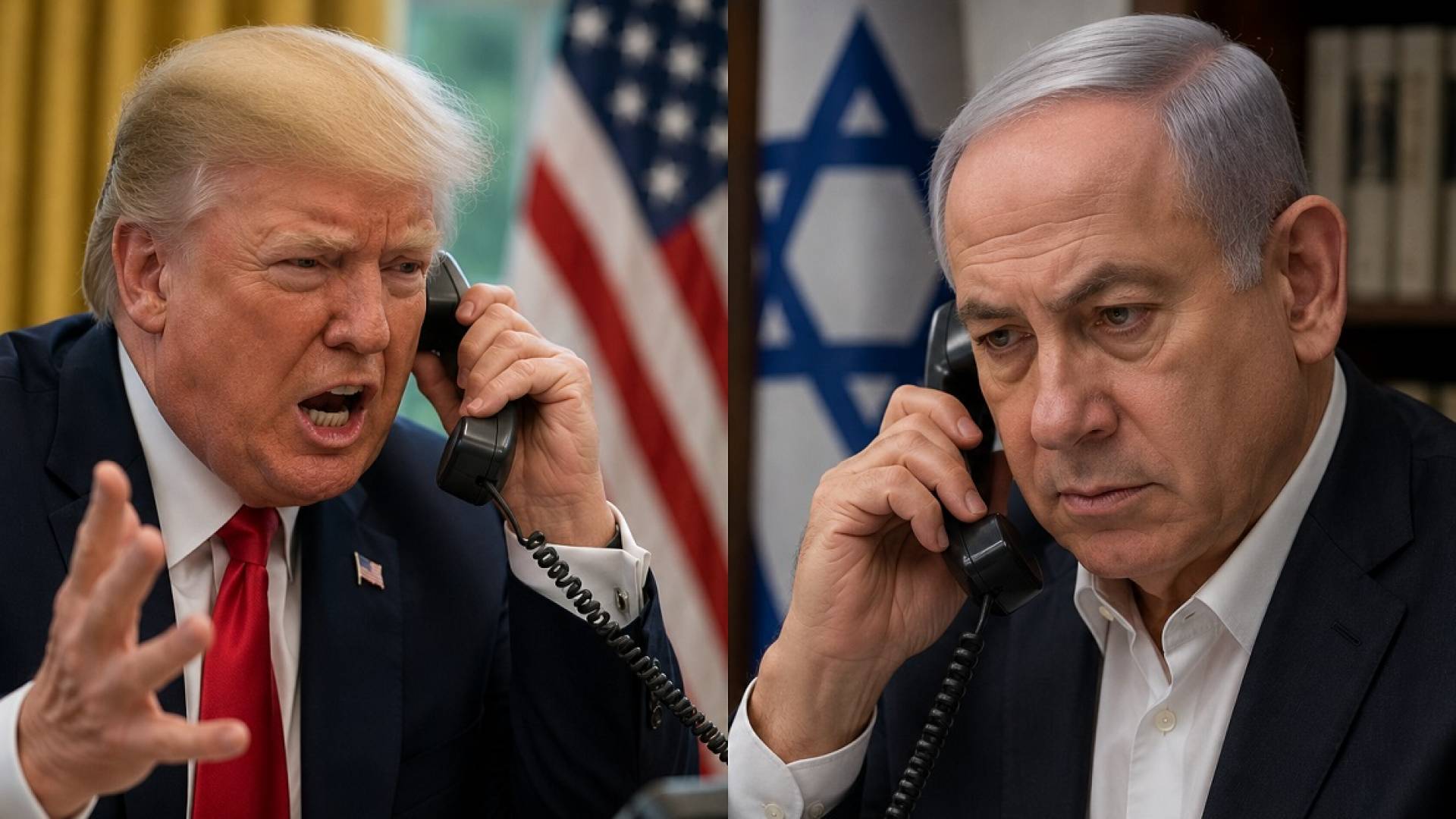
The move deeply angered US President Trump, who had just managed to halt a similar 'Israeli' operation during a tense phone call days earlier, a conversation where Trump reportedly lost his temper and called Netanyahu "fking crazy".
Fulfilling a prior vow to respond if 'Israel' hit the Lebanese capital, Iran immediately retaliated by launching a wave of missiles toward 'Israeli' territory, a threat some factions within the 'Israeli' military had mistakenly dismissed as empty bluster.
"Bibi, you do what you do"
With the threat of an all-out war looming, Trump called Netanyahu on Sunday evening to demand restraint.
Trump argued that a sweeping diplomatic deal with Tehran was just days away, making retaliatory strikes unnecessary.
According to an 'Israeli' source, Trump told Netanyahu that if a deal wasn't reached, he might personally lead the strikes on Iran later.
While US officials described the Sunday night call as "polite" and "calmer" than previous outbursts, Netanyahu aggressively pushed back.
The 'Israeli' Prime Minister argued that failing to respond would signal that Iran had the upper hand and could successfully deter both Washington and 'Israel'.
The call ended in a dangerous gray area.
While US officials believed they had bought more time, Netanyahu interpreted Trump's opposition as a soft warning rather than a firm veto.
As one US official bluntly recalled:
"There is no way Bibi could have interpreted what the president told him as an agreement. He was expressly told the president didn't support it, but he does what he does."
Following an emergency meeting with his security cabinet, Netanyahu greenlit the strikes anyway.
To smooth over the fallout, 'Israeli' officials held a late-night call with Secretary of State Marco Rubio to reach an understanding on the targets.
'Israeli' jets subsequently struck a key component of Iran's largest petrochemical facility, alongside other targets in Tehran.
Trump's final ultimatum
The strike on Tehran triggered a furious counter-response. Iran launched a massive, fresh barrage of missiles, this time directly targeting Tel Aviv.
By Monday morning, two more rounds of direct strikes and counterstrikes had pushed the region to the absolute brink of total war.
While US forces did not participate in the offensive operations, US defense officials confirmed American military assets actively helped the 'Israeli' military intercept incoming Iranian missiles.
As 'Israel' prepared for its largest operation yet -a Monday wave aimed at dozens of highly sensitive targets inside Iran- the backchannels exploded with panic.
Trump told Axios in a phone interview that he received frantic calls from five regional countries pleading with him to stop Netanyahu.
Simultaneously, the White House received a direct message from Tehran stating that the Iranians were willing to stop shooting if 'Israel' did the same.
Armed with this leverage, Trump placed a final, decisive call to Netanyahu, delivering a brutal ultimatum.
"I said, 'Bibi, you better be careful, or you will be on your own very soon,'" Trump told Axios, explicitly warning the prime minister that he risked fighting Iran entirely alone if he proceeded.
Faced with the threat of losing American backing, Netanyahu backed down and ordered senior military commanders to cancel the massive Monday wave.
Diverging reality
Though Trump insists that a "phenomenal" deal to permanently stop Iranian nuclear enrichment is imminent, the view from Tehran remains deeply cynical.
Iran's parliament speaker and chief negotiator, Mohammad-Bagher Ghalibaf, publicly blasted Trump's claims on Monday, stating that the US draft memorandum contradicted previous agreements and concluding, "We have no trust in the other side." Ghalibaf added that Iran's military pressure has successfully redrawn the ground rules in Lebanon.
Ultimately, the chaotic 24-hour flashpoint underscores a widening geopolitical rift between the two allies.
As one US official summarized, the core issue is that the political survival of both leaders is now actively at odds: "Bibi needs the war to continue to stay politically alive in Israel, and Trump needs the war to end to stay politically alive in the US"