


Day 80 | Trump to Iran: ‘Clock is ticking’ for reaching US agreement
Trump said the “clock is ticking” for Iran to reach a peace deal with the United States, warning there “won’t be anything left of them” if no agreement is reached. The remarks came as Iran’s Mehr news agency reported that Washington’s latest response to Tehran’s proposed negotiation agenda offered no meaningful concessions.
Meanwhile, a drone strike in the UAE triggered a fire in an electrical generator at the Barakah Nuclear Energy Plant in the al-Dhafra region, raising fresh concerns over regional security tensions.
In Lebanon, 'Israel' said it had struck 100 sites in the country’s south over the past two days, despite negotiators agreeing to a 45-day extension of the supposed “ceasefire.”
Tehran also announced it will soon unveil a plan to regulate maritime traffic and impose shipping tolls in the Strait of Hormuz, a move that could further heighten tensions along one of the world’s most critical oil transit routes.
Day 81 of the US-‘Israeli’ war on Iran
For further updates - visit the link below.
Read more: Day 81 | Trump says attack on Iran put on hold after Gulf states’ intervention
Trump says delaying Iran attack at request of Gulf leaders
US President Donald Trump said he was postponing a planned attack on Iran scheduled for Tuesday at the request of Gulf leaders amid "serious negotiations" with Tehran.
Trump's sudden announcement on social media on Monday came after Iran said it had responded to a new US proposal aimed at ending the war.
Trump said he would "hold off on our planned Military attack of the Islamic Republic of Iran, which was scheduled for tomorrow," in a message on his Truth Social network.
The US president said he had been asked to do so by the leaders of Qatar, Saudi Arabia and the United Arab Emirates as "serious negotiations are now taking place."
The Gulf allies believe "a Deal will be made" that includes "NO NUCLEAR WEAPONS FOR IRAN!" added Trump.
Trump said he had informed the US military "that we will NOT be doing the scheduled attack of Iran tomorrow."
But he said he had "further instructed them to be prepared to go forward with a full, large scale assault of Iran, on a moment's notice, in the event that an acceptable Deal is not reached."
Trump had given Iran a series of increasingly ominous warnings in the days since his return from a trip to China to meet President Xi Jinping.
Late Sunday he said the "clock is ticking" and threatened that "there won't be anything left" of Iran if no peace deal is reached.
The United States and ‘Israel’ have been locked in a war with Iran since US and Israeli forces launched strikes in late February.
Trump has struggled to break an impasse in negotiations and end the conflict, which has shaken the Middle East and sent energy prices climbing.
The two sides have held only a single round of talks in Pakistan despite a fragile ceasefire in April.
On Sunday, Iran's Fars news agency said Washington had presented a five-point list, which included a demand for Iran to keep only one nuclear site in operation and transfer its stockpile of highly enriched uranium to the United States.
Fars said that the Iranian proposal had emphasized that Tehran would continue to manage the strategic Strait of Hormuz, a vital energy conduit which Iran has largely kept closed since the start of the war.
On Monday, the Persian Gulf Strait Authority (PGSA), a new body Iran has set up to manage the Hormuz strait, said it would provide "real-time updates" on X of operations and developments in the waterway.
Trump says Iran must open up the strait as part of any deal.
Trump says delaying attack on Iran scheduled for Tuesday
US President Donald Trump said he would "hold off" an attack on Iran scheduled for Tuesday at the request of Gulf leaders.
Trump said on his Truth Social network on Monday that "serious negotiations" were now underway with Iran and that Gulf states believed "a deal will be made."
But he said Washington was ready for a "full, large scale assault of Iran, on a moment's notice, in the event that an acceptable Deal is not reached."
“Dialogue does not mean surrender,” says Iran’s President
Iran’s President Masoud Pezeskhian said Monday that peace talks with the United States aim to “safeguard the interests and honor” of the Islamic Republic.
“Dialogue does not mean surrender. The Islamic Republic of Iran enters into dialogue with dignity, authority, and the preservation of the nation's rights, and under no circumstances will it retreat from the legal rights of the people and the country,” Pezeshkian says on X, amid the stalled negotiations with Washington.
“We will serve the people with logic and with all our might, to the end, and safeguard the interests and honor of Iran.
Trump says Iran knows what’s “going to be happening soon”
US President Donald Trump said Monday he is “not open” to offer Iran any concession amid their stalled peace talks.
Iran knows “what’s going to be happening soon,” Trump said in a threat to Tehran, according to statements given to The New York Post.
The comments come after Iran said on Monday it had responded to a new US proposal aimed at ending the war, adding that diplomatic exchanges continue despite Iranian media reports describing Washington's demands as excessive.
"As we announced yesterday, our concerns were conveyed to the American side," foreign ministry spokesman Esmaeil Baqaei told a news briefing, adding that exchanges were "continuing through the Pakistani mediator".
Baqaei defended Iran's demands, including the release of Iranian assets frozen abroad and the lifting of long-standing sanctions.
On the possibility of Iran suspending uranium enrichment for 20 years, Trump said: “I’m not open to anything right now”.
“I can tell you they want to make a deal more than ever, because they know we’re—what’s going to be happening soon,” he continued, adding that he is not “frustrated” with Iran.
US extends sanctions waiver on Russian at-sea oil by 30 days: Treasury
The US Treasury on Monday extended its sanctions waiver for Russian oil cargoes that were already at sea by 30 days, as global energy prices continue to surge due to the Iran war.
The latest "temporary 30-day general license" will "provide the most vulnerable nations with the ability to temporarily access Russian oil currently stranded at sea," Treasury Secretary Scott Bessent said in a social media post.
Lebanon president says he will “do the impossible” to stop war with ‘Israel’
Lebanese President Joseph Aoun said Monday he was ready to "do the impossible" to stop the war with ‘Israel’, as the health ministry said ‘Israeli’ strikes have killed more than 3,000 people.
Aoun's comments came as the ‘Israeli’ army carried out another series of strikes in south Lebanon, while Hezbollah said it had struck a military target in northern ‘Israel’.
Since the start of the ceasefire on April 17, ‘Israel’ has continued to launch strikes, carry out demolitions and issue evacuation orders in south Lebanon, saying it is targeting the Iran-backed armed group.
On Monday, it issued fresh evacuation warnings to three southern villages, and later repeated its warning to one on the outskirts of the coastal city of Tyre.
Hezbollah has also continued operations against ‘Israeli’ forces in south Lebanon and northern ‘Israel’, including what it said was a drone attack Monday on "the vehicle of the commander of the 300th Brigade of the Israeli enemy army".
On Monday, the health ministry said the death toll from ‘Israeli’ strikes since the start of the war on March 2 had reached 3,020, with 211 people 18 and under and 116 healthcare workers among those killed.
“The framework that Lebanon has set for the negotiations consists of an Israeli withdrawal, a ceasefire, the deployment of the army along the border, the return of the displaced, and economic aid,” Aoun said in a statement Monday.
“My duty, based on my position and my responsibility, is to do the impossible, and to choose what is least costly, in order to stop the war against Lebanon and its people,” he added.
Last week the truce was extended for 45 days following a third round of talks between Lebanese and ‘Israeli’ representatives in Washington, discussions to which Hezbollah is opposed.
But the ceasefire has failed to stop the violence, with Hezbollah on Monday saying it had fired a drone at a military target in northern Israel.
Ongoing demolitions
The target was "an Iron Dome platform belonging to the Israeli enemy army" based in a military encampment in northern Israel, Hezbollah said, referring to ‘Israel's’ air defence system.
The attack was a response to ‘Israeli’ violations of the ceasefire, it added.
Lebanon's state-run National News Agency reported a series of ‘Israeli’ strikes across the south.
The ‘Israeli’ military also issued an evacuation warning for three southern Lebanese towns.
The attacks came a day after ‘Israeli’ strikes killed seven people in Lebanon, including a member of the group Palestinian Islamic Jihad in the country's northeast, far from the ‘Israel’-Lebanon border.
‘Israeli’ soldiers have invaded and occupied part of south Lebanon, operating inside an ‘Israeli’-declared "yellow line" that runs around 10 kilometres (six miles) north of the border. They have carried out large-scale demolitions in the area.
‘Israeli’ Prime Minister Benjamin Netanyahu said on Sunday his country was facing the challenge of neutralising first-person view drones, as Hezbollah has increasingly made use of the tech to strike ‘Israeli’ forces.
‘Israeli’ attacks have killed more than 2,900 people in Lebanon since the start of the war, including more than 400 since the ceasefire took effect on April 17, according to Lebanese authorities.
Iran threatens to impose permits on internet cables passing through Hormuz
Iran's Islamic Revolutionary Guard Corps said Monday that internet fibre optic cables passing through the Strait of Hormuz could be brought under a system of permits as Tehran tightens control over the waterway.
"Following the imposition of control over the Strait of Hormuz, Iran, citing its absolute sovereignty over the bed and subsoil of its territorial sea... could declare that all fibre-optic cables passing through the waterway are subject to permits," the IRGC said, in a social media post.
Iran’s new offer “insufficient” and risks return to war: Axios
Iran's new and “revised” offer is insufficient and risks a return to war, according to senior US officials cited by Axios.
“The White House believes it is not a meaningful improvement and is insufficient for a deal,” the report by Axios said.
US officials are warning military action could resume if Tehran “refuses major nuclear concessions,” it added.
Trump claims media would spin total Iranian surrender as "brilliant victory”
US President Donald Trump targeted mainstream media outlets, claiming they are so biased against his administration that they would frame an absolute Iranian military defeat as a victory for Tehran.
"If Iran surrenders, admits their Navy is gone and resting at the bottom of the sea, and their Air Force is no longer with us, and if their entire Military walks out of Tehran, weapons dropped and hands held high... and admit their defeat to the great power and force of the magnificent U.S.A.," Trump wrote on Truth Social.
He asserted that even under those conditions, major news organizations—which he labeled "the Fake News Media"—would distort reality.
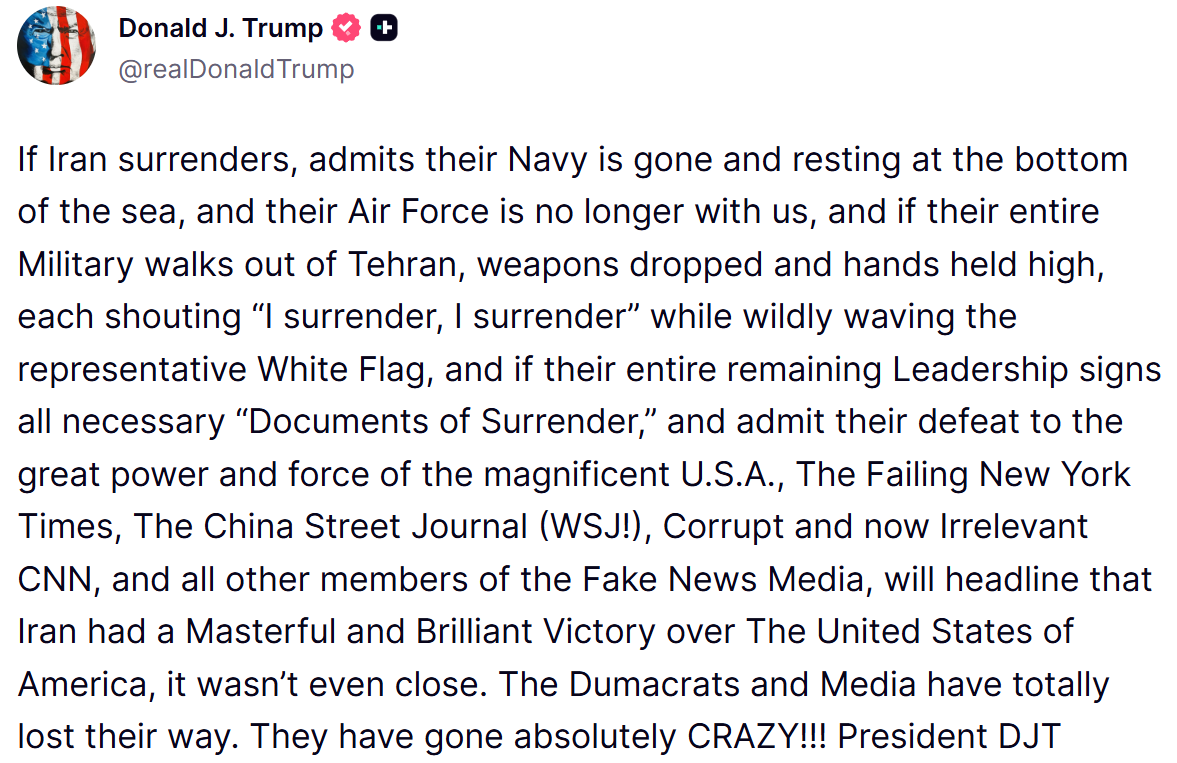
Trump explicitly singled out several prominent publications, using derogatory nicknames including "The Failing New York Times," "The China Street Journal (WSJ!)," and "Corrupt and now Irrelevant CNN."
He claimed these outlets would run headlines declaring that "Iran had a Masterful and Brilliant Victory over The United States of America, it wasn’t even close."
The President concluded his post by attacking his political opponents and the press collectively, writing, "The Dumacrats and Media have totally lost their way. They have gone absolutely CRAZY!!!"
Pakistan sent fighter jets, troops to Saudi Arabia during Iran war: Reuters
Pakistan deployed approximately 8,000 troops, a squadron of fighter jets, drones, and an advanced air defense system to Saudi Arabia during the Iran war under a mutual defense pact, according to Reuters citing sources.
The deployment reportedly includes a full squadron of around 16 JF-17 fighter aircraft, jointly developed with China, which arrived in early April, along with two squadrons of drones and a Chinese HQ-9 air defense system.
Pakistani personnel operate all equipment, with Saudi Arabia financing the operation. Sources indicate a pledge to send additional forces if required.
It builds upon longstanding military ties, with Pakistan previously deploying smaller contingents for training and operational support, now expanded significantly under the Strategic Mutual Defence Agreement signed in September 2025.
The pact commits both nations to treat aggression against one as an attack on the other.
The current deployment follows Iranian strikes on Saudi energy infrastructure that resulted in casualties.
Iran says the attacks, which also extended to all Gulf countries, are “retaliation” for US-‘Israeli’ strikes.
Notably, Pakistan is simultaneously serving as the primary mediator in efforts to resolve the ongoing Iran conflict, which has involved the United States and regional actors.
Islamabad has facilitated message relays, hosted talks, and supported diplomatic initiatives toward a ceasefire, with backing from Saudi Arabia and others.
‘Israeli’ military says intercepted three targets after sounds heard in Upper Galilee
The ‘Israeli’ military said that about 10 rockets were launched by Hezbollah, which activated alarms in the settlements of Kiryat Shmona and Metula.
“Most of the rockets were aimed at IDF forces in southern Lebanon, while two rockets crossed into Israeli territory and exploded in an open area,” a statement by the ‘Israeli’ military said, cited by Hebrew media.
There were no casualties, the statement added.
Hezbollah and ‘Israel’ continue to trade blows despite a ceasefire agreement between ‘Israel’ and Lebanon brokered in April.
Iranian TV reports 1,500 ships waiting in Strait of Hormuz for passage approval
Strait of Hormuz has seen around 1,500 vessels waiting for clearance to pass, according to Iranian state television, which said the ships are awaiting permission from the naval forces of the Islamic Revolutionary Guard Corps.
The report comes amid heightened regional tensions affecting maritime traffic through one of the world’s most critical oil shipping routes, though independent verification of the figures has not been provided.
US agrees to temporarily waive Iran oil sanctions: Tasnim
- US agreed to temporarily waive sanctions on Iranian oil during the ongoing negotiations.
- The proposed US framework offers a temporary exemption via the Office of Foreign Assets Control (OFAC).
- Iran continues to demand the permanent lifting of all economic sanctions.
The United States has agreed to temporarily lift sanctions on Iranian oil within a newly drafted negotiating framework.
A source close to the diplomatic negotiating team confirmed the development to Tasnim news agency, noting that the concession marks a distinct shift from the previous texts put forward by American negotiators.
Under the terms of the updated text, the US has consented to waive oil sanctions specifically during the active negotiation period.
A sanctions waiver represents a temporary exemption or provisional lifting of economic penalties, rather than a permanent policy reversal.
Read more: Iran submits response to new US proposal
Frictions persist
Despite the breakthrough in the text, a significant gap remains between the two sides regarding the ultimate scope of the relief.
The United States has proposed a temporary suspension of restrictions enforced by the Office of Foreign Assets Control (OFAC), which would remain in place only until a final, comprehensive understanding is officially reached.
However, the Iranian delegation is maintaining a rigid stance on the nature of the economic rollbacks.
Iran continues to insist that the permanent lifting of all sanctions levied against the country must be included as an absolute, binding component of the United States' core commitments before a final deal can be finalized.
Jordan condemns drone attack over Saudi Arabia
- Jordan condemned the drone attack targeting Saudi Arabia, labeling it a violation of international law.
- The condemnation follows the three hostile drones originating from Iraqi airspace were intercepted over Saudi territory.
- The Saudi Ministry of Defense has asserted its right to respond to the violation at a time and place of its choosing.
The Jordanian Ministry of Foreign Affairs and Expatriate Affairs issued a sharp condemnation on Monday following a cross-border drone attack directed at Saudi Arabia.
The diplomatic rebuke characterizes the incident as a flagrant violation of Saudi sovereignty, a direct threat to regional stability, and a blatant breach of international law and the United Nations Charter.
In an official statement, the Jordanian Foreign Ministry affirmed Amman's absolute solidarity with the Kingdom of Saudi Arabia.
The ministry emphasized Jordan’s unwavering stance alongside Riyadh, supporting any and all steps the Saudi government deems necessary to safeguard its territories, sovereignty, and the safety of its citizens and residents.
دان الأردن اليوم الاعتداء الذي تعرضت له المملكة العربية السعودية الشقيقة بثلاث مسيرات قادمة من الأجواء العراقية؛ انتهاكا سافرا لسيادة السعودية الشقيقة، وتهديدا لأمنها واستقرارها وسلامة أراضيها، وخرقا صارخا للقانون الدولي وميثاق الأمم المتحدة.
— وزارة الخارجية وشؤون المغتربين الأردنية (@ForeignMinistry) May 18, 2026
وأكدت وزارة الخارجية وشؤون… pic.twitter.com/TmAXuKxkeU
Saudi Arabia interception
The diplomatic backing from Amman comes directly in the wake of a security briefing released by the Saudi Ministry of Defense.
According to the official spokesperson for the ministry, Major General Turki Al-Maliki, Saudi defense systems intercepted and destroyed three unmanned aerial vehicles (UAVs) on the morning of Sunday.
Military tracking confirmed that the three drones had violated the Kingdom's sovereign airspace after crossing over from Iraqi airspace.
Riyadh warns of operational response
While Saudi Arabia successfully neutralized the immediate airborne threat without reported casualties or infrastructure damage, the defense establishment warned that the cross-border provocation would not go unanswered.
Major General Al-Maliki affirmed that the Saudi Ministry of Defense reserves the right to respond to the aggression at the appropriate time and place.
He stressed that the military will take and implement all necessary operational measures to counter any future attempts to infringe upon the Kingdom’s sovereignty, security, and the safety of the people within its borders.
'Israeli' military orders evacuation for three southern Lebanese towns
- 'Israeli' military has ordered the immediate evacuation of three southern Lebanese towns, Harouf, Burj Al-Shamali, Dibal.
- Residents were ordered to clear a minimum distance of 1,000 meters into open areas.
The 'Israeli' military has issued an immediate evacuation directive for residents living in three specific towns across southern Lebanon.
The high-alert warning, published Monday by Arabic-language military spokesperson Avichay Adraee, signals an imminent surge in heavy airstrikes and localized ground actions in the sector, threatening to completely unravel the fragile regional ceasefire.
The urgent notice commands all remaining civilians in the villages of Harouf, Burj Al-Shamali, and Dibal to abandon their homes without delay.
Adraee stated that the 'Israeli' military are compelled to act "forcefully" in these sectors, explicitly citing what the military characterized as persistent violations of the active truce agreement by Hezbollah.
1,000-meter buffer zone
The operational warning emphasizes that civilians must distance themselves from built-up municipal borders, routing population movements toward unpopulated perimeters.
#عاجل انذار عاجل الى سكان لبنان المتواجدين في البلدات والقرى التالية: حاروف, برج الشمالي, دبعال
— افيخاي ادرعي (@AvichayAdraee) May 18, 2026
في ضوء قيام حزب الله الارهابي بخرق اتفاق وقف اطلاق النار يضطر جيش الدفاع على العمل ضده بقوة. جيش الدفاع لا ينوي المساس بكم.
حرصا على سلامتكم، عليكم إخلاء منازلكم فورا… pic.twitter.com/y8kwF1lhXO
The 'Israeli' military announced it struck over 30 Hezbollah infrastructure sites -claiming it targeted weapons depots and observation posts- and eliminated several operatives over the past 24 hours to neutralize ongoing threats against its soldiers and civilians in southern Lebanon.
Iran submits response to new US proposal
Iran announced Monday that it had submitted its response to a new proposal from the United States aimed at ending the ongoing war, while confirming that diplomatic contacts between the two sides remain active.
Iranian Foreign Ministry spokesperson Esmaeil Baghaei said during a press conference that Tehran had clearly conveyed its concerns to the American side.
“As we announced yesterday, our concerns were clearly communicated to the US side,” Baghaei said.
The remarks came amid Iranian media reports describing the American demands included in the proposal as “excessive.”
Baghaei added that communication channels with the US administration remain open through Pakistani mediation, noting that meetings and correspondence between the two sides are ongoing.
He did not provide further details regarding the contents of Iran’s response or the specifics of the US proposal.
Earlier, the Pakistani embassy in Iran said Islamabad and Tehran had discussed efforts related to peace mediation and the possible resumption of talks.
Iran conflict costs $25 billion, counting
- Reuters reveal that the ongoing conflict with Iran has saddled global corporations with at least $25 billion in losses.
- Iran's blockade of the Strait of Hormuz has pushed crude oil prices past $100 a barrel, polyethylene, aluminum, and fertilizers.
- Over 270 multinational firms have issued profit warnings.
The ongoing military conflict involving the United States, 'Israel', and Iran has already cost global corporations at least $25 billion, with financial damage accelerating daily.
A comprehensive Reuters analysis of corporate disclosures from listed entities across the United States, Europe, and Asia reveals a corporate landscape severely fractured by soaring energy prices, severed maritime trade routes, and a persistent blockade of the Strait of Hormuz.
The economic shockwave represents the latest disruption in a multi-year cycle of global business volatility, following hard on the heels of the COVID-19 pandemic and the war in Ukraine.
According to data compiled from earnings reports, at least 279 multinational firms have initiated defensive operational shifts.
These measures range from implementing emergency fuel surcharges and cutting manufacturing output to freezing stock buybacks, suspending dividends, and furloughing personnel.
"This level of industry decline is similar to what we have observed during the global financial crisis and even higher than during other recessionary periods," Whirlpool CEO Marc Bitzer told market analysts.
The home appliance giant recently slashed its full-year financial forecast in half and suspended its dividend payout, noting that cash-strapped consumers are choosing to repair old machines rather than purchase new ones.
Commodity shock
The core catalyst of the corporate distress is Iran’s strategic chokehold on the Strait of Hormuz, the planet's most vital energy transit corridor.
The naval standoff has propelled crude oil prices above $100 a barrel, marking a spike of more than 50% since the outbreak of hostilities three months ago.
The closure of the waterway has paralyzed the transit of consumer goods and choked the supply of critical industrial inputs, including helium, aluminum, fertilizers, and polyethylene.
Approximately 20% of the companies reviewed in the analysis -spanning industries from cosmetics and tire manufacturing to global airlines and cruise lines- flagged a direct negative hit to their balance sheets.
European and United Kingdom firms, already vulnerable to elevated energy baselines, comprised the largest portion of affected businesses, while Asian corporations accounted for nearly a third due to their deep structural reliance on Middle Eastern oil
'Israel' kills Palestinian Islamic Jihad commander in Baalbek strike
A commander in the Palestinian Islamic Jihad movement and his daughter were killed early Monday in an airstrike targeting an apartment on the outskirts of Baalbek in eastern Lebanon, according to Lebanon’s state news agency.
The report said the strike hit a residential unit housing a Palestinian family, resulting in the deaths of the senior figure and his daughter.
Top Iranian official warns US to end siege before ‘Sea of Oman becomes your graveyard’
Mohsen Rezaei, a member of Tehran’s Expediency Council and former commander in the Islamic Revolutionary Guard Corps, has warned the United States to end its naval blockade of Iranian ports, saying Iran’s military is prepared for further confrontation.
Speaking on Iranian state television, Rezaei issued a direct warning to Washington, saying: “We advise the US military to end the siege before the Sea of Oman becomes your graveyard.”
He described the US blockade as an “act of war” and said Tehran considers confronting it a legitimate right.
Rezaei said prolonged restrictions on Iranian maritime activity would have broader international repercussions.
“The longer they prolong the naval blockade of Iran, the greater the damage to countries around the world will be,” he said, referring to potential disruptions to regional trade routes and global energy markets.
Despite the sharp rhetoric, Rezaei said diplomatic efforts to end the standoff remain ongoing, while insisting the burden lies with Washington to demonstrate genuine intent.
“It is America that must prove itself now,” he said. “Our armed forces have their finger on the trigger, and, at the same time, diplomacy continues.”
The US blockade began on April 13, with US President Donald Trump saying it would remain in place until Tehran agrees to a peace deal under terms set by Washington.


