
US Defense Secretary Pete Hegseth

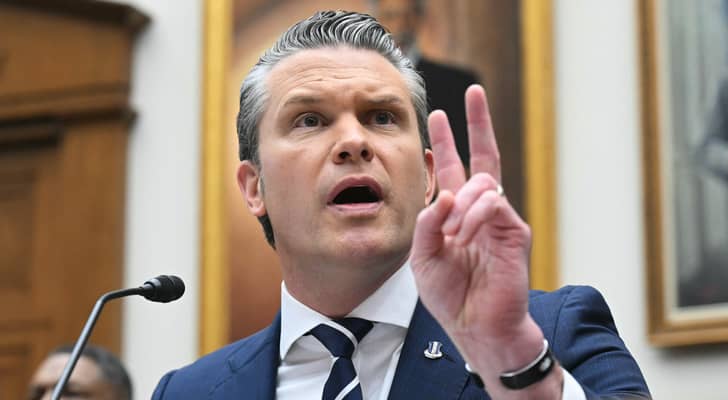
US Defense Secretary defends $1.5 trillion budget, Congress hearing
Note: AI technology was used to generate this article’s audio.
- Defense Secretary Pete Hegseth appeared before Congress to defend a record $1.5 trillion budget request for 2027, a 50% increase from the previous year.
- Hegseth claimed significant military success in Iran within weeks, reaffirmed Trump's determination to prevent a nuclear-armed Tehran.
- The Secretary called for a "new NATO" that returns to its "warrior roots", demanding that allies bear a greater share of the security burden.
In a high-stakes appearance before the House Armed Services Committee on Wednesday, Defense Secretary Pete Hegseth broke months of public silence to defend a staggering $1.5 trillion budget request for 2027.
Hegseth, who has faced mounting criticism for avoiding congressional scrutiny since the outbreak of the war with Iran, used the hearing to report military progress and outline the "peace through strength" principal.
The hearing marks the first time the Secretary has testified under oath since the conflict began on February 28, ending a period where he primarily communicated via conservative media outlets and religious references.
Reporting success
During his testimony, Hegseth offered an optimistic assessment of the recent combat operations. "We have achieved forms of military success in Iran in just a matter of weeks," Hegseth told the committee, though he did not provide specific details on the extent of the damage or the current status of the Iranian leadership.
Despite these claims of success, Hegseth emphasized that the primary mission remains unchanged. He stated that "President Trump is determined that Iran will not obtain a nuclear weapon," reaffirming a core objective of the administration that has remained a central justification for the ongoing military and economic pressure campaign.
A ‘New NATO’ and Middle East Burden Sharing
In his most provocative remarks, Hegseth called for the creation of a "new version of NATO," arguing that the alliance must be "reforged to its combat roots."
He stated that the era of American-led security without reciprocal effort is over, emphasizing that "burden sharing is a central part of our strategy in the Middle East."
Hegseth pressured regional partners to do more to advance mutual interests, but singled out one nation for high praise. He described 'Israel' as a "model ally" that has demonstrated the "ability and desire to fight side-by-side with our forces."
Rebuilding the 'Arsenal of freedom'
The proposed $1.5 trillion budget is intended to transition the US defense industrial base back to a "war footing." Hegseth argued that the massive increase is necessary to build a military that "Americans can be proud of" and to achieve "peace through strength."
"This budget request enables the Pentagon to fulfill its mission of establishing peace through force," Hegseth testified, noting that the funds would enable the US to modernize its capabilities while maintaining an active stance in the region.
Bipartisan backlash
Despite Hegseth’s forceful presentation, he faced a barrage of questions from both sides of the aisle. Democrats on the committee, led by Representative Wesley Bell (D-MO), questioned the Secretary about the administration’s "undefined" goals.
Bell noted that objectives have shifted from neutralizing nuclear programs to "regime maintenance" and destroying an "antiquated navy."
Republicans also expressed confusion, particularly regarding the recent ousting of Navy Secretary John Phelan and General Randy George in the midst of an active war.
Some GOP members questioned whether a 50% spending hike is sustainable, even as they support the broader goal of military modernization.
As the hearing continues, the focus remains on whether Hegseth can convince a skeptical Congress that his "Dream Military" is worth the unprecedented price tag, or if the US is drifting into a "frozen conflict" without a clear exit strategy.







