

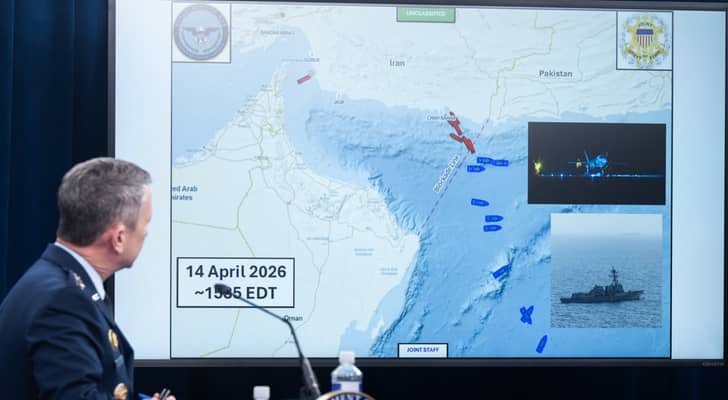
Day 50 | Iran closes Strait of Hormuz again, citing US ‘breaches of trust’
The 2026 Iran War began on February 28, when the United States and ‘Israel’ launched a large-scale attack on Iran, unleashing nearly 900 airstrikes within 12 hours on the Islamic Republic’s missile systems, air defenses, nuclear facilities, military bases, and leadership targets.
The assault followed years of shadow conflict, including direct missile exchanges in 2024 and a limited 12-day war in 2025 that damaged Iran’s nuclear and ballistic capabilities.
Supreme Leader Ayatollah Ali Khamenei and senior officials were killed in the opening strikes. Iran responded within hours, launching waves of ballistic missiles and drones at ‘Israel’, US bases, and targets across the Gulf.
On April 8, the United States, Iran, and ‘Israel’ agreed to a temporary two-week ceasefire, brokered by Pakistan, with Iran committing to reopen the Strait of Hormuz while negotiations continue toward a broader agreement.
The fragile truce has since come under strain, particularly as ‘Israel’ launched major bombardments in Lebanon and clashes with the Iran-backed group Hezbollah intensified.
Here’s the latest:
- Trump signals imminent talks: US President Donald Trump says a deal with Iran could come “soon,” with possible negotiations expected within days, likely again in Pakistan.
- Draft deal under discussion: Talks now include a potential agreement where Iran would hand over its enriched uranium stockpile in exchange for up to $20 billion in frozen funds, alongside a temporary halt to enrichment.
- Key disputes persist: Major disagreements remain over uranium enrichment limits, sanctions relief, and enforcement mechanisms, despite signs of progress.
- Strait of Hormuz reopens, blockade remains: Iran has declared the Strait open to commercial shipping during a ceasefire, but the US naval blockade is still in place, creating a contradictory situation at sea.
- Shipping resumes cautiously: Vessel traffic has begun to return, though security concerns and coordination requirements with Iranian forces continue to limit full normalization.
- ‘Israel’–Lebanon ceasefire largely holding: A US-brokered ceasefire between ‘Israel’ and Lebanon is mostly holding, though sporadic violations, including a reported ‘Israeli’ drone strike.
- Strikes pause under US pressure: Trump has temporarily halted further ‘Israeli’ escalation in Lebanon as part of broader efforts to stabilize negotiations.
- Iran warns against coercion: Iranian officials say negotiations cannot proceed under pressure, warning of consequences if maritime restrictions or military threats continue.
- Markets react sharply: Oil prices have dropped by around 10–11% following the reopening of the Strait and optimism over a deal, signaling reduced global supply fears.
Thread ended
This live thread has ended. Follow our online coverage of day 51 of the war, as Iran closes the Strait of Hormuz again.
Read more: Day 51 | Iran closes Hormuz Strait again as Trump warns against “blackmail”
Iranian hospitals damaged from US and ‘Israeli’ strikes
Iranian Red Crescent Society has published what it says is first-time footage documenting severe destruction to hospitals and critical medical facilities inside Iran.
In a statement accompanying the video, the organization said the damage to healthcare infrastructure was the result of intense airstrikes carried out by US and ‘Israeli’ forces during recent confrontations.
The footage shows collapsed hospital wards, damaged operating rooms, and destroyed medical equipment, highlighting the impact on emergency and medical services.
India raises concern over reported attack on Indian-flagged ships near Hormuz
India has summoned Iran’s envoy in New Delhi to express “deep concern” over an attack on two Indian-flagged vessels attempting to pass through the Strait of Hormuz on Saturday.
According to an Indian government source, one of the ships involved was identified as the Sanmar Herald. The crew and vessel were reported to be safe.
India’s foreign ministry said a senior official urged the Iranian ambassador to relay New Delhi’s concerns to Tehran and to resume facilitation of India-bound shipping through the strategic waterway. The ambassador said he would convey the message to Iranian authorities.
IRGC challenges Trump to open Hormuz Strait by force
A commander in Iran’s Islamic Revolutionary Guard Corps (IRGC) Navy said on Saturday that Iranian forces will target any vessel attempting to pass through the Strait of Hormuz without official permission or ignoring naval warnings.
He said control over the strategic waterway is part of Iran’s sovereignty, warning the United States that any military action against Iranian ships would be met with a “firm and immediate response beyond Washington’s expectations.”
The naval commander directly addressed US President Donald Trump, questioning the seriousness of his previous threats to destroy Iran’s naval forces.
“If Trump is serious about his threats, why does he not send his warships to open the Strait of Hormuz by force?” he said, adding that the US Navy’s reluctance to engage directly demonstrates the effectiveness of Iran’s deterrence strategy.
The remarks come amid heightened maritime tensions in the Gulf, with Iran repeatedly signaling its willingness to use the Strait of Hormuz as a strategic pressure point in response to economic sanctions and external pressure.
Iran: Hormuz Strait is fully under our control
Iran’s parliament speaker Mohammad Bagher Ghalibaf said the Strait of Hormuz is under “full control” of Iranian forces, highlighting heightened tensions in the strategic waterway.
Ghalibaf added Iranian forces recently foiled a US attempt to remove naval mines in the area after what he described as a direct threat to target American vessels.
He said the developments reflect Iran’s ability to maintain control over the key maritime passage.
Hezbollah chief: Hormuz move forced ceasefire, sets conditions for lasting truce
- Hezbollah says battlefield resilience drove political shifts
- Claims Iran’s Hormuz closure pressured ceasefire acceptance
- Warns of response to any ‘Israeli’ violations in Lebanon
Hezbollah’s Secretary-General said that developments on the ground were the main driver behind recent political changes, arguing that Iran’s closure of the Strait of Hormuz was the decisive factor that forced Washington to pressure the “occupation” into accepting a ceasefire.
He stressed that the truce would not have been achieved without what he described as the “resistance’s struggle,” which he said proved its ability to impose a balance of deterrence.
Conditions for continuation
The Hezbollah leader said any ceasefire must be mutual, comprehensive, and permanent across all Lebanese territory. He called for the “withdrawal of the enemy” from all occupied Lebanese land up to internationally recognized borders.
He warned that the field would remain open for resistance forces to respond to any ‘Israeli’ violations, adding that Hezbollah would not commit to a one-sided halt in operations if red lines are crossed.
Toward a new phase internally
Hezbollah also signaled openness to “new cooperation” with Lebanese authorities, based on strengthening national sovereignty and preventing internal strife, in what appears to be an effort to reinforce national unity during a sensitive period.
Iran’s Revolutionary Guard comments on Hormuz closure
- Iran says Strait of Hormuz closed from Saturday afternoon
- Move linked to ongoing US “naval blockade” claims
- Tehran dismisses Donald Trump’s statements
- Tehran escalates maritime standoff
Iran’s Islamic Revolutionary Guard Corps announced Saturday the closure of the Strait of Hormuz starting in the afternoon, saying the measure will remain in place until what it described as a US naval blockade is lifted.
In statements carried by Iranian media, the IRGC said the decision was taken after the “enemy” failed to cancel restrictions imposed on Iranian ships and ports.
Warning to global shipping
The IRGC said vessels should rely only on official communications from Iran’s naval authorities for updates, dismissing statements by US President Donald Trump as having “no value.”
The development marks a sharp escalation in tensions in one of the world’s most critical maritime routes, with potential implications for global energy supplies and shipping.
IRGC conducts drone strikes on 'separatist' groups in Iraqi Kurdistan
Iran’s Islamic Revolutionary Guard Corps (IRGC) announced that it has carried out drone strikes targeting members of what it described as a "separatist terrorist" group.
According to the IRGC, the aerial attacks were executed across two distinct areas within the Kurdistan region of Iraq.
Hezbollah supporters rally in Beirut against Lebanon-'Israel' talks
Supporters of Hezbollah held a rally in the southern suburbs of Beirut to back the group's opposition to Lebanon's direct talks with 'Israel'.
The demonstration aimed to show support to Hezbollah's latest stance on the negotiations, which the group has called a "failure" and an act of "surrender".
US prepares to seize Iran-linked oil tankers in coming days, WSJ reports
US forces are preparing to board and seize oil tankers linked to Iran in international waters in the region in the coming days, according to US officials cited by the Wall Street Journal.
The report also said American forces are expected to target and intercept vessels suspected of carrying Iranian oil, as tensions continue to rise over maritime security routes in the area.
Trump says Iran cannot 'blackmail' US over Hormuz threats
US President Donald Trump has sharply rejected Tehran's recent threats regarding the strategic Strait of Hormuz, declaring that the United States will not succumb to Iranian "blackmail."
Khamenei says navy ready to “make enemies taste defeat”
- Iran says its navy is at peak readiness
- Tensions escalate in the Strait of Hormuz
- Rising rhetoric in critical waterway
Iran’s Supreme Leader Mojtaba Khamenei warned Saturday that the country’s naval forces are fully prepared to inflict new defeats on what he described as “enemies,” amid escalating tensions in the Strait of Hormuz.
In a statement published on his official Telegram channel, Khamenei said the navy stands ready “to make the enemies taste the bitterness of new defeats,” in an apparent reference to United States forces.
The remarks are notable as they come from Khamenei, who has not appeared publicly since his election, and at a time of heightened confrontation over one of the world’s most critical maritime corridors.
Tehran tightens control over Strait
Earlier Saturday, Tehran announced it had restored what it called “strict control” over the Strait of Hormuz, reversing a decision made a day earlier to reopen the global shipping route.
Iran’s central military operations room attributed the move to what it described as continued “American piracy” under the guise of a blockade. Officials said Iran had previously allowed a limited number of tankers to pass in good faith but reimposed tighter oversight following US actions.
The Strait of Hormuz remains a key flashpoint, with global markets closely monitoring developments as tensions between Iran and the United States continue to rise.
Lebanon president vows to prosecute those who attacked French UN peacekeepers
Lebanese President Joseph Aoun vowed on Saturday to prosecute those who targeted French UN peacekeepers, killing one and wounding three.
In a statement shared by the presidency, Aoun expressed his condolences to his French counterpart Emmanuel Macron in a phone call, condemning the incident and vowing that Beirut "will not hesitate to pursue those involved and bring them to justice".
France blames Hezbollah for French peacekeeper's death in Lebanon
A French soldier was killed and three others wounded in an attack Saturday on UN peacekeepers in Lebanon that appeared to have been carried out by Hezbollah, French President Emmanuel Macron said.
"Everything points to Hezbollah being responsible for this attack," he said on X, urging Lebanese authorities to arrest the perpetrators.
No date set for next round of Iran-US talks: Iran deputy FM
No date has been set for the next round of Iran-US peace talks brokered by Pakistan following the failure of the first one, Iran's deputy foreign minister said on Saturday.
"Until we agree on the framework, we cannot set the date," Saeed Khatibzadeh told journalists on the sidelines of an annual Turkish diplomatic forum in the southern province of Antalya.
"Now we are focusing on finalising the framework of understanding between two sides. We don't want to enter into any negotiation or meeting which is due to failure which can be pretext for another round of escalation," he said.
Iranian gunboats fire on tanker in Hormuz strait: British maritime security agency
Iranian gunboats fired on a tanker in the Strait of Hormuz on Saturday, a British maritime security agency reported, after Iran's military reversed a pledge to open the route to shipping.
The tanker's captain reported being approached 37 kilometres (23 miles) northeast of Oman by two gunboats of Iran's Revolutionary Guards Corp (IRGC). Without any radio warning, the gunboats "then fired upon the tanker", the UK Maritime Trade Operations Centre said in an online statement.
"Tanker and crew are reported safe. Authorities are investigating."
Statement from supreme leader says Iran's navy 'stands ready' to defeat US
A statement said to have been issued by Iran's supreme leader Mojtaba Khamenei warned Saturday that Tehran's navy was ready to defeat US forces, as the foes sparred over the Strait of Hormuz.
In a statement carried on his Telegram channel, Khamenei, who has not been seen in public since before the start of the war, said Iran's "brave navy stands ready to make the enemies taste the bitterness of new defeats".
Trump 'tweets a lot, talks a lot', Iran's deputy FM says
US President Donald Trump "tweets a lot", Iran's deputy foreign minister said on Saturday after Washington threatened fresh strikes if no deal was reached with Tehran.
"The American side tweets a lot, talks a lot. Sometimes confusing, sometimes, you know, contradictory," Saeed Khatibzadeh told journalists on the sidelines of an annual Turkish diplomatic forum in the southern province of Antalya.
Egypt FM says hopes for Iran-US peace deal 'in the coming days'
Egypt and Pakistan are working "very hard" as mediators to bring about "a final agreement between the United States and Iran", Egypt's foreign minister said Saturday as he attended an Antalya Diplomacy Forum in Turkey.
"We hope to do so (reach an agreement) in the coming days," Badr Abdelatty said, noting that "not only us in the region, but the whole world is suffering from the continuation of this war".
"We are pushing very hard in order to move forward," he said.
'We warned you': Iranian Security Chief issues blunt statement on the Strait of Hormuz
The head of the National Security Committee in the Iranian Parliament, Ebrahim Azizi, has issued a stark message regarding the strategic Strait of Hormuz, taunting Washington for failing to heed Tehran's previous cautions.
In a blunt statement, Azizi declared, "We warned you and you ignored the matter, Now ENJOY the Strait of Hormuz returning to the status quo".


