The "chill path": How India became a post-service haven for 'Israeli' soldiers
Note: AI technology was used to generate this article’s audio.
- Around 80,000 'Israeli' soldiers visit India annually for post-service recovery along the "Hummus Trail."
- India has become a major arms customer and close ally of 'Israel,' reflecting growing ideological and defense alignment.
- The influx of 'Israeli' tourists is transforming local economies and raising ethical concerns amid the 'Israeli' war on Gaza.
For decades, the "chill path" has served as a rite of passage for young 'Israelis' completing their mandatory military service. With the 'Israeli' war on Gaza intensifying, the arrival of roughly 80,000 'Israeli' travelers annually into India is attracting increased scrutiny. Investigative reports, including those from MintPress News, describe a controversial shift: India is increasingly acting as a "detox center" for 'Israeli soldiers seeking respite after operations in the Palestinian territories.
From diplomacy to post-service recovery
Historically, India maintained a staunchly pro-Palestine stance as a leader of the Non-Aligned Movement. Under Prime Minister Narendra Modi, that position has shifted dramatically. Today, the India-'Israel' relationship is cemented by massive defense contracts, with India accounting for roughly 37% of 'Israel’s' international arms sales.
Read more: 'Blood dates': How 'Israeli' exporters use identity theft to bypass global boycotts
Beyond trade, the cultural footprint is visible in towns like Kasol, Rishikesh, and Pushkar:
- Hebrew signage: Cafes and guesthouses cater specifically to 'Israeli' tourists.
- Cultural hubs: Chabad houses and "Hummus Trail" hotspots provide a slice of home for travelers.
- Post-service "detox": Many visitors are active or reserve 'Israeli' soldiers aiming to reset after combat deployments.
Shared ideology and defense
Observers note that the Hindutva movement in India and 'Israeli' Zionism share nationalist approaches and geopolitical outlooks. This alignment has helped position India as 'Israel’s' closest ally in the region.
Impact on local communities
The heavy presence of 'Israeli' tourists has reshaped local economies but also generated tension. In pockets of Himachal Pradesh and Goa, 'Israeli' cultural dominance has altered community dynamics. While tourism revenue is significant, hosting thousands of soldiers recently involved in the 'Israeli' war on Gaza raises ethical questions for locals.
Read more: PM Modi on Indian-origin Jewish: "Israel is their fatherland and India their motherland"
Modi visit strengthens India‑'Israel' alliance
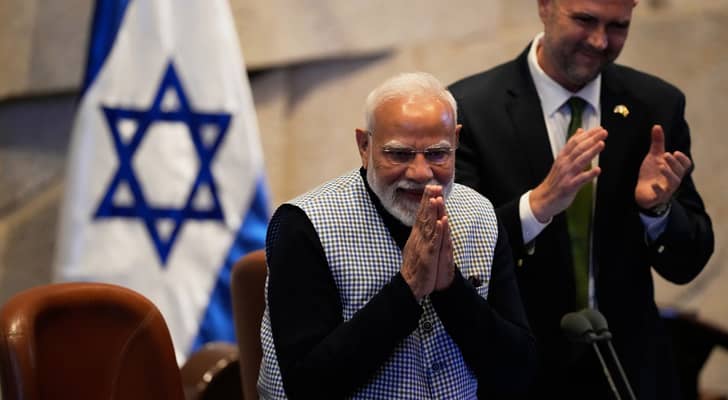
Indian Prime Minister Narendra Modi concluded a two‑day state visit to 'Israel' on February 25‑26, marking a landmark moment in bilateral relations. It was the first time in nearly nine years that Modi traveled to 'Israel', and he became one of the few foreign leaders to address the 'Israeli' parliament, the Knesset, underscoring the deepening diplomatic engagement between New Delhi and 'Israel'.
During the visit, India and 'Israel' agreed to elevate their ties to a “Special Strategic Partnership for Peace, Innovation and Prosperity,” a move that reflects broader cooperation in defence, technology, trade and people‑to‑people exchanges. Leaders from both countries signed a sweeping set of more than a dozen agreements covering areas such as cybersecurity, artificial intelligence, semiconductors and digital payments, including the introduction of India’s Unified Payments Interface (UPI) in 'Israel'.
The trip also served a diplomatic purpose beyond bilateral cooperation. Modi reiterated India’s support for peace initiatives in the Middle East and backed international efforts aimed at resolving the war in Gaza, while highlighting the need for stability across West Asia. Observers say the visit signals a shift in India’s foreign policy toward a more prominent role in regional alliances, with potential implications for security dynamics involving neighbouring countries and strategic corridors such as the India‑Middle East‑Europe Economic Corridor (IMEC).
Economic and defence cooperation stood at the centre of the talks. Trade between the two countries continues to grow, with negotiations underway for a free trade agreement, and defence partnerships expanding to include joint production, technology sharing and cyber cooperation. As 'Israel' relies on India as one of its largest defence partners, the visit is likely to further integrate their strategic industries and enhance long‑term defence coordination.