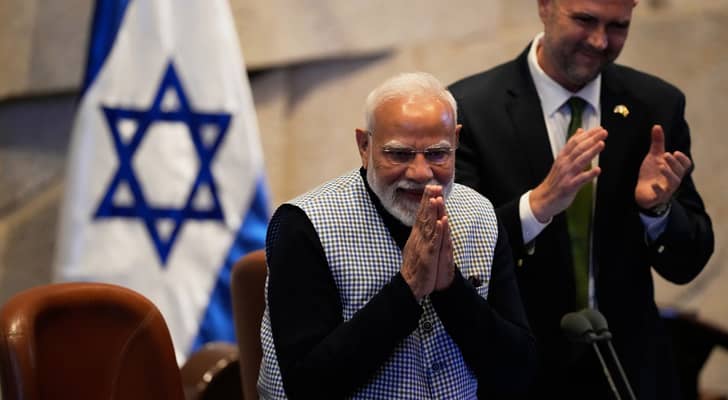
PM Modi on Indian-origin Jewish: "Israel is their fatherland and India their motherland"
Note: AI technology was used to generate this article’s audio.
- PM Modi tells Knesset: "'Israel' is a fatherland and India the motherland," praising Indian Jews in 'Israel'.
- Statement triggers anger among social media users.
During his visit to the Knesset, Prime Minister Narendra Modi addressed the Indian-origin Jewish community in 'Israel', highlighting their dual identity. He said:
"Today, a vibrant Indian-origin Jewish community lives here... They hold firmly that Israel is their fatherland and India their motherland. We are proud of them."
Context of the Statement
The comment referred specifically to the feelings of the Indian Jewish communities, such as the Bene Israel of Maharashtra, the Cochini Jews, and the Baghdadi Jews of Kolkata, who migrated from India to 'Israel'. The Prime Minister praised their dual loyalty: a civic and national connection to 'Israel' as their new homeland, alongside a cultural and emotional attachment to their Indian roots as their motherland.
Diplomatically, the phrasing reflects careful messaging. Modi drew implicitly on ideas popularized by Indian thinker Vinayak Savarkar, framing them in human and social terms to celebrate the community’s loyalty, avoid overt political controversy, and simultaneously signal support to both his Indian audience and the hosts in 'Israel'.
Background of the Visit
The visit is part of India’s broader push to strengthen ties with 'Israel', including cooperation in technology, counter-terrorism, and strategic alignment. The Knesset address was the first by an Indian leader, aimed at honoring the Indian Jewish community while reinforcing bilateral relations.
Social Media Backlash
The statement drew criticism online. Users argued that praising 'Israel' in this way, even when describing the community, risks normalizing support for 'Israel' amid the ongoing Palestinian crisis. Many expressed anger over the symbolic weight of calling 'Israel' a "fatherland," highlighting regional sensitivities.
Israel is a fatherland.
— Amock (@Politicx2029) February 26, 2026
India is a motherland.
And this was Narendra Modi speaking in the Knesset, Parliament of Israel.
On the global stage
Please stop embarrassing Indians any further
pic.twitter.com/VOSqkLG0Dw
Indian social media users reacted with embarrassment and disbelief to PM Modi’s Knesset speech, mocking his phrasing about Indian Jews’ dual loyalty to 'Israel' and India:
"Israeli that Israel is that Fatherland and India that MotherLand"
— Nehr_who? (@Nher_who) February 26, 2026
Wtf that even mean? What kind of speech is this?
Imagine using a Teleprompter and still talking Gibberish.
As an Indian this feels like a Global Embarrassment pic.twitter.com/zMmMdxZdfg
When you have a compromised PM, and that too, an uneducated one, you end up with shameful statements like this.
— Nagrik (@indian_nagrik) February 25, 2026
"Israel is a fatherland and India is a motherland !"
So Israelis are now our father?https://t.co/dc7OpCSdiK