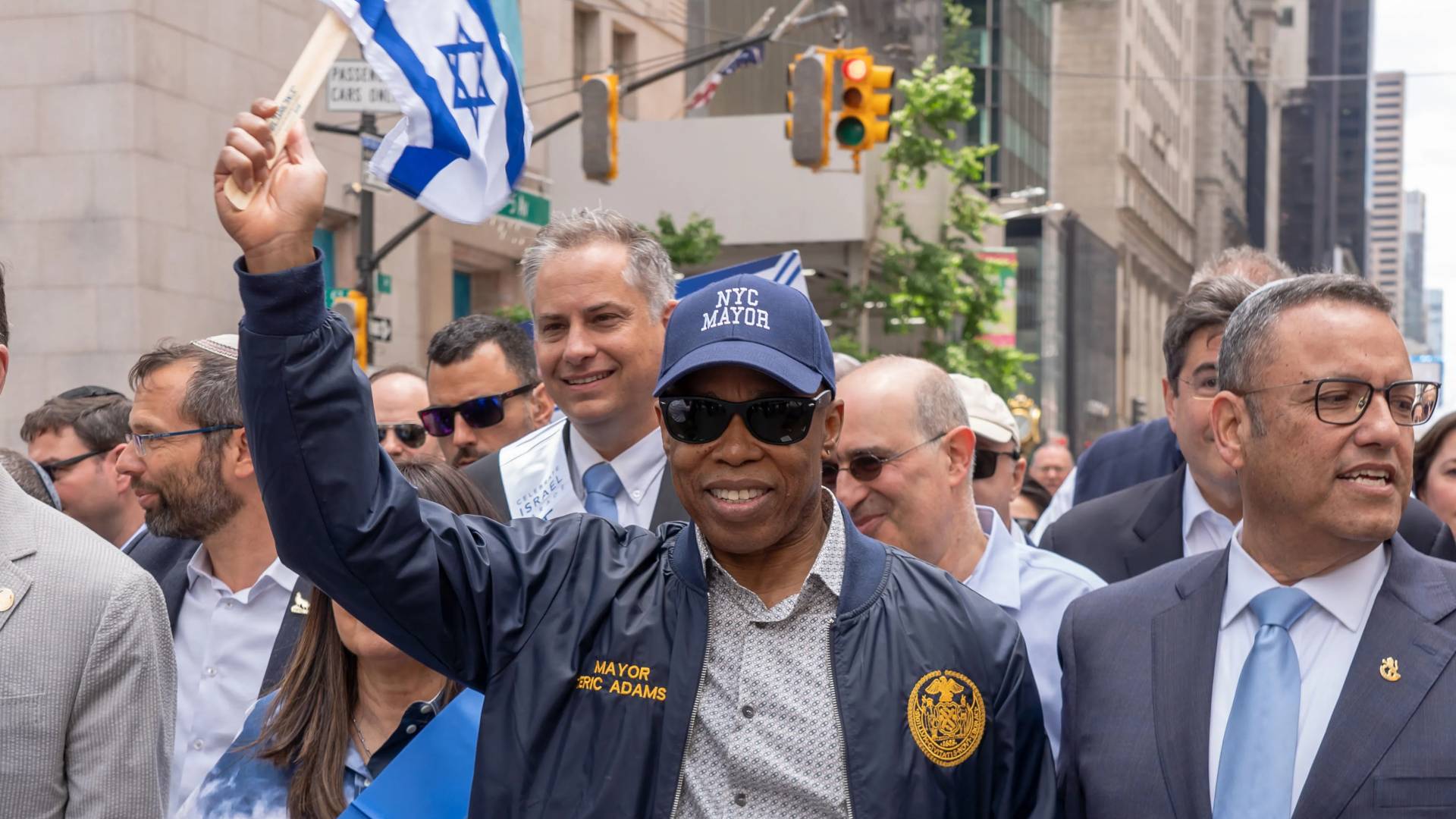
New York City Mayor Eric Adams holding the 'Israeli' flag

Outgoing NYC mayor Adams bars anti-'Israel' boycotts in final executive orders
Note: AI technology was used to generate this article’s audio.
- New York City Mayor Eric Adams issued two last-minute executive orders targeting BDS and restricting protests near places of worship.
- The orders place incoming mayor Zohran Mamdani in a politically sensitive position.
- Critics say the measures curb free speech and shield 'Israel' from boycotts while limiting protest rights.
- The move follows Adams’ controversial pro-'Israel' trip and a history of crackdowns on pro-Palestinian activism.
With his term ending in less than a month, New York City Mayor Eric Adams has introduced two sweeping executive orders aimed at curbing support for the Boycott, Divestment, and Sanctions (BDS) movement and tightening rules around protests at religious institutions.
The BDS movement, launched nearly 20 years ago by Palestinian civil society groups, promotes non-violent pressure on 'Israel' to end its occupation, dismantle discriminatory policies, and halt what activists describe as atrocities, including the ongoing war in Gaza. Across the United States, at least 38 states have enacted laws penalizing entities that choose to boycott 'Israel', often by denying state contracts or funding to those who support or advocate for such actions.
New York State already enforces its own anti-BDS legislation. By adding a new municipal executive order, Adams is effectively forcing his successor, mayor-elect Zohran Mamdani, a vocal supporter of BDS, to either uphold the policy or overturn it, a choice that is expected to generate political backlash regardless of the outcome. New York City is home to the largest Jewish population outside 'Israel' and also a sizable Muslim community; Mamdani’s victory was fueled by an energized progressive base.
Announcing Executive Order 60 online, Adams wrote, "Executive Order 60 makes it clear: BDS has no place in our city. The movement is antisemitic in nature and discriminatory in practice. NYC contracts and pensions must serve the public good. Discrimination is illegal. Antisemitism is abhorrent."
City officials said that out of the roughly USD 300 billion in global market investments held in pension funds for municipal workers and retirees, about USD 300 million is tied to 'Israeli' bonds and assets. Five independent pension systems support around 750,000 current and former city employees.
According to the order, financial decisions must prioritize the economic health of these systems and cannot factor in any effort “targeting Israeli citizens.” No comparable protections exist for any other foreign country.
In a written statement, Adams defended this approach, saying, "New York City not only has a strong bond with the State of Israel because of our commitment to protecting a Jewish homeland, but also because it has always been a sound financial investment, and our financial decisions should continue to reflect that truth."
- Order on protests raises First Amendment concerns -
Adams also signed Executive Order 61, which tasks the NYPD with reviewing protest regulations and proposing ways to limit demonstrations in front of houses of worship. The move came after a protest outside Manhattan’s Park East Synagogue last month, where critics rallied against an event promoting relocation to illegal 'Israeli' settlements in the occupied West Bank.
Adams said online, "Executive Order 61 directs the NYPD to review the Patrol Guide to evaluate proposals to limit protest activity that intimidates worshippers at houses of worship."
"The First Amendment protects speech - but time, place, and manner rules protect the right to pray in peace," he added.
Demonstrators outside the synagogue had chanted slogans including “Death to the IDF” and “globalise the intifada.” Inside, the event promoted settlement expansion, a practice considered illegal under international law and widely seen as undermining the feasibility of a contiguous Palestinian state.
Mamdani responded at the time by distancing himself from the protesters’ language while also criticizing the event’s purpose, stating, "These sacred spaces should not be used to promote activities in violation of international law."
The Anti-Defamation League (ADL), however, defended the gathering, calling it an expression of Jews returning to their “ancestral homeland.”
- A mayoral term shaped by clashes over pro-Palestine activism -
The executive orders come on the heels of Adams’ taxpayer-funded visit to 'Israel' shortly after the November election, during which he told 'Israeli' Jews, “I served you as the mayor… I’m your brother.” His remarks sparked criticism from civil rights advocates who say 'Israel' wields disproportionate political influence in US urban leadership.
Throughout his time in office, Adams has taken a hard line against pro-Palestinian demonstrations. His administration backed robust NYPD crackdowns, from Brooklyn protests on Nakba Day to sweeping arrests of students at Columbia University encampments. Rights organizations argue these actions amount to a broader attempt to criminalize Palestinian advocacy, while Adams has consistently framed protesters as disorderly or influenced by “outside agitators.”
His tenure has also been shadowed by a federal indictment alleging illegal campaign contributions and benefits from Turkish nationals during his time as Brooklyn Borough president. Those charges were later dropped after President Donald Trump took office, and Adams maintains he engaged in no wrongdoing.